While the Western capitalist system is grappling with the problem of wealth distribution in the age of AI, Viet Nam now has a historic opportunity to apply innovation creatively, remove bottlenecks, and accelerate towards double-digit economic growth while building socialist communes and wards.
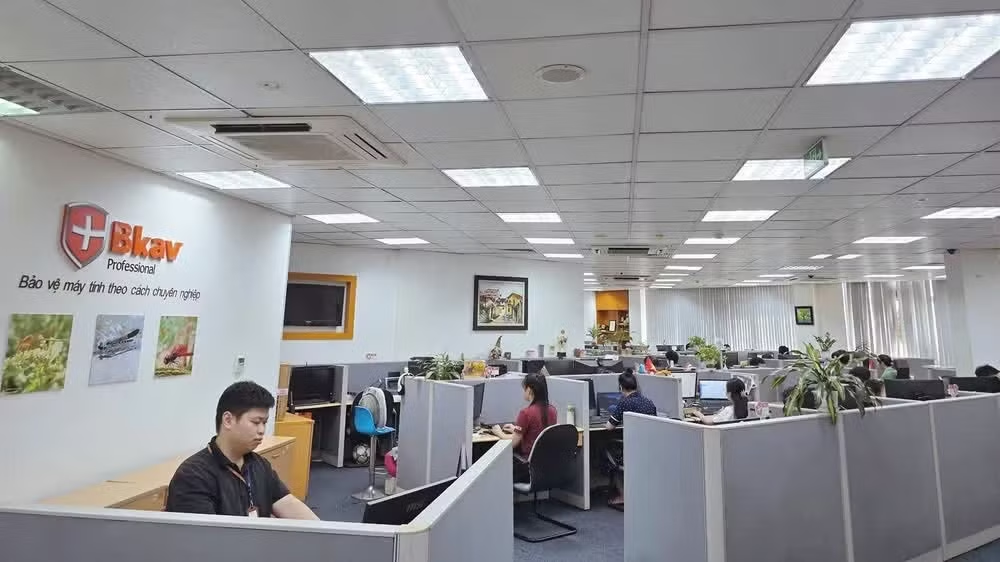
At BKAV, we have recently undergone an experiment — a turning point which, I believe, has “torn apart” all previous limits on human labour productivity. Consider the traditional reality: a complex project would normally require 10 highly skilled engineers working tirelessly for eight months, with a budget of 3 billion VND. Yet a breakthrough occurred. A single engineer, using AI tools at a cost of just 3 million VND — merely one-thousandth of the previous cost — completed the entire project in exactly one week.
When project completion time is compressed from eight months to just one week, what opens up before us is not merely efficiency, but an entirely new “ocean of opportunities”. Bringing a product to market months earlier creates an overwhelming competitive advantage.
We are no longer speaking about ordinary reductions in time. Placing “weeks” alongside “months” demonstrates that these two ways of thinking no longer belong to the same dimension. It represents a complete transformation in capability and in the speed at which early products can capture the market. It also signals an explosion in scale, because within the same timeframe, projects can be completed exponentially faster, enabling a business — or even an entire nation — to experiment, fail, and improve at lightning speed.
For a developing country, resources are often more limited than those of major powers. The ability to “experiment and correct mistakes at the speed of light” through AI is the only way to optimise resources, avoid falling behind, and achieve a spectacular leapfrog breakthrough.
This is also compelling evidence that the productive forces are developing so powerfully that marginal costs are approaching zero before our very eyes.
When one individual can replace an entire team, the defining question of the AI era is no longer “How can productivity be increased?”, but rather: Where does human value lie when tools have surpassed human capability?
Recently, Sam Altman, Chief Executive Officer of OpenAI and creator of ChatGPT, stated: “Capitalism has long functioned on a delicate balance between employers and workers, but this is changing completely when humans can no longer work more effectively than GPUs (graphics processing units powering AI).”
Behind this statement lies the deadlock of the current system, where technologies such as AI and robotics are capable of generating limitless value, yet society lacks a fair mechanism for sharing benefits, pushing large sections of workers towards the risk of losing their livelihoods and consequently weakening purchasing power.
Every technological explosion has been accompanied by challenges in wealth distribution, often leading to what is known as a “crisis of overproduction”. Notable examples include the overproduction crisis in Britain in 1825 during the First Industrial Revolution, and the Great Depression caused by overproduction in the US in 1929 during the Second Industrial Revolution, when goods were mass-produced by machines but markets lacked the purchasing power to absorb them.
From these phenomena, Karl Marx formulated an economic law identifying the fundamental contradiction between society’s enormous productive capacity and the limitations of a distribution mechanism based on private capitalist ownership. At the heart of his philosophy was the principle of placing human beings at the centre of production, steadfastly protecting the rights and livelihoods of the majority of workers instead of allowing economic gains to serve only the accumulation of a small capitalist class.
To fundamentally resolve this imbalance, Marxism-Leninism proposes the establishment of social ownership combined with macro-level state regulation. This mechanism aims to distribute surplus value more harmoniously, complete the production-consumption cycle, and fundamentally prevent crises of overproduction, thereby laying a strong theoretical foundation for the communist socio-economic system (with socialism as its initial stage), aimed at sustainable development.
Today, as AI replaces not only skills but intelligence itself, humanity faces an even harsher overproduction crisis, because what is becoming excessive is not merely physical goods, but large numbers of workers suddenly pushed to the margins of production. At this moment, Karl Marx’s theory shines once again as a truth: only a system that places people at its centre can ensure that technology serves humanity rather than the wealth accumulation of a small oligarchic elite.

Against this global backdrop, it can be affirmed that Viet Nam has chosen the right path. Remaining steadfast in Marxism-Leninism and Ho Chi Minh Thought is entirely correct both morally and scientifically, because the ultimate goal of socialism is to protect the majority and ensure that “no one is left behind”. However, such humanitarian ideals can only become complete and sustainable when realised through strong material capacity.
We must also face a reality directly: despite its humanitarian orientation, Viet Nam is not yet truly wealthy. The economy still faces bottlenecks restraining the nation’s momentum. The aspiration for Viet Nam to “transform into a dragon” by 2045 and achieve consecutive years of double-digit growth is not merely a subjective ambition. It is an objective requirement and the convergence point of the entire nation’s desire for breakthrough development, at a time when infrastructure, technology (as demonstrated by AI advances at BKAV), and international standing have all matured.
The concept of the “Era of National Rise”, initiated by General Secretary and President To Lam, represents a coherent call to action, transforming internal aspirations into a practical development strategy.
Human history demonstrates that no country has overcome hardship and risen to greatness without relying on a theoretical economic foundation — whether Adam Smith’s “Invisible Hand” or the theories of Karl Marx. The role of theorists is akin to that of blacksmiths forging “lenses” through which humanity can perceive the true nature of social movement. They observe reality and distil scattered phenomena into philosophical and systematic laws. These theories not only explain the world but also become guiding principles for nations in building institutions, formulating policies, and liberating productive forces. Thanks to solid theoretical foundations, humanity emerged from the darkness of instinctive governance to manage society scientifically; and when theory is connected with practice, it becomes an immense material force.
Viet Nam is no exception. Reality has demonstrated that Karl Marx’s theory is a science of enduring relevance across time and space. Viet Nam’s wisdom lies in choosing Marxism-Leninism and Ho Chi Minh Thought as its guiding principles, firmly pursuing development along the socialist path — a path fully aligned with the progressive laws of the era. This is the ultimate foundation enabling us to maintain strategic direction in the coming period.
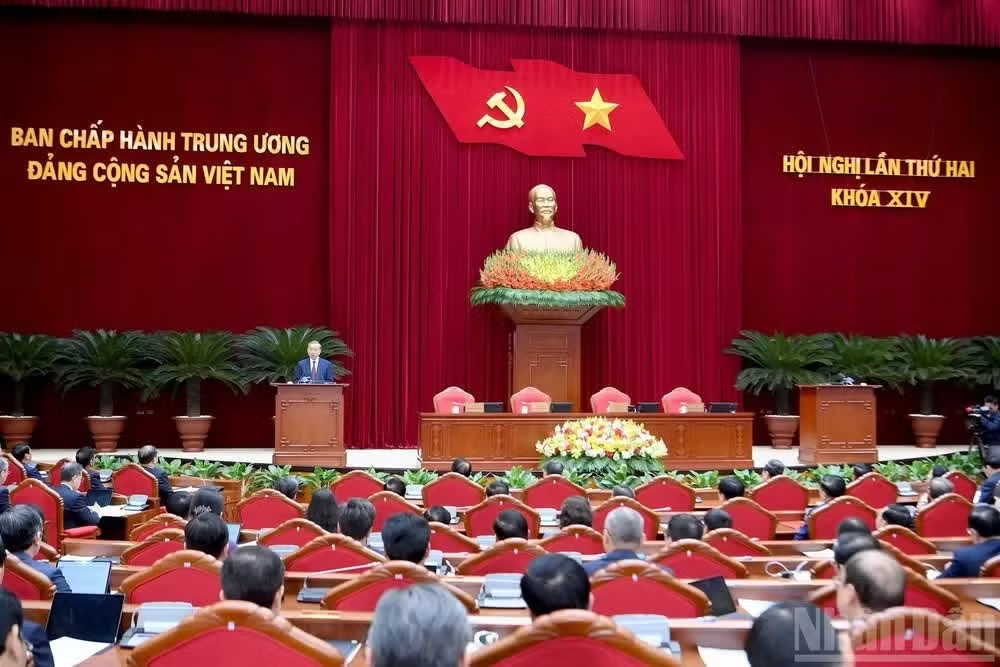
In his closing speech at the second conference of the 14th Party Central Committee on March 25, 2026, General Secretary To Lam called for a deep understanding of the “four steadfast principles”: “Steadfastly adhering to, creatively applying and developing Marxism-Leninism and Ho Chi Minh Thought; steadfastly pursuing the goals of national independence and socialism; steadfastly maintaining the Party’s renewal policy; and steadfastly upholding the Party’s organisational and operational principles to firmly build and defend the Socialist Republic of Viet Nam.”
The core question now is: how should we “creatively apply and develop” these principles in order to build a new economic theory suitable for the AI era, capable of unleashing society’s full potential and driving double-digit growth? Just as in earlier periods of human history, we need profound economic-philosophical perspectives so that breakthrough solutions for removing bottlenecks do not remain temporary or technical measures, but instead arise from a coherent theoretical foundation.
The deepest loyalty to the legacy of Marxism-Leninism and Ho Chi Minh Thought lies in non-dogmatic creativity, with practice serving as the criterion of truth. We cannot constrain our thinking simply because the classical theorists never named an economic model for the AI era. Today’s greatest bottleneck can be overcome only if we boldly summarise practical realities to define and design a new mode of production capable of maximising the productive capacity of all social resources and harnessing AI’s extraordinary efficiency, especially given Viet Nam’s advantage in the superior nature of its socialist rule-of-law system.
We must clearly recognise an inevitable principle: only abundant wealth creation can provide a solid foundation for implementing social welfare. Viet Nam’s most sustainable path at present is to immediately transform its mode of production in order to seize breakthrough growth opportunities in the AI era.
As the BKAV experiment demonstrated, AI creates tremendous momentum. “Maximum benefits — minimum consumption — optimal resource utilisation — minimum time”, these 16 words fully capture AI’s core strength and accurately define how the ultra-powerful productive forces of the digital era operate. My engineers have been “liberated” from repetitive tasks. AI handles the work of the “craftsman”, while humans become the “masters” — creators, strategists, and value-builders. Human energy and intellect are used in their purest form, bringing fulfilment and genuine meaning to work.
If we seize this opportunity and make AI the nucleus of production, while proactively establishing a new mode of production for the AI era, we will possess the “key” enabling Viet Nam to achieve self-reliance and breakthrough development. In doing so, we can unleash the innovative power of all social resources, multiplying labour productivity dozens or even hundreds of times, thereby both improving the quality of growth and ensuring sustainable development.
Only once prosperity is achieved through this new high-productivity mode of production will the superior advantages of the socialist rule-of-law system fully demonstrate their strength. At that point, the State can proactively design a roadmap to transform AI-generated “super profits” into “super welfare” for the entire population, fundamentally resolving the issue whereby AI, instead of competing with workers for livelihoods as seen in the West, becomes a powerful assistant elevating Vietnamese people and helping the country enter an era of national rise and humane prosperity.
This vision is entirely feasible and realistic rather than utopian, especially when viewed in light of General Secretary and President To Lam’s orientation towards piloting “socialist communes and wards” in Ha Noi so that people can experience exemplary governance, inspiring other localities to strive towards similar standards.
According to General Secretary and President To Lam, with the current pace of development, it would not be difficult for Ha Noi to pilot and realise the model of socialist communes and wards. Indeed, in the AI era, the challenge of optimised governance, transparency, and welfare distribution at grassroots level can be fundamentally resolved. The breakthrough speed of AI, combined with the superior nature of the political system, will transform these pilot communes and wards into practical beacons. They will become places where advanced technology and automation serve not the narrow interests of corporations, but instead provide a strong foundation for creating shared prosperity and shaping a Viet Nam that is independent, self-reliant, and deeply humane.