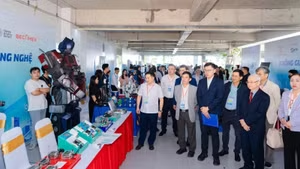
In Viet Nam, 5G technology infrastructure has begun to be rolled out extensively by domestic telecom operators, laying the groundwork for an upcoming boom in applications. In the broader socio-economic landscape, 5G is set to bring substantial benefits to the country, businesses and the public.
Infrastructure comes first
Since August 2025, Viettel Post has organised dozens of livestreaming sessions in the four provinces of Thai Nguyen, Vinh Long, Bac Ninh and Lai Chau to help people in mountainous areas sell their agricultural produce. After just three livestreaming sessions in Sin Ho Commune (Lai Chau Province), the local H’Mong community managed to sell more than 300 tonnes of yacon.
Dinh Thanh Son, Deputy General Director of Viettel Post, shared that for farmers, especially those in mountainous areas, the familiar problem of bumper harvests depressing prices, or high prices coinciding with poor harvests, still persists. Now, through 5G network applications and logistics systems, Viettel Post has brought the entire world of buyers directly to ethnic minority communities.
Thanks to 5G, farmers can carry the market in the palm of their hands, livestreaming sales while standing amid tea hills, terraced fields or their own gardens, introducing each bundle of vegetables or tubers to consumers everywhere.
Moreover, this technology is also transforming agricultural production, as IoT devices powered by 5G to measure temperature, humidity and weather conditions are being piloted on a wide scale.
According to the Ministry of Science and Technology, in 2025, 5G was commercialised nationwide, with coverage reaching more than 90% of the population, thereby promoting smart manufacturing. Viettel alone has deployed an additional 23,500 base stations, exceeding its commitment of 20,000 stations, bringing its total number of 5G stations to 30,000, achieving 90% outdoor and 70% indoor coverage.
Nguyen Duy Lam, a senior telecommunications solutions expert at Huawei Viet Nam, commented that Viet Nam’s 5G network is developing very rapidly, with many applications already strongly deployed in e-commerce. However, deeper applications such as smart cities and smart factories still need time to take off, as they require strong participation from businesses and clear policy direction from the government.
Therefore, the government needs to introduce incentive mechanisms and policies to encourage and promote the application of 5G, while the media should step up communication efforts to provide businesses with information on the benefits of 5G so that they are more willing to embrace it.
Laying the foundation for application development
Responding to questions about why investment costs for 5G are so high yet Viettel remains determined to roll it out nationwide, Nguyen Ha Thanh, Deputy General Director of Viettel Telecom, explained that the group has always regarded investment in 5G as the construction of strategic national digital infrastructure in line with the Politburo’s Resolution 57 on breakthroughs in science-technology development, innovation and digital transformation.
The effectiveness of 5G investment should be assessed at the national level, from developing an economy based on improved efficiency in governance and administration at all levels, to improving living standards for the public through technology application, and enabling businesses to develop new business models.
At the same time, 5G has already delivered initial business results, with Viettel’s 5G subscribers accounting for half of all new subscribers; data usage increasing by 15-20%; and customer satisfaction surveys for mobile services showing a 20% improvement compared with previous levels.
Furthermore, once the infrastructure is in place, applications can be deployed very rapidly. In the near future, Viettel Telecom will announce three virtual assistant platforms for individuals, households and businesses, all operating efficiently on the existing 5G infrastructure.
Sharing the same view, Nguyen Tuan Huy, Deputy Head of MobiFone’s Technology Department, noted that the recent deployment of AI cameras in Ha Noi has significantly improved public awareness of traffic regulations while also easing congestion, delivering tangible socio-economic benefits.
MobiFone is continuing to participate in the project to build a smart city for Ha Noi, aiming to address five major bottlenecks: urban order, traffic congestion, localised flooding, environmental pollution, and food safety and hygiene.
Among the 5G applications currently being piloted are a rescue centre using drones that can fly directly to fire sites, determine whether an incident involves chemical or conventional fires, and automatically dispatch fire engines and ambulances using AI; as well as camera systems serving multiple purposes such as monitoring flooding and crime, and supervising illegal encroachment on pavements and roadways.
In the coming period, Ha Noi will continue to develop large-scale new urban areas, enabling the deployment of smart urban zones under the Smart City 3.0 model, based on data, real-time operations and automation.
It is evident that from 2026 onwards, if the spirit of Resolution 57 is properly implemented, 5G applications will truly take off.
Regarding the shared use of 5G infrastructure, Nguyen Anh Cuong, Deputy Director of the Telecommunications Authority under the Ministry of Science and Technology, stated that the ministry’s recent policy has been to allow full competition in areas with strong competitive potential, while encouraging infrastructure sharing in areas that need development but have lower levels of competition.
In remote and disadvantaged regions, for example, areas will be allocated for enterprise investment, followed by mandatory roaming and shared use. Policies on infrastructure sharing need to be flexible, tailored to local conditions, closely aligned with passive infrastructure planning, and at the same time ensure the interests and competitiveness of telecom operators.