A wave of high-tech investment from the private sector
In recent years, clear momentum has emerged from the private sector as businesses proactively enter high-tech segments with investments of international scale and technical standards.
In the healthcare sector, in mid-February 2026, the Tam Anh General Hospital System signed a contract with Mevion, a leading US medical equipment group, to purchase and transfer operational technology for the world-leading Proton cancer treatment system MEVION S250-FIT, worth nearly 2 trillion VND.
More recently, Viet Nam Vaccine Joint Stock Company (VNVC) signed a contract with Syntegon Group to purchase a large-capacity, highly automated, and state-of-the-art vaccine production line from Germany for its new factory. At the same time, VNVC has expanded cooperation with many of the world’s leading vaccine and pharmaceutical corporations to build technology absorption capacity and develop human resources, contributing to the establishment of a modern vaccine industry foundation for Viet Nam.
The common feature of these decisions lies in the investment mindset of aiming for the highest standards from the outset, with the goal of participating in global value chains and meeting global benchmarks. “We view this not merely as an investment in a factory but as an investment in national self-reliance in a field of particular importance to public health, contributing to the development of Viet Nam’s high-tech vaccine and pharmaceutical industry. That is why we have made every effort to access the world’s most advanced technologies and equipment from the very beginning,” said Ngo Chi Dung, Chairman and Chief Executive Officer of Viet Nam Vaccine Joint Stock Company, expressing his expectations.

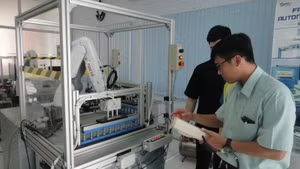
Not only in healthcare, many private enterprises have also invested heavily in robotics and automation. Phenikaa-X Joint Stock Company has developed autonomous robots, AI-integrated service robots, and intelligent automation solutions for manufacturing and logistics. In the electric vehicle sector, VinFast has built manufacturing complexes with high levels of automation, integrating robotic welding, painting, and assembly in line with Industry 4.0 standards.
What is notable here is not merely the act of “buying robots” or “importing modern machinery”. More importantly, private enterprises are transforming themselves to build the capability to operate high technology through standardised processes, workforce training, mastery of production data, and the integration of digital systems.
State-owned enterprises facing the need to change in order to lead
Against this backdrop, the demand for transformation within the state-owned enterprise sector has become even clearer. In his directive remarks at the National Conference on disseminating and implementing Resolution No. 79-NQ/TW on developing the state sector and Resolution No. 80-NQ/TW on developing Vietnamese culture issued by the Politburo, General Secretary To Lam emphasised that the state sector must be concretised through five major “pillars”. Among these are serving as a pillar guiding the private sector and a pillar leading innovation and core technologies. If the state sector is strong only in capital and assets but weak in technology, governance, and human resources, it cannot maintain a leading role in the new era.
In reality, state-owned enterprises can achieve success when appropriate mechanisms are in place, with Viettel being a typical example. Since 2015, Viettel has invested in research into 5G equipment and by 2024 had obtained certification for 5G base stations designed and manufactured by itself. The company has also exported its Private 5G system to India, placing Viet Nam among the small group of countries capable of producing 5G network equipment. This represents genuine endogenous research and development (R&D) capacity, going beyond the traditional model of merely operating imported technology.

For many SOEs, long-standing bottlenecks lie in governance capacity and investment mechanisms. Capital and asset resources have not been fully unlocked due to legal constraints; initiative and competitiveness remain limited; many business decisions require approval processes that delay opportunities; incomplete decentralisation hinders sufficiently rapid decision-making in a constantly changing technological environment; and there remains uncertainty in defining accountability mechanisms when R&D projects fail.
Enhancing governance capacity and reforming institutions to unlock capital mechanisms are prerequisites for effective technology investment. Without strong reforms in financial mechanisms, decentralisation, transparency, and accountability control, even enterprises with significant resources will struggle to innovate at the pace required by the times.

Professor Dr Hoang Van Cuong, former Vice-Rector of the National Economics University and member of the Prime Minister’s Policy Advisory Council, noted: “In renewing management thinking, especially governance for state-owned enterprises, we must accept risks, and the performance of enterprises should be evaluated comprehensively rather than by individual activities. Although this principle has been stated in the law, it has not yet been concretised into practical operational mechanisms. This lack of readiness makes SOE managers hesitant to make investment decisions in new, high-risk fields such as emerging technologies.”
Another major bottleneck lies in mechanisms governing procurement and technology investment. Under current regulations, when SOEs purchase equipment or invest in new technologies, they must follow public procurement bidding procedures. However, such procedures typically allow only widely available technologies to be selected — sometimes even outdated ones — because only those can be compared competitively. Truly new and pioneering technologies cannot be tendered in this way because there is no comparable basis for evaluation.
Therefore, conventional regulations cannot be applied to entirely new issues. New challenges require new approaches that may not follow precedent. For example, the acquisition of new technologies could be conducted through evaluation councils comprising scientists and experts rather than through conventional bidding procedures. To prevent abuse for personal gain, however, any special mechanisms or non-standard approaches must be publicly announced beforehand so that they can be monitored by society. If the outcome proves unsuccessful, it should be considered a publicly acknowledged risk rather than an attempt to bypass regulations for personal benefit.
Regarding governance, Professor Dr Hoang Van Cuong emphasised: “For state-owned enterprises to operate effectively, the representative of state capital must be granted full decision-making authority similar to that of a private enterprise manager. If they must seek approval from multiple levels before making investment decisions, opportunities will pass, and both the authority and responsibility of managers will effectively disappear.”
The evaluation of performance should therefore consider all activities of an enterprise in a comprehensive manner and over a sufficiently long period to allow managers time to implement their plans. Under such a mechanism, those entrusted with management would have full authority and would need to operate capital flows as efficiently as possible — reaping greater rewards for success or being replaced if they fail to fulfil their responsibilities. With close supervision and timely intervention, losses can be prevented. Conversely, if authority is given to individuals lacking sufficient capability and oversight is delayed, the failure of an enterprise also becomes the responsibility of the managing authority.
From this perspective, a strategic requirement emerges: if the private sector has already boldly invested in the most advanced operational technologies — such as proton radiotherapy, automated vaccine production lines, and industrial robotics — then state-owned enterprises, with their advantages in resources and strategic positioning, should take the lead in technological “frontier areas” requiring long-term R&D and higher levels of risk. These include digital infrastructure, new energy, semiconductors, defence industries, telecommunications, and artificial intelligence.
In the new context, the “leading role” must be understood in two dimensions. First, leadership in core technologies in strategic sectors, forming the foundation for the entire economy. Second, leadership in financial mechanisms, governance standards, transparency, clear decentralisation, accountability tied to results, and the creation of space for innovation. Without either of these elements, the “leading role” will remain confined merely to the scale of assets and market share. State-owned enterprises must accelerate their efforts at the innovation level — not to compete with the private sector, but to truly become a strategic pillar and a model of governance for the entire economy.