Affirming that the state economy is a particularly important component of the socialist-oriented market economy, Resolution No. 79 opens up new space for the state sector to make breakthroughs, while also serving as a source of inspiration for other economic sectors to grow together.
Under the resolution, the state economy is required to take the lead in shaping development, acting as a trailblazer and driving force for industrialisation and modernisation, economic restructuring and the establishment of a new growth model. Science and technology, innovation and digital transformation are identified as the primary engines, with the aim of enhancing national competitiveness.
Activating the nation’s overall resources
According to Dr Bui Quy Thuan, Head of the Research Division at the Viet Nam Industrial Park Finance Association (VIPFA), from a macroeconomic perspective, Resolution No. 79-NQ/TW (hereinafter referred to as Resolution No. 79) represents a watershed moment, laying a strategic foundation for Viet Nam to realise the Party’s development goals to 2030 and its vision to 2045.
Specifically, Resolution No. 79 defines the state economy as a macroeconomic regulatory instrument, playing the leading role in the socialist-oriented market economy by ensuring macroeconomic stability, maintaining major economic balances, setting strategic development directions, and safeguarding national defence and security. Rather than focusing solely on areas where the private sector is reluctant to invest, the resolution steers the state economy towards high-tech industries, digital transformation and strategic infrastructure, enabling it to become a formative and leading force.
The resolution also sets out objectives for managing and exploiting state resources in accordance with market principles. For the 2026–2030 period, it stipulates targets for budget mobilisation (18 per cent of GDP), the budget deficit (5 per cent of GDP) and public debt (below 60 per cent of GDP), thereby establishing strict fiscal discipline. Notably, Resolution No. 79 underscores that the state economy is equal before the law and engages in cooperation and fair competition with other economic sectors. The combination of the private economy (under Resolution No. 68-NQ/TW) and the state economy is expected to create a solid economic structure: the state sector retains control over infrastructure and key industries that form the “foundation”, while the private sector contributes flexibility, dynamism and creativity. Together, they constitute the “key” to building a self-reliant and resilient economy, reducing dependence on external factors and activating the nation’s overall resources as Viet Nam enters a new era.
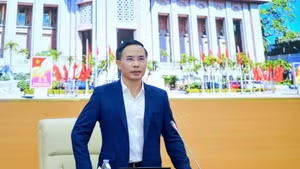
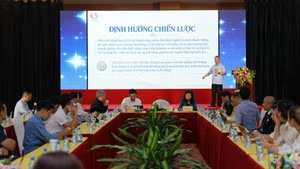
Dr Nguyen Quoc Viet, Head of the Economic and Policy Research Group at Viet Nam National University, Ha Noi, noted that one of the most significant highlights of Resolution No. 79 is its open-minded approach to developing the state economy, moving away from previous closed thinking. Under the new development orientation, the state economy must pioneer development, lead the way and drive industrialisation and modernisation.
One of the most significant highlights of Resolution No. 79 is its open-minded approach to developing the state economy, moving away from previous closed thinking. Under the new development orientation, the state economy must pioneer development, lead the way and drive industrialisation and modernisation.
Dr Nguyen Quoc Viet,
Head of the Economic and Policy Research Group
at Viet Nam National University, Ha Noi
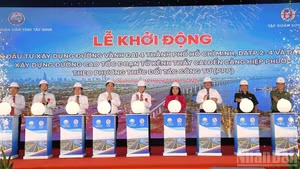
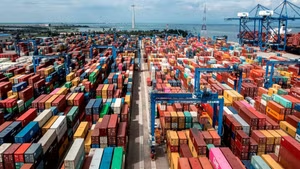
At the same time, the state economy will focus on spearhead and high-tech industries, future technologies, and large-scale projects in priority areas such as digital infrastructure, energy, electronics and telecommunications, finance and banking, logistics, strategic mineral extraction and processing, and transport, instead of spreading investments thinly across numerous sectors and fields. “In this way, the state economy will become a lever to draw major private conglomerates and foreign-invested enterprises into difficult, new and strategic sectors, thereby realising the Vision 2045 goals,” Dr Viet said.
Building “lead geese” for the economy
From a business perspective, Luu Anh Tu, Chairman and Director of Regional Petroleum Company No. 5 under the Viet Nam National Petroleum Group, observed that Resolution No. 79 introduces breakthrough elements, clearly reflecting the Party’s evolving thinking on the role, development approach and governance of the state economic sector. These include highlighting science and technology, innovation and digital transformation as the main drivers; focusing on improving operational efficiency; applying advanced technologies and modern governance models in line with international standards; enhancing transparency, autonomy and accountability; and strengthening responsibility and oversight.
This, he noted, opens up prospects for the formation of economic groups with global competitiveness. However, opportunities go hand in hand with challenges, requiring strong breakthroughs in awareness, mindset and concrete action. First and foremost, policies must be institutionalised swiftly, comprehensively and consistently to create a legal corridor that ensures state-owned enterprises can operate smoothly and effectively, without missing opportunities. In particular, substantive empowerment must be coupled with clear responsibilities to encourage innovative thinking, bold action and accountability, while at the same time tightening oversight to prevent abuse of power and losses.
Affirming the state economy as a particularly important component of the socialist-oriented market economy, Resolution No. 79 sets the target that by 2030, 50 state-owned enterprises will rank among the 500 largest enterprises in Southeast Asia, and one to three state-owned enterprises will be among the world’s top 500 companies.
To achieve this goal, the resolution clearly states: “State-owned enterprises are entitled to decide on the use of science and technology development funds to proactively implement or commission external research and development under output-based contracting mechanisms. Mechanisms shall be introduced to allow state-owned enterprises to establish, or to cooperate with the State and other enterprises to establish, venture capital funds. State-owned enterprises are encouraged to expand and enhance their competitiveness by participating in investment projects, technology transfer contracts, and mergers and acquisitions associated with technology transfer activities.”
According to economists, the issuance of Resolution No. 79 marks an important adjustment in thinking and in the development approach towards the state economic sector, providing strategic guidance for Viet Nam’s economic development path in a new era – an era of national resurgence.
Notably, the goals, tasks and solutions set out in the resolution are highly specific, demonstrating its close alignment with business realities while also addressing the urgent needs of the economy. A case in point is the concrete target of building one to three state-owned enterprises into the world’s top 500 by 2030. Since August 2025, the 4th Party Congress of the Group Party Committee has identified this target and put in place a comprehensive system of solutions closely aligned with the spirit of Resolution No. 79. Enterprises are therefore expecting the swift institutionalisation of these viewpoints and policies to bring them into practice and ensure that the resolution truly takes effect in real life.
According to economists, the issuance of Resolution No. 79 marks an important adjustment in thinking and in the development approach towards the state economic sector, providing strategic guidance for Viet Nam’s economic development path in a new era – an era of national resurgence.