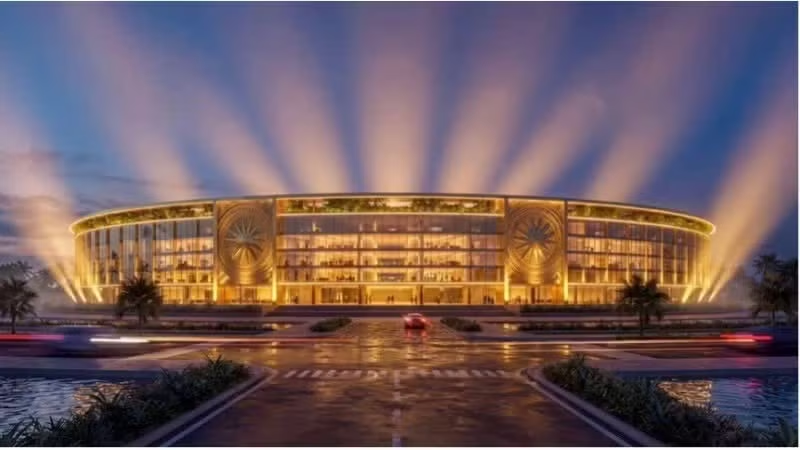
Viet Nam’s “Innovation Capital”: A long-term ambition
Around the world, successful R&D centres are often associated with iconic works: the renowned glass structure of the MIT Media Lab in the US, Naver 1784 in the Republic of Korea (RoK), which CNN described as “the most AI-powered building in the world,” and Sphere Bibliothèque in France, which has become a symbol of knowledge in Paris.
One of the most striking features revealed in the initial design renderings is that the Sunshine R&D Centre is inspired by the image of a “modern Dong Son drum” — a symbol of Vietnamese intelligence, creativity, and aspirations dating back to the Dong Son culture. Through this design, the centre aims to become a national landmark of similar stature while drawing inspiration directly from the 2,000-year-old Dong Son cultural heritage.
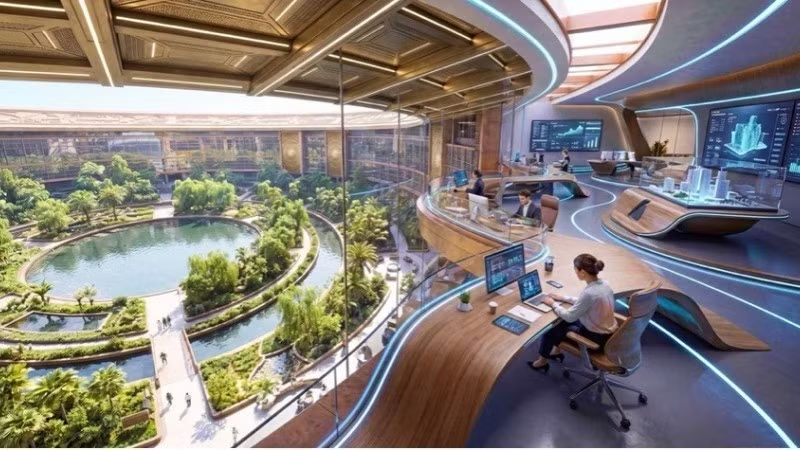
The centre is designed according to an open ecological principle, with a green central core and water features that help regulate the microclimate. Surrounding structures are arranged to optimise natural ventilation and daylight. This approach reflects the standards adopted by leading sustainable research parks worldwide, including Biopolis in Singapore and Masdar City in the United Arab Emirates.
According to the long-term vision announced, the Sunshine R&D Centre is intended not only as a research complex but also as an “Innovation Capital” of Viet Nam, integrating R&D facilities, start-ups, universities, investment funds, international expert communities, and future-technology laboratories. This model has already been proven by the world's most successful countries and regions.
Examples include Silicon Valley in the US, which brings together Stanford University, an area for experts, investment funds, laboratories; Zhangjiang in Shanghai, home to 200,000 researchers, universities, start-ups, and data centres; Hsinchu in Taiwan, China, which hosts 170,000 personnel and is closely linked with TSMC, universities, and laboratories; and Pangyo in the Republic of Korea, where 1,800 technology companies operate alongside firms such as Naver and Kakao, as well as universities.
The 4 billion USD Sunshine R&D Centre is designed to give Viet Nam its first version of this model in Dong Nai, near Long Thanh International Airport, the Cai Mep–Thi Vai Port complex, Ho Chi Minh City, and major industrial parks and manufacturing zones.
Timing: Why now?
Sunshine’s announcement of the 4 billion USD R&D centre coincides with the period when Dong Nai has been elevated to a centrally governed city and is striving to become a dynamic, modern, civilised, and happy development model, as well as an important growth pole for the Southeast region and the whole country.
During a recent address, General Secretary and State President To Lam emphasised that Dong Nai possesses numerous strategic advantages, positioning it as a multifunctional growth centre, a dynamic urban hub, and a national centre for industry, aviation, and innovation. He stressed that the city should transform these unique strengths into new values of development.
Science and technology, innovation, and digital transformation are increasingly becoming key driving forces for promoting economic growth and enhancing local competitiveness. Dong Nai enjoys major advantages in industry, infrastructure, regional connectivity, and a dynamic business community, all of which support the development of an innovation ecosystem.
In its new development phase, one of the city’s key tasks is to transform its growth model based on science and technology, innovation, digital transformation, and high-quality human resources, placing enterprises at the centre of innovation and data at the heart of strategic resources.
The centre is being developed amid a particularly favourable international context. Competition in the global semiconductor sector is prompting technology corporations to seek alternative investment destinations beyond China. Meanwhile, Viet Nam has been identified by the US, the RoK, and Japan as a priority destination for R&D investment. The upcoming operation of Long Thanh International Airport will further strengthen direct international connectivity, while second- and third-generation overseas Vietnamese scientists in the US, Australia, and Europe are increasingly expressing interest in returning to contribute to the country.
The 4 billion USD R&D centre has emerged precisely at the intersection of these trends, which explains the attention it has attracted even at the conceptual design stage.
From the “Dong Son bronze drum” to the “digital bronze drum”
More than 2,000 years ago, ancient Vietnamese people engraved images of war boats, the sun, and Lac birds on Dong Son bronze drums, symbols of a civilisation with aspirations to reach beyond the horizon. Since then, the Dong Son drum has become one of the most enduring cultural symbols in Vietnamese consciousness. Two millennia later, that same symbol has been chosen to represent a research centre dedicated to artificial intelligence (AI), semiconductors, and space technology — the new horizons of the 21st century.
Whether the Sunshine R&D Centre will become the “bronze drum” of the digital age, in the same way that the Petronas Twin Towers symbolise Kuala Lumpur or the Burj Khalifa symbolises Dubai, remains to be seen. The answer will depend on whether the 4 billion USD investment is implemented in line with the ambitions that have been announced.
What can already be said, however, is that this is the first time a Vietnamese real-estate project has dared to pose a question on such a scale.