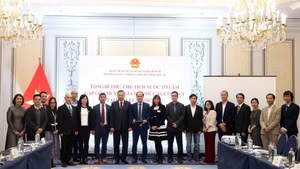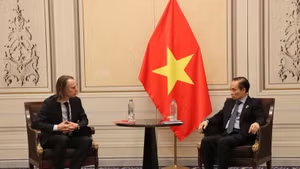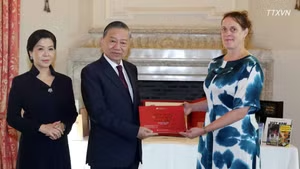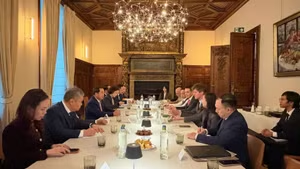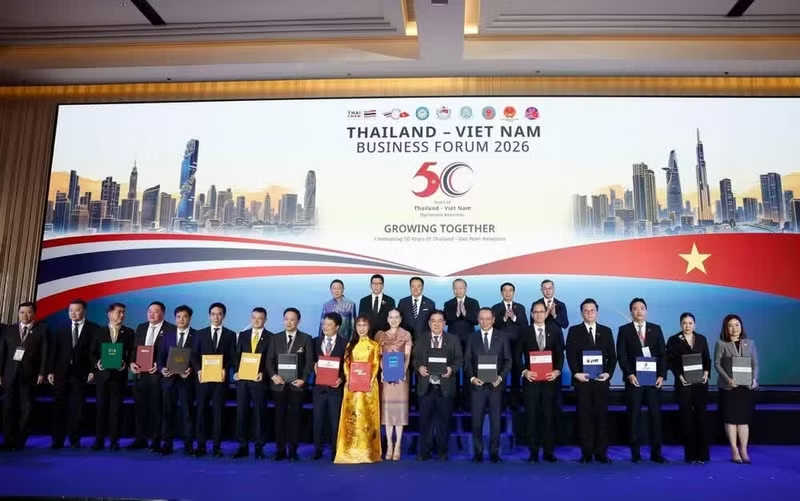
The event was co-organised by Viet Nam's Ministry of Finance, the Embassy of Viet Nam in Thailand, Thailand's Ministry of Foreign Affairs and the Thailand-Viet Nam Friendship Association.
Addressing the forum, General Secretary and President Lam described the event as a key highlight of his official visit to Thailand, reflecting the determination of both countries to deepen and substantively advance their comprehensive strategic partnership.
If political relations provide the foundation of trust, economic cooperation must provide the engine for development, he said. If the governments of the two countries open the way, then businesses must take the lead in transforming commitments into projects, potential into value, and friendship into tangible benefits for the two countries' people.
The Vietnamese leader stressed that Viet Nam and Thailand are two major ASEAN economies with longstanding friendship, increasingly deep political trust and closely intertwined development interests. In 2026, they mark the 50th anniversary of diplomatic relations. The elevation of ties to a comprehensive strategic partnership in May last year opened a new phase of cooperation requiring greater vision, quality and effectiveness. Both sides are currently implementing an action programme for 2025–2030 aimed at translating new strategic priorities into concrete outcomes.
General Secretary and President Lam noted that the world is entering a period of profound restructuring, with supply chains being reorganised and emerging technologies – including artificial intelligence, green transition, the circular economy and energy security – reshaping national competitiveness.
Against this backdrop, he said, Viet Nam and Thailand must move beyond traditional bilateral cooperation and jointly create a complementary economic space in which the two countries enhance one another's position in ASEAN value chains, strengthen ASEAN resilience and contribute to sustainable regional growth.
Highlighting the respective strengths of both countries, Viet Nam’s top leader said one possesses strong economic dynamism while the other offers extensive experience and industrial depth. By combining these advantages through a shared strategic vision, Viet Nam and Thailand could jointly develop supply chains, manufacturing and distribution hubs, trade and service platforms, and new growth drivers for both countries and their bloc as a whole.
He noted that bilateral economic cooperation has become increasingly substantive and deep in recent years, but added that considerable untapped potential remains. Trade continues to rely largely on the exchange of goods, while two-way investment has yet to fully reflect the capabilities of businesses in either country. Production linkages, digital finance, tourism and services also remain fragmented, with the broader synergistic value of ASEAN supply chains not yet fully realised.
The General Secretary and President called on businesses from both countries to focus on building Viet Nam–Thailand value chains within the broader ASEAN framework. Cooperation, he said, should move beyond conventional trade towards joint production, processing, distribution and brand-building.
Drawing on complementary strengths in agriculture, food production, consumer goods, retail, energy, tourism and services, both countries could deepen cooperation in manufacturing, e-commerce, green standards and traceability systems to create new products, supply chains and ASEAN-branded value.
He also urged the two countries to strengthen three key areas of connectivity – production, infrastructure and transformation connectivity – in order to establish a more integrated and complementary economic space. Such linkages, he said, would enable Viet Nam and Thailand to evolve beyond a standard trading relationship into mutually reinforcing components of ASEAN's emerging production and services network.
Economic cooperation should also have a direct impact on people's daily lives through tourism, services and digital finance, the leader said. He called for stronger connectivity in air travel, joint tourism routes, retail, cuisine, culture and education, alongside expanded cross-border QR payments, e-wallets, digital commerce and digital finance systems.
He proposed that, following the forum, both sides quickly develop a list of priority projects for 2026–2030 covering logistics, agriculture, food processing, clean energy, digital commerce, tourism and workforce training.
General Secretary and President Lam reaffirmed that Viet Nam views the success of foreign investors as part of its own success and values the long-term, serious and effective presence of Thai businesses in Viet Nam, describing them as important bridges between the two economies and business communities.
He said Viet Nam is becoming an increasingly stable, transparent and predictable investment destination, while continuing to improve institutions, infrastructure and human resources, accelerate digital and green transition, streamline administrative procedures and protect the legitimate rights and interests of investors.
Viet Nam–Thailand cooperation, he added, should ultimately be measured by concrete projects, new technologies, new jobs, higher value-added products and tangible benefits for citizens, thereby injecting fresh vitality into a dynamic, resilient and connected ASEAN.
In his opening remarks, Thai PM Anutin stressed that amid growing global complexity and change, ASEAN member states must work more closely together and rely more heavily on one another to strengthen resilience and respond to external challenges. Thailand and Viet Nam, he said, play important roles in driving the region's economic development.
PM Anutin noted that Thailand and Viet Nam maintain close and interdependent ties, with both countries benefiting from each other's growth. Thailand is currently Viet Nam's largest trading partner in ASEAN, while Viet Nam is Thailand's second-largest ASEAN trading partner. Bilateral trade has reached nearly 24 billion USD and is approaching the 25 billion USD target. Thailand is also Viet Nam's eighth-largest foreign investor.
The Thai PM said the success of bilateral cooperation would not be possible without the strong role played by the private sector, which he described as a key driver of trade, investment and economic connectivity between the two countries. He expressed his hope that bilateral friendship would continue to flourish and contribute to sustainable prosperity for both nations.
On the sidelines of the forum, the Vietnamese and Thai leaders, together with senior officials from both countries, witnessed an announcement by Viet Nam Airlines regarding the launch of a new direct route linking Ho Chi Minh City and Phuket. The route will begin operations in July using Airbus A321 aircraft with four flights per week, aimed at boosting tourism, exchanges and trade between the two countries.
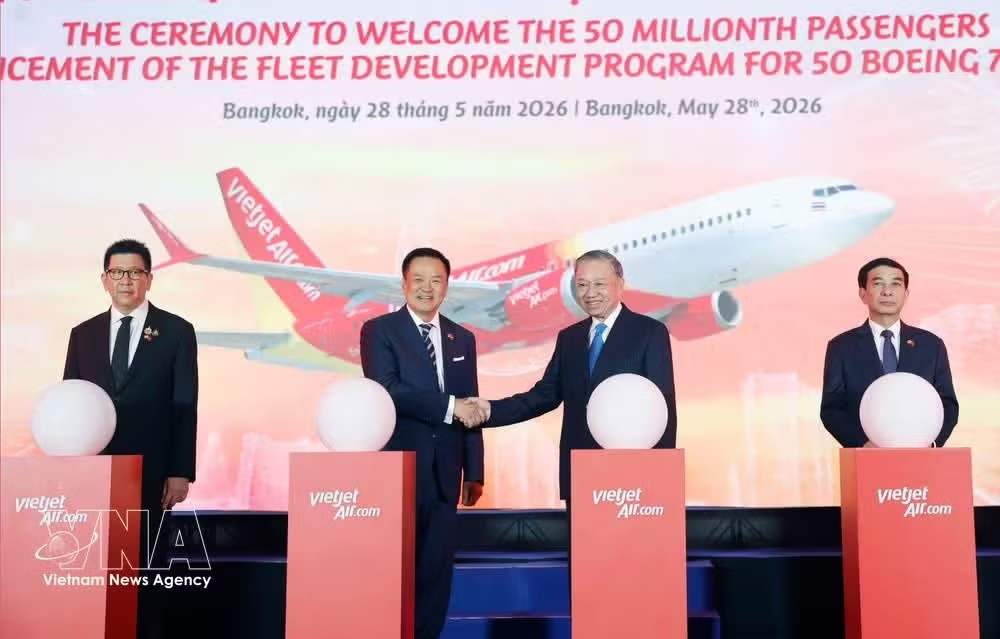
Vietjet Air also officially announced a fleet development programme involving 50 Boeing 737-8 aircraft for Vietjet Thailand to mark the 50th anniversary of diplomatic relations between the two nations.
The two leaders also witnessed the exchange of 17 strategic memoranda of understanding between Vietnamese and Thai businesses.
![[In Pictures] General Secretary and President To Lam and his spouse visit and present books to Royal Library of Belgium](https://en-cdn.nhandan.vn/images/3NY4Z6Du1Md1PrS_s0ZZOrwc5xDfq4rRua69depr-TBkwatGjBcD9lagzrI2BmGDo4nKYA9qjKDjuB3-yYloL_1KbNBr00klMZQFyHQxQ6Jq6GzFfAiY0m5agKw6jNtArN4QnVntX8RQeUmD7pdCq7nwvn3e235v3kufpokBN_s/1-tong-bi-thu-chu-tich-nuoc-va-phu-nhan-tham-tang-sach-cho-thu-vien-hoang-gia-bi.jpg.avif)