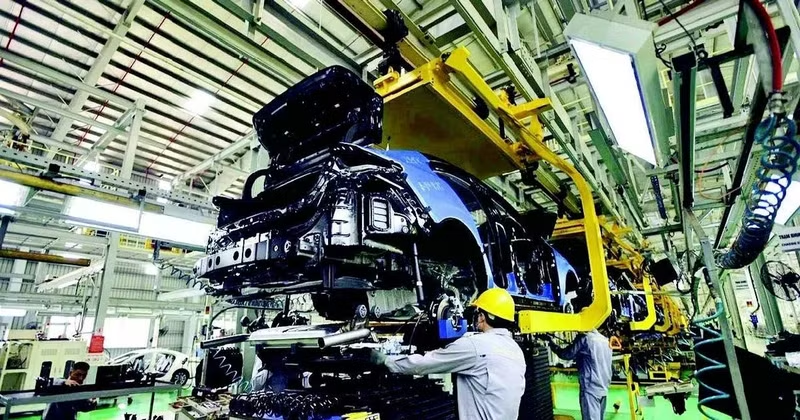
The year 2026 is a pivotal moment for shaping the development model and long-term growth trajectory of Viet Nam’s economy, with the requirement to fundamentally transform the growth model towards one based on productivity and innovation; and to restructure the economy in a green, digital, and circular direction.
Contributions of new growth drivers
According to economist Le Duy Binh, Managing Director of Economica Viet Nam, foundational industries, spearhead industries, and emerging industries are being strongly promoted to create new growth drivers for the economy. This is a strategic step, as the 14th National Party Congress set out the requirement to establish a new growth model, taking science and technology and innovation as the central driving forces guiding the growth and development of Viet Nam’s economy.
In the first month of 2026, the Military Industry and Telecommunications Group (Viettel) broke ground on the construction of the first semiconductor chip manufacturing plant in Viet Nam at the Hoa Lac High-Tech Park (Ha Noi), marking an important step in implementing the strategy to build domestic semiconductor manufacturing capacity. According to the plan, by the end of 2027 the plant will complete construction investment items, receive technology transfer, and begin trial production; from 2028 to 2030 it will move into the phase of technology absorption, process refinement, and operational efficiency improvement, thereby forming a foundation for researching more advanced semiconductor manufacturing technologies.
Among the six main stages of the semiconductor chip production process, enterprises in Viet Nam have gradually participated in five stages, including product definition, system design, detailed design, packaging and testing, and integration and testing, but have not yet participated in the most complex stage, namely chip fabrication. Therefore, Viettel’s construction of a semiconductor chip manufacturing plant not only helps complete the domestic semiconductor ecosystem, creating conditions for enterprises and training and research institutions to shorten testing cycles and quickly bring new products and technologies into practical application, but also supports training linked to a real production environment. This contributes to realising the goal of training 50,000 chip design engineers by 2030, as set out in the national semiconductor industry development strategy.
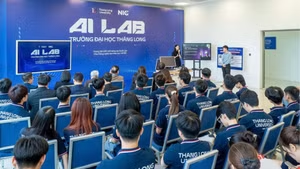
Also in January 2026, the National Innovation Center (NIC) launched a STEM ecosystem. This is one of the activities aimed at implementing the Party’s and State’s guidelines and policies on promoting STEM education and developing high-quality human resources to meet the country’s development requirements in the new period. The STEM ecosystem at NIC Hoa Lac includes reference STEM classrooms and STEM experiential spaces with a modern equipment system, including educational robots, computers, 3D printers, and fabrication equipment designed in an open manner, covering learning, practice, fabrication, and technology experience areas.
On this infrastructure foundation, NIC coordinates with agencies and enterprises to implement training and coaching programmes, organise experiential activities and events, with the aim of forming a vibrant and comprehensive STEM ecosystem closely linked to practice and the country’s development needs. According to Vu Quoc Huy, Director of NIC, the formation of the STEM ecosystem at NIC Hoa Lac is the result of close cooperation among the State, educational institutions, and enterprises, clearly demonstrating a spirit of partnership and shared responsibility in developing STEM education in a context where this model is no longer a choice but a strategic requirement for all countries today.
Repositioning the roles of economic sectors
According to economic experts, in the new growth model, economic sectors are assigned more clearly defined roles. Resolution No. 79-NQ/TW affirms that the state economy must pioneer in creating development, leading, opening the way, promoting industrialisation and modernisation, restructuring the economy, and establishing a new growth model with science and technology, innovation, and digital transformation as the main drivers to enhance national competitiveness. Meanwhile, in the spirit of Resolution No. 68-NQ/TW, the private economy is identified as one of the most important drivers of the national economy and as the pioneering force in the development of science and technology, innovation, and digital transformation.
Lawyer Nguyen Hong Chung, investment policy expert and Chairman of DVL Lawfirm, assessed that Resolution No. 79 opens opportunities to restructure the state economic sector towards market standards, with a focus on strategic concentration, OECD governance, data transparency, and accountability. If Resolution No. 79 is soon translated into action, the state economic sector will become a locomotive for governance, transparency, and efficiency, laying the foundation for industrialisation and digital transformation. Accordingly, the contribution of the state economic sector will lie not in scale advantages but in raising governance standards, reducing social capital costs, and activating industrial and technological ecosystems.
According to Doctor Nguyen Dinh Cung, former Director of the Central Institute for Economic Management, in the current restructuring phase, state-owned enterprises must choose the right industries and fields of operation, move directly into new technologies and new products, and thereby pull enterprises from other economic sectors to develop together. From this, “leading cranes” of the economy will be formed on the basis of existing enterprises or newly established ones. The expert also expressed expectations that, with current institutional breakthroughs and strengths in human resources, capital, and technology, the state enterprise sector will have conditions to rise and truly become a leading force in development under the new growth model.
Meanwhile, the private economy plays the role of the main driving force promoting economic growth, with significant room to apply technology and knowledge to production and business in order to rise and compete in the broader global market. To create a legal corridor for new economic issues, the Government is making efforts to build controlled experimental mechanisms (sandboxes) for new economic models such as international financial centres, special economic zones, and free trade zones, opening a “runway for take-off” for private enterprises.
Just one month after the establishment of the international financial centre in Viet Nam, on February 4, 2026, the Asia–Pacific Aviation Finance Hub (AAFH) located at the Ho Chi Minh City Financial Centre was activated, creating a new financial platform for regional aviation growth in the context of a strong restructuring of the global aviation industry. It is expected that by 2035, AAFH will attract international investment flows with a transaction scale of around 50 billion USD.
In the new growth model of Viet Nam’s economy, new growth drivers are taking shape more clearly and are beginning to make substantive contributions to overall economic growth, marking a fundamental shift from an extensive development model based on natural resources and cheap labour to an intensive development model oriented towards productivity, quality, and enhanced economic competitiveness.