Addressing the problem at its root
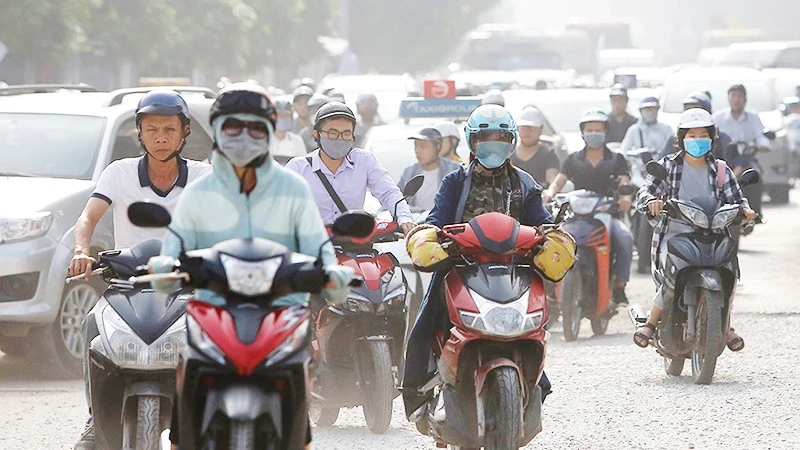
In the final days of 2025 and the early days of 2026, air quality in Ha Noi continued to record severe pollution episodes, clearly reflecting environmental pressure in the process of rapid urbanisation. On December 11, 2025, the Air Quality Index (AQI) at many monitoring stations across the city exceeded 220; in particular, the area of Ha Noi University of Science and Technology recorded an AQI of 227, classified as very unhealthy.
On December 12, 2025, the situation became even more serious when air quality remained at a very poor level for many hours and at 9:18 p.m. reached the hazardous threshold with an AQI of 309. By January 5, 2026, the monitoring station at the Parabol Gate of Ha Noi University of Science and Technology continued to record an AQI of 154, at the poor level. These figures show that air pollution in Ha Noi is no longer an abnormal phenomenon, but has become a cyclical issue, recurring seasonally and closely linked to the structure of urban development.
For many years, solutions to control air pollution in Ha Noi were mainly situational. These measures had a certain effect in the short term, but were not sufficient to create sustainable change due to the lack of continuous monitoring tools and sufficiently strong enforcement mechanisms. This reality has forced Ha Noi to change its approach. Instead of merely “responding when pollution occurs”, the city is moving towards controlling emissions at their source, especially traffic emissions.
One step that clearly demonstrates this shift is the low emission zone (LEZ) policy. Unlike isolated administrative prohibitions, the LEZ is an urban governance tool based on institutions, with a clear roadmap, scope and criteria. According to the plan, the 2026–2027 period will pilot implementation in Ring Road 1 and several key wards. From 2028, it will be expanded to the entire Ring Road 1 and part of Ring Road 2, with the goal after 2030 of extending to the Ring Road 3 area.
In these zones, Ha Noi plans to ban trucks over 3,500 kg, restrict cars and motorbikes that do not meet emission standards, and control the operation of app-based motorcycle transport services. Importantly, these regulations will not be applied abruptly, but will be accompanied by a publicly announced roadmap so that citizens and businesses can proactively adapt.
According to Senior Lieutenant Colonel Dao Viet Long, Deputy Head of the Traffic Police Department (Ha Noi City Police), the police force will coordinate with departments and agencies to announce in detail the roads and time frames for vehicle restrictions, ensuring that the policy is implemented transparently and avoids major disruptions to urban life.
Transforming management through AI
If institutions are the framework, then technology, especially artificial intelligence (AI), is the tool that enables policy to be implemented in practice. According to Ms Le Thanh Thuy, Deputy Head of the Environmental Management Division (Ha Noi Department of Agriculture and Environment), the city is gradually deploying a traffic camera system integrated with AI to monitor vehicles in low emission zones. These systems not only record images but also have the ability to recognise licence plates, classify vehicles, and connect with vehicle inspection data and emission standards. Ms Thuy said that coordinating with the police force to deploy AI cameras for vehicle monitoring represents a shift from manual management to data-driven management, allowing continuous monitoring instead of periodic inspections.
Previously, on December 26, 2025, the People’s Committee of Ha Noi issued Plan No. 372/KH-UBND on implementing solutions to overcome “bottlenecks” in environmental protection work. In this plan, Ha Noi requires a shift from manual inspection and periodic handling to regular monitoring by technology, through expanding the system of cameras, environmental sensors and exploiting digital data. This is the first time the Capital has raised the issue of building an integrated environmental–traffic data system as a key task, serving both immediate operational management and long-term policy planning.
For the transport sector, Plan No. 372 provides the legal foundation for implementing low emission zones, while also requiring departments and agencies to closely coordinate with the police force in organisation and enforcement. The application of AI cameras is not only aimed at detecting violations, but also serves traffic flow analysis and the identification of emission hotspots, thereby adjusting traffic organisation and routing in a rational manner. This approach clearly reflects the objective of controlling emissions at their source, rather than merely dealing with consequences after pollution has already occurred.
According to experts, controlling air pollution is a long-term challenge that cannot be solved by short-term or campaign-style solutions. Ha Noi’s shift from an “immediate response” approach to proactive control through institutions and technology shows a fundamental change in urban governance thinking. Although there are still many challenges in terms of resources and infrastructure, this approach opens up prospects for forming a more effective and more sustainable pollution control system, laying the foundation for the goal of improving the quality of life in the Capital in the coming years.
Head of the Transport Management Division under Ha Noi Department of Construction Nguyen Tuyen believes that without sanctions accompanying monitoring technology, it would be very difficult to implement low emission zones. Technology helps reduce dependence on human factors and increases fairness and transparency in policy enforcement.