Together with improving vehicle emission inspection procedures, strengthening inspection capacity and enforcement against vehicles that fail to meet emission standards are essential requirements.
Legal and practical foundations
A report by the Traffic Police Department under the Ministry of Public Security shows that the force has been equipped with thousands of modern specialised devices to inspect and handle traffic violations, such as load inspection scales, speed-measuring devices with imaging capability, alcohol concentration testers, drug testing devices, radiation detectors, chemical marking equipment, emission and smoke measurement devices, and noise measurement tools. The presence of modern technical equipment has significantly assisted authorities in detecting violations and limiting the use of substandard vehicles.
According to Nguyen Dinh Tho, Deputy Director of the Institute of Strategy and Policy on Agriculture and Environment under the Ministry of Agriculture and Environment, the legal framework for controlling and handling vehicles that violate regulations on environmental pollution and emission levels is now relatively comprehensive and closely aligned with practical conditions.
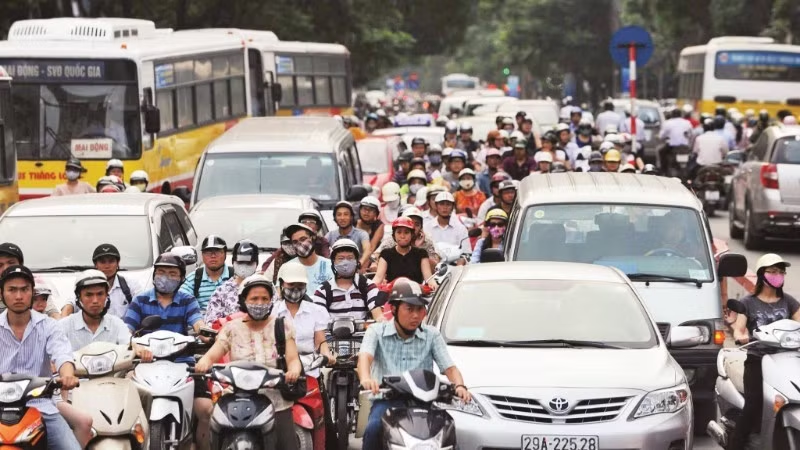
Along with the rapid development of transport infrastructure has come a surge in the number of vehicles, with 7.2 million cars and 81 million motorcycles having been registered. A large proportion of these vehicles have been in use for many years and fail to meet emission standards at Euro 3 or above.
In the context of the Vietnamese Government’s commitment to the net-zero emission target by 2050 and the policy of restricting vehicles powered by fossil fuels in the central areas of major cities, the responsibilities of enforcement agencies have become increasingly demanding with a wide scope of coverage.
They must operate across multiple fronts, including monitoring public compliance with regulations on vehicle emission inspection, checking compliance with emission standards across different zones, and conducting patrols and handling polluting vehicles in real time on road networks.
A Prime Minister decision issued in March 2019 on the roadmap for applying new emission standards for cars is one of the key legal documents governing the detection and handling of administrative violations related to the inspection and measurement of vehicle emissions.
However, the decision still lacks detailed parameters, measurement standards remain inconsistent, specialised equipment and vehicles are insufficient, and coordination among forces during patrol and inspection is not yet synchronised.
In addition, sanctions remain incomplete and there is a lack of alignment between legal regulations and civilian technical infrastructure.
These shortcomings create considerable challenges for enforcement agencies in carrying out their duties.

Several solutions
Besides improving the system of legal documents, investing in modern equipment and vehicles, strengthening coordination mechanisms, and improving the capacity of enforcement forces are urgent requirements at present.
Major General Do Thanh Binh, Director of the Traffic Police Department, stated that to better perform the tasks in controlling and handling vehicles that violate environmental protection regulations, enforcement forces need additional regulatory guidance.
Specialised mechanisms are needed to remove institutional bottlenecks, while it is necessary to increase resources, equip forces with more advanced and suitable technical equipment, enhance professional skills and capacity, and promote the application of information technology, digital transformation, and supporting technological tools.
According to Nguyen To An, Deputy Director of the Viet Nam Register, the agency is currently developing an optimal plan for vehicle emission inspections. This will rely on data from manufacturers as well as modern measurement equipment to ensure accurate and transparent calculations.
Authorities have also built a unified command and operational system, particularly through the development and utilisation of information from the Data Centre for the Management, Monitoring, and Handling of Violations and Traffic Operations.
This centre must be connected with and share data with the databases of relevant ministries and agencies, ensuring the capacity to analyse big data using artificial intelligence applications in order to detect vehicles that violate emission regulations.
The data source will also be connected with vehicle registration centres and the data system for managing, monitoring, and handling violations committed by vehicles participating in traffic.
Priority tasks include tightening control over emission sources through smart sensor camera systems capable of analysing emission concentrations at traffic intersections, strengthening and innovating patrol methods to ensure the principle that all violations must be detected and strictly handled, especially those related to emissions and environmental pollution, installing and operating vehicle identification and classification tools, and using the intelligent transport system to support emission control.
The Traffic Police Department has also proposed exemptions or reductions in fees, charges, and registration taxes, along with other preferential policies, for green vehicles.
Conversely, taxes and fees on vehicles using fossil fuels would be increased in order to promote environmentally friendly transport and limit the registration of new private vehicles that are major sources of emissions, while supporting citizens in transitioning to cleaner vehicles.
Relevant agencies should strengthen communication efforts both directly and through electronic applications and social media platforms, while developing support mechanisms and policies for enterprises involved in green energy infrastructure and vehicles.


![[In Pictures] Bridge columns and underpasses in Ha Noi begin to turn green](https://en-cdn.nhandan.vn/images/nyM650OGFWrOVWc-xajqN-rTZ68Rlmc1fiGJOhBRYHH_N-Xs0TE8Psnfce7ORTs-KVfoJaEblqjNufFrgeF3e2xFkGtLQVaXm04VcmMKBEkANUyiOkpz4zAuIKgydVrrfBxmGez0E_YJIag0u_Uil0E7jpuJXsIxeMmGjoY1-W4/1791863309074-2994714492692222878-2994714492692222878-adb9ff3f4175c70066ed8bb80cfbead9.jpg.avif)