The causes include habitat loss and the widespread, organised hunting, trading, and consumption of wild birds.
In some localities, bird hunting was once regarded as a livelihood, while demand from speciality restaurants and the pet bird trade has continued to sustain illegal hunting and trading activities.
As a result, conservation efforts have often been reactive, with authorities struggling to enforce regulations effectively.
Against this backdrop, on October 17, 2025, the Ministry of Public Security and the Ministry of Agriculture and Environment signed a joint plan, known as Plan 628, to coordinate communications, enforcement, and legal action against violations of wildlife protection regulations and threats to Viet Nam’s aquatic resources.
Plan 628 was implemented at all levels of government, down to commune-level police units, across all 34 provinces and cities over a three-month period. The campaign focused on taking strict action against violators and coordinating efforts to detect illegal transactions on social media platforms, online forums, and e-commerce sites.
One notable success under Plan 628 was the dismantling of an interprovincial ring involved in the trafficking and transportation of endangered wildlife. The operation was carried out by Nghe An Police in coordination with the Traffic Police Department.
Through field intelligence and online monitoring, authorities uncovered a network using Facebook, Zalo, and Telegram to market endangered wildlife through sophisticated and covert methods.
The ringleader, Nguyen Van Chuong from Ninh Binh, had allegedly collected large quantities of protected wildlife from southern provinces for transportation to northern markets for consumption and sale.
On March 22, the task force arrested Chuong and a driver, seizing 14 rhinoceros hornbills, 16 otters classified under Group IB (species strictly prohibited from commercial exploitation), and 181 monkeys classified under Group IIB (species with restricted exploitation).
Chuong was later prosecuted for violating regulations on the protection of endangered and rare animals.
On April 8, Hung Yen Provincial Police, in coordination with the Forest Protection Department, inspected a pet bird business owned by Dong Huy Oanh in Xuan Truc Commune.
Authorities discovered that the suspect was illegally holding 20 wild birds classified as Group IIB.
Hung Yen Police subsequently initiated criminal proceedings against Oanh for violating wildlife protection regulations.
Based on information gathered from known hotspots, police, forest rangers, fisheries inspectors, and local authorities organised numerous patrols and inspections at markets, restaurants, business premises, and along transport routes.
At the same time, they launched a coordinated communications campaign spanning grassroots community groups and social media outreach, helping to break the “demand link” in the wildlife hunting and trading chain.
Stronger inter-agency coordination has enabled more unified and effective operations, shortening processing times and eliminating overlapping responsibilities.
According to official reports, over the three-month implementation period of Plan 628, authorities detected and handled nearly 1,800 violations. Since April 1 alone, police nationwide have handled 444 cases, initiated criminal proceedings in 31 cases involving 47 suspects, and imposed administrative penalties in 327 cases, with total fines exceeding 1.6 billion VND (approximately 60,700 USD).
In addition, the use of criminal charges under the Penal Code, carrying penalties of up to 1 billion VND or seven years’ imprisonment, in place of the administrative sanctions previously relied upon has created a significantly stronger deterrent effect.
The outcomes achieved under Plan 628 are helping to shape a new, long-term approach to biodiversity protection in Viet Nam, gradually restoring ecosystems and wildlife populations in several localities. In many areas where habitats had significantly degraded, wildlife species have begun to return.
At Tram Chim National Park in Dong Thap, after six years of absence, a flock of six spot-billed pelicans — a species listed in Viet Nam's Red Data Book — has reappeared. Other rare bird species, including painted storks, comb ducks, and black-tailed godwits, have also returned. Meanwhile, a flock of around 300–400 eastern sarus cranes has returned to Phong Nha–Ke Bang National Park, a sight rarely witnessed in recent years.
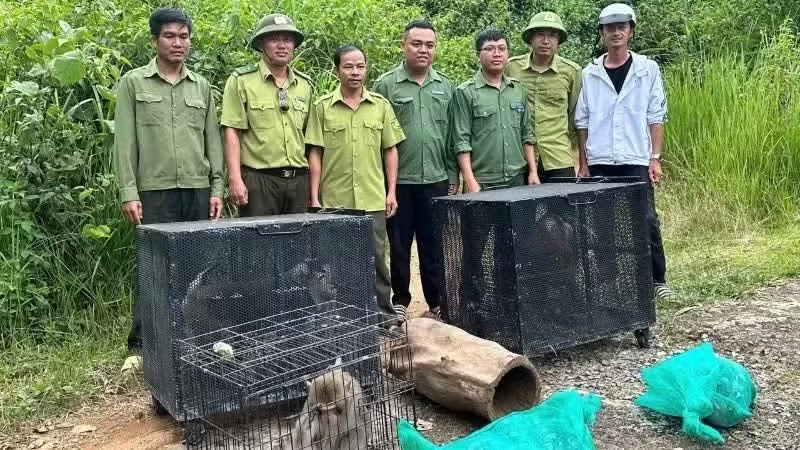
In northern Viet Nam, 74 birds from 12 species, including seven classified under Group IIB, were successfully released back into the wild at Tam Dao National Park.
At the conference reviewing Plan 628, Senior Lieutenant General Nguyen Van Long, Deputy Minister of Public Security, reaffirmed that the Party and State uphold the principle that economic development must be balanced with environmental protection and that ecological sustainability should not be sacrificed for economic growth.
To ensure biodiversity and aquatic resource protection efforts yield meaningful results, the Deputy Minister instructed local police forces to enforce stricter discipline and decisively address any superficial or lenient treatment of violations that understates the seriousness of offences.
Looking ahead, Long directed local police to focus on detecting and prosecuting cases involving the possession and use of explosives, electric shock devices, and banned fishing gear, as well as homemade firearms and other illegal wildlife hunting equipment.



![[In Pictures] Bridge columns and underpasses in Ha Noi begin to turn green](https://en-cdn.nhandan.vn/images/nyM650OGFWrOVWc-xajqN-rTZ68Rlmc1fiGJOhBRYHH_N-Xs0TE8Psnfce7ORTs-KVfoJaEblqjNufFrgeF3e2xFkGtLQVaXm04VcmMKBEkANUyiOkpz4zAuIKgydVrrfBxmGez0E_YJIag0u_Uil0E7jpuJXsIxeMmGjoY1-W4/1791863309074-2994714492692222878-2994714492692222878-adb9ff3f4175c70066ed8bb80cfbead9.jpg.avif)