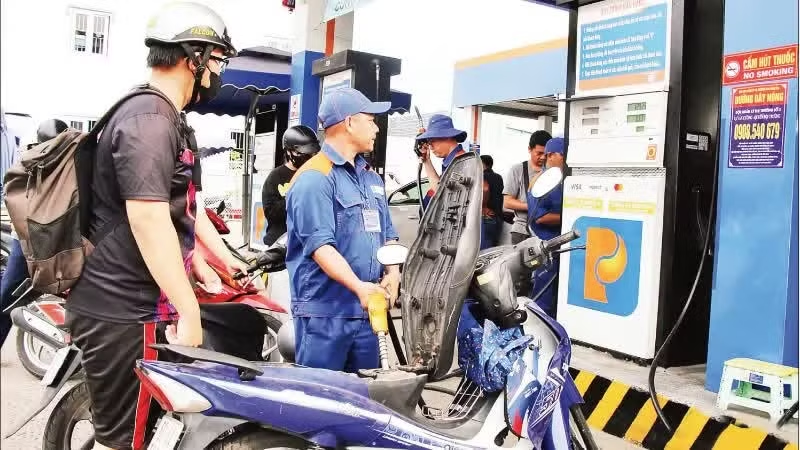
From June 1, the Department of Domestic Market Management and Development under the Ministry of Industry and Trade, together with relevant authorities, will step up inspections and oversight of fuel distribution and retail outlets. Local authorities have been instructed to ensure E10 petrol fully replaces RON95 nationwide.
According to Associate Professor Dr Pham Huu Tuyen, Director of the Research Centre for Propulsion Systems and Autonomous Vehicles at Ha Noi University of Science and Technology, E10 petrol consists of approximately 10% ethanol and 90% conventional petrol. He has spent many years researching the fuel and notes that, although its ethanol content is relatively low, it is sufficient to improve several combustion properties.
Specifically, ethanol contains oxygen, which enables more complete and cleaner combustion in the engine. This enhances combustion efficiency and, in turn, improves overall engine performance.
Some have argued that ethanol has a lower calorific value than conventional petrol and that blending it may reduce the fuel’s energy content, leading to higher consumption. In reality, this difference in calorific value is relatively small, only a few percentage points, and is offset by more efficient combustion in the engine.
Research and testing have shown that when E10 petrol is used, engine power output and fuel consumption are broadly comparable to those of conventional petrol. In some cases, fuel efficiency may even improve as a result of more optimised combustion.
Associate Professor Dr Pham Huu Tuyen also noted that one of the most significant benefits of E10 petrol is a reduction in emissions. Harmful pollutants such as carbon monoxide (CO) and unburnt hydrocarbons fall substantially, a result that is good not only for the environment but also for public health.
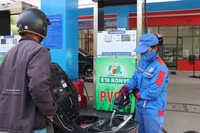
Many retail fuel stations have already removed RON95 signage and replaced it with E10 signage. Nevertheless, some consumers remain cautious and are taking a wait-and-see approach. Owners of older vehicles have brought their cars and motorcycles to repair shops to replace worn or deteriorating components and ensure compatibility with E10. Some have even sought information on fuel additives that might help their vehicles match the performance of conventional petrol.
Experts also point out several limitations associated with E10 petrol. Ethanol readily absorbs moisture, can corrode metals, and may damage rubber seals. These characteristics can affect the performance of older vehicles and potentially damage fuel delivery systems and storage tanks.
Ethanol’s high moisture absorption can also allow water levels in the fuel to exceed permitted thresholds if valves, pipes or tank caps are not properly sealed, making engines harder to start and causing rough running.
According to Associate Professor Dr Nguyen The Luong of Ha Noi University of Science and Technology, owners of newer vehicles that have been certified by manufacturers as compatible with ethanol-blended fuels can be fully confident in the reliability of their engines.
However, because ethanol absorbs moisture, fuel that sits unused for extended periods may absorb water from the surrounding environment, resulting in phase separation, where the fuel mixture separates into two distinct layers. This can affect vehicle performance when the vehicle is next used.
On this point, a representative of the Viet Nam Automobile Manufacturers’ Association stated that although modern vehicles are equipped with alcohol-resistant fuel systems, owners of vehicles that are rarely driven should still run them at least once a month.
If a vehicle has been left unused for a prolonged period, particularly with little fuel remaining in the tank, it should be inspected by an authorised dealer before being driven again to ensure it is running properly.
Associate Professor Dr Nguyen The Luong also noted that E10 petrol has already been adopted in 50 countries and that, based on the experience and testing of those countries, Viet Nam can move ahead with widespread E10 adoption with confidence.
Under the latest circular issued by the Ministry of Science and Technology, E10 petrol is defined as a blend of unleaded petrol and ethanol containing between 8.0% and 10.0% ethanol by volume. This updates the previous requirement of between 9.0% and 10.0%.