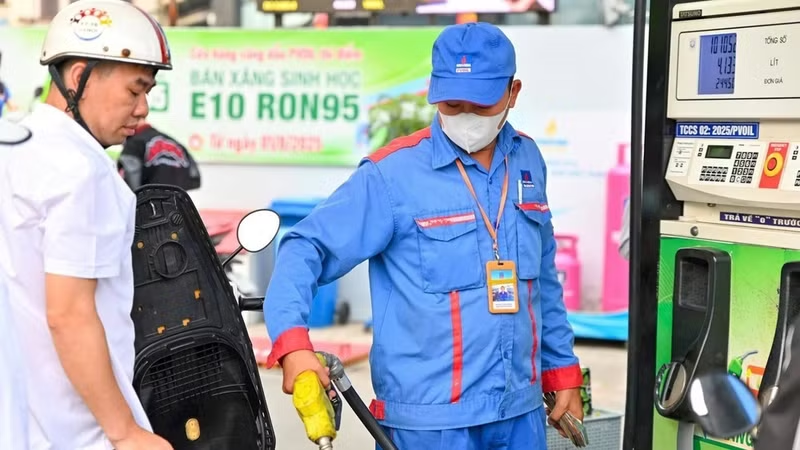
In June, nationwide consumption of biofuel petrol (E5 and E10) exceeded 1 billion litres. Of this total, E10 accounted for nearly 95%, while E5 made up the remaining 5%.
Significant advantages
All of the country's more than 17,000 petrol retail outlets have now completed the transition to distributing biofuel petrol. On the supply side, 26 major fuel distributors are supplying E10, of which 11 also continue to provide E5. Total biofuel petrol consumption in June reached approximately 1 billion litres, equivalent to the volume of conventional petrol previously consumed.
According to monitoring data from the Environment Agency under the Ministry of Agriculture and Environment, comparing the end of June with the end of May, fine particulate concentrations in Ha Noi fell sharply, with PM2.5 declining by 31.0% and PM10 by 29.6%.
In Ho Chi Minh City, improvements were even broader, with substantial reductions recorded across both particulate matter and gaseous pollutants. Nitrogen dioxide (NO₂), carbon monoxide (CO) and nitrogen oxides (NOₓ) fell by 68.6%, 65.2% and 57.6%, respectively. Sulphur dioxide (SO₂) declined by 38.5%, while ozone (O₃) fell by 14.4%. PM2.5 and PM10 concentrations also decreased by 15.7% and 14.3%, respectively.
Associate Professor Dr Pham Huu Tuyen, Director of the Centre for Powertrain and Autonomous Vehicle Research at Ha Noi University of Science and Technology, said practical nationwide use of E10 had confirmed its many advantages. Its performance is comparable to that of conventional mineral petrol, while maintaining all essential vehicle operating characteristics.
The key advantage of E10 lies in its oxygen content of around 3.4%, which enables more complete, efficient and cleaner fuel combustion inside the engine. This significantly reduces emissions of hydrocarbons (HC) and carbon monoxide (CO), a benefit that has been clearly demonstrated by air quality monitoring results.
According to experts, E10 also offers a practical economic solution by strengthening value chains and making better use of Viet Nam's strengths as an agricultural nation, particularly benefiting cassava growers.
A long-term vision
According to Dr Dang Tat Thanh from the Department of Innovation, Green Transformation and Industrial Promotion under the Ministry of Industry and Trade, the introduction of E10 is not merely about bringing a new fuel to market, but about building a comprehensive energy security ecosystem.
Alongside its existing advantages in cassava and molasses production, Viet Nam should learn from countries such as Brazil by accelerating the development of next-generation ethanol technologies using agricultural and forestry residues, including rice straw, sugarcane bagasse and maize cobs. Such an approach would help reconcile the dual objectives of energy security and food security.
To ensure this ecosystem operates effectively, blending, mixing and distribution systems must also be upgraded in a coordinated manner. Quality control of biofuel petrol should be strengthened in line with existing technical standards, while scientific information on fuel quality and engine compatibility should be made publicly available in a transparent manner.
At present, Viet Nam's three domestic ethanol plants meet around 20% of market demand. This figure is expected to rise to between 30% and 35% by the end of 2026 as two or three additional plants resume operations.
However, according to Vu Thien Huong, Secretary General of the Viet Nam Biofuels Association, achieving complete self-sufficiency in ethanol supply is not essential. Maintaining an appropriate level of imports would diversify supply sources while helping to preserve balanced trade relations with strategic partners.
Viet Nam's biofuel roadmap will not end with E10. Dr Tran Hai Ninh, Director of the BSR Innovation Centre under Binh Son Refining and Petrochemical JSC (BSR), said upgrading refinery technology is a long-term investment process. Accordingly, alongside supplying E10 to the domestic market, BSR is gradually expanding research and development into next-generation renewable fuels, including sustainable aviation fuel and renewable diesel fuels.