According to a report by the working group implementing Circular No. 50 under the Ministry of Industry and Trade on the implementation of the roadmap for blending, mixing, and using E10 biofuel petrol in Viet Nam, air quality monitoring data in Ha Noi and Ho Chi Minh City revealed initial signs of environmental improvement. The data was provided by the Department of Environment under the Ministry of Agriculture and Environment across three periods: early May, late May, and late June 2026.
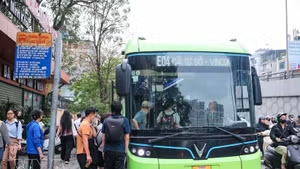
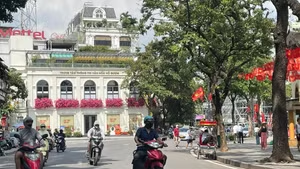
Specifically, aggregated air data for Ha Noi and Ho Chi Minh City at the end of June compared with the end of May revealed that in Ha Noi, the particulate group declined markedly: PM2.5 fell 31.0% and PM10 fell 29.6%. This indicates an improvement in dust-related air quality in Ha Noi. However, numerous transport and construction projects are being implemented in Ha Noi, which is also one of the factors that may affect air quality.
In Ho Chi Minh City, the improvement trend was clearer and more uniform. Compared with late May, late June recorded a 15.7% decrease in PM2.5, a 14.3% decrease in PM10, a 65.2% decrease in CO, a 68.6% decrease in NO2, a 57.6% decrease in NOx, a 38.5% decrease in SO2 and a 14.4% decrease in O3. These results indicate that both dust and pollutant gas groups experienced a downward trend, reflecting more positive environmental developments.
In terms of biofuel petrol consumption, from June 1 to 30, 2026, total consumption of biofuel petrol (E5 and E10) reached more than 1 billion litres. Of this, E10 accounted for nearly 95% of total consumption, while E5 made up about 5%.
Thus, compared with previous consumption of conventional petrol at about 1 billion litres per month, biofuel petrol consumption was equivalent, demonstrating that claims asserting biofuel petrol is less fuel-efficient than conventional petrol are baseless.
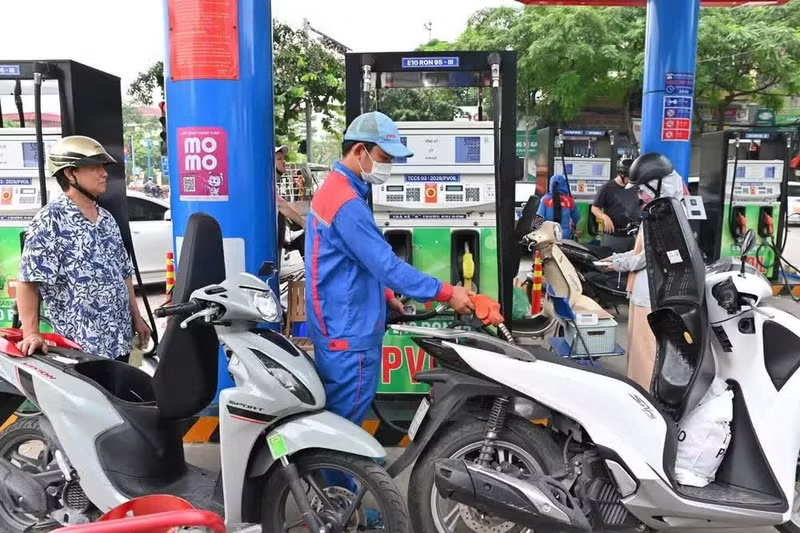
The country currently has more than 17,000 petrol and oil stations, and all petrol retailers have transitioned to distributing biofuel petrol. There are 26 key traders supplying E10 petrol and 11 out of 26 key traders supplying E5 petrol.
To facilitate public access, the Department of Domestic Market Management and Development has launched the “Quanh toi” (Around me) application to publish addresses of petrol and oil stations nationwide, including those selling E5 petrol, for people to reference. The country currently has 1,585 stations selling E5 petrol.
Moving forward, the Ministry of Industry and Trade will continue to track developments in the E5 and E10 petrol consumption market to direct enterprises to adjust product categories in line with demand in each locality.