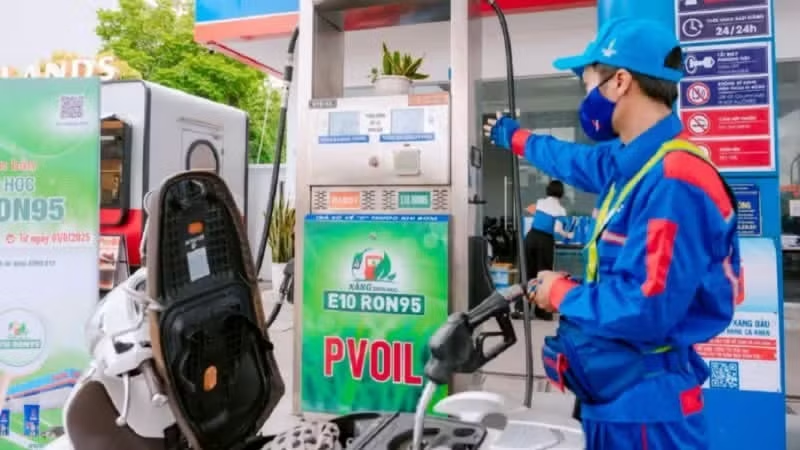
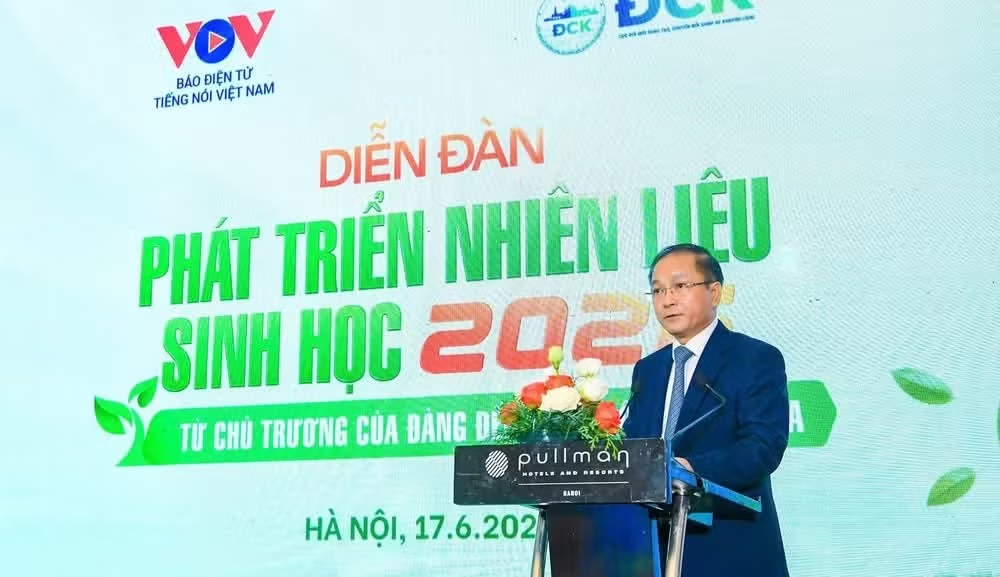
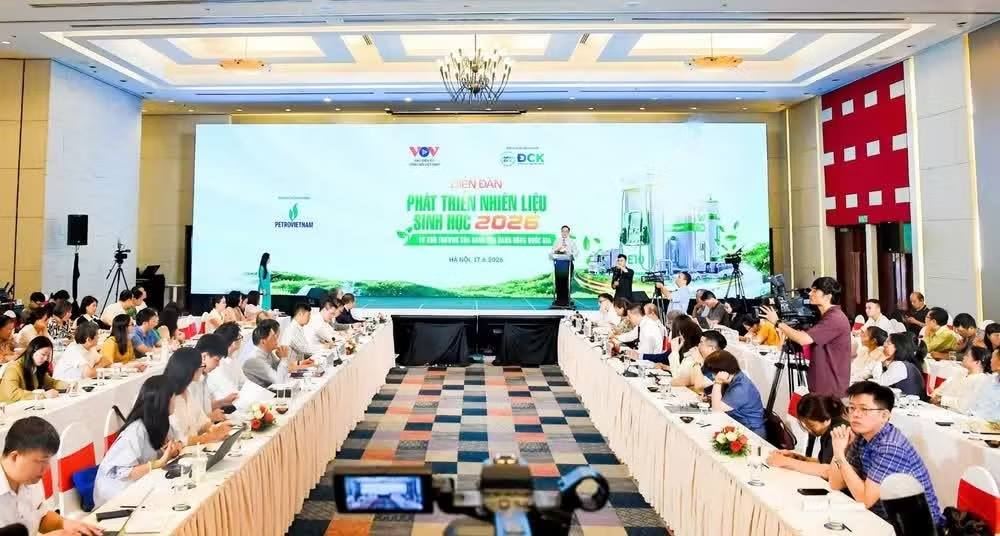
At the forum themed “Biofuel Development 2026: From Party Policy to National Action”, held in Ha Noi on June 17, policymakers, experts and business representatives reviewed the initial outcomes of E10 biofuel deployment while candidly discussing the challenges that must be overcome to build a sustainable biofuel industry.
Early results boost confidence in the transition roadmap
One of the key topics attracting great attention at the forum was the initial assessment following the nationwide introduction of E10 biofuel.
Dao Duy Anh, Deputy Director of the Agency for Innovation, Green Transition and Industry Promotion, said that the rollout of E10 was not a decision made overnight but the result of months of preparation and testing. According to him, fuel distributors had conducted pilot distribution programmes before the nationwide implementation.
Notably, after more than two weeks of official deployment, fuel retailers have reported no negative feedback from customers regarding fuel quality, engine performance, mechanical failures or operational efficiency.
According to figures presented at the forum, approximately 540 million litres of petrol were distributed nationwide during the first 15 days of implementation, including around 40 million litres of E10 petrol. Transport activities, agricultural production, inland waterway transport and other socio-economic activities continued as normal, with no disruptions or bottlenecks resulting from the fuel transition.
However, participants noted that these early figures primarily reflect market acceptance. A more comprehensive assessment of E10’s effectiveness will require additional time to evaluate its environmental, economic and social impacts.
More importantly, according to Dao Duy Anh, the programme’s success should not be measured solely by consumption volumes but also by broader objectives such as environmental protection, enhanced fuel self-sufficiency and improved economic resilience against volatility in global energy markets.
“Biofuels are only one of many solutions in the green transition process, but they represent an important solution for safeguarding national energy security,” he stressed.
The greatest challenge lies in feedstock supply
From the perspective of industry, Mai Tuan Dat, Deputy General Director of Binh Son Refining and Petrochemical Joint Stock Company (BSR), said that the rollout of E10 had demonstrated the significant development potential of biofuels in Viet Nam.
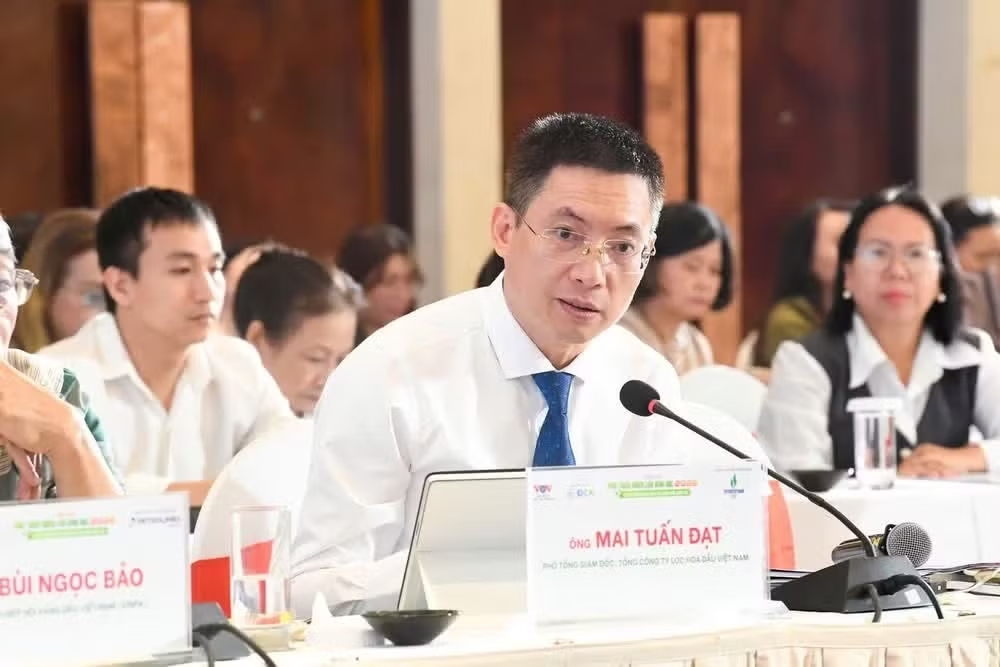
According to him, biofuels should not be associated solely with cassava or a handful of traditional feedstock crops. In the future, a wide range of biological resources from agriculture, forestry and fisheries, as well as by-products and production residues, could become valuable inputs for the biofuel industry.
Drawing on international experience, particularly that of Brazil which is widely regarded as a global success story in biofuel development, Mai Tuan Dat argued that Viet Nam still has considerable room to expand the industry’s value chain.
In addition to reducing dependence on imported fossil fuels, biofuels could create new livelihood opportunities in rural areas and generate added value from agricultural by-products that are currently underutilised or inefficiently processed.
According to analyses presented at the forum, future demand for fuel ethanol could create a market worth tens of trillions of Vietnamese dong annually. A substantial share of this value could flow back into the agricultural sector through feedstock procurement.
As global energy markets are increasingly affected by geopolitical tensions and supply-chain disruptions, securing part of the nation’s fuel supply from domestic biomass resources is viewed as a strategically important long-term direction.
While acknowledging the strong prospects for biofuels, participants also pointed to several bottlenecks that require urgent attention.
Nguyen Hung Manh, Chief of Office of the Vietnam Cassava Association, said that feedstock supply remains the most significant challenge to the sustainable development of the industry. He noted that if demand for fuel ethanol continues to rise, cassava requirements will increase substantially, while current supplies are already showing signs of strain. Moreover, cassava must compete with starch production, animal feed manufacturing and export markets.
The challenge, therefore, is how to secure sufficient feedstock for biofuel production without placing pressure on food security or other economic sectors. Mai Tuan Dat echoed this concern, arguing that relying solely on cassava would make it difficult to achieve long-term competitiveness. A more sustainable approach would be to develop new technologies capable of utilising agricultural and forestry residues and other biomass sources, thereby reducing dependence on traditional feedstocks.
In other words, the future of biofuels lies not in expanding feedstock cultivation at all costs, but in technological innovation that enables more efficient use of existing resources.
A comprehensive policy ecosystem is essential
From the perspective of sustainable development, Associate Professor Dr Nguyen Hong Quan, Director of the Institute for Circular Economy Development (ICED) at Viet Nam National University, Ho Chi Minh City, said that the biofuel debate should be viewed within the broader context of energy security and green development.
According to him, Brazil’s success demonstrates the decisive importance of science and technology, innovation and strong government support during the early stages of market development.
If left entirely to conventional market forces, the development of a biofuel-based agricultural industry would face significant obstacles. Therefore, alongside market competition, supportive policies on finance, green credit, taxation and public investment are needed to provide initial momentum for businesses.
Many participants shared this view, noting that Viet Nam should establish a complete biofuel ecosystem encompassing feedstock regions, processing technologies, logistics infrastructure, financial mechanisms and consumer markets. Consequently, biofuel development cannot be regarded solely as an issue for the petroleum sector; it requires coordinated participation from the agriculture, industry, science and technology, finance and environmental sectors.
Discussions at the forum suggest that Viet Nam has made a relatively positive start in expanding the use of biofuels. However, these early achievements represent only the beginning of a much longer journey.
The experience of implementing E10 demonstrates that the challenge is not merely to replace one type of fuel with another, but to build a new economic sector grounded in the principles of green growth and the circular economy. If developed effectively, biofuels can contribute not only to reducing greenhouse gas emissions and strengthening energy security, but also to generating new momentum for agriculture, stimulating technological innovation and expanding the economy’s growth potential.
This was also the common message conveyed by participants at the “Biofuel Development 2026” forum: translating the Party’s and State’s sound policies into concrete, coordinated and long-term actions to establish a modern, efficient and sustainable biofuel ecosystem for Viet Nam.



![[Infographic] Key targets for six socio-economic regions by 2030](https://en-cdn.nhandan.vn/images/8dQCkhYSk-wM_FT297wTOii-mNVUnU5mzzruupQlYFDFwvviBtqb6WPMtkT9EUwOaR8TPtE72qFzCDyjwtAUrw/keytargets.png.avif)