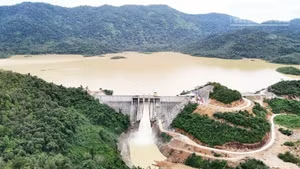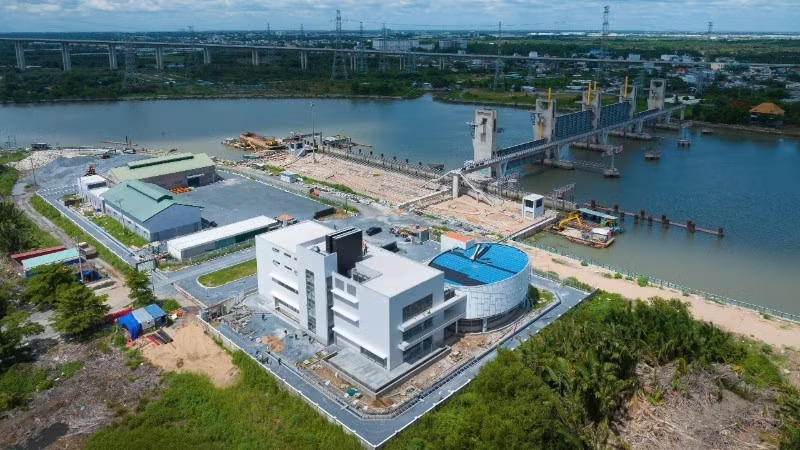
Under the proposal, the city would invest approximately 2.673 trillion VND in the construction of 19 embankments and sluice gates at critical locations, linking them with the 10 trillion VND tidal flood control project to create a continuous flood defence "ring" protecting inner Ho Chi Minh City.
Of the 19 projects, 17 would be funded by the city's budget at a cost of more than 2.3 trillion VND and implemented under an urgent mechanism for completion in 2027. The remaining two projects would be financed by the private sector with a combined investment of about 359 billion VND.
Several large-scale projects have also been proposed for the city's consideration, including a 260-billion-VND embankment along the left bank of Cau Kinh Canal in Tan Thuan Ward. In Hiep Phuoc Commune, major projects include the Lap Dau tidal control sluice gate (540 billion VND) as well as a dyke and sluice system on Ba Lao Canal (230 billion VND).
According to the City Department of Agriculture and Environment, these urgent projects form part of the roadmap for completing Irrigation Plan No. 1547, which serves as the outer flood control system for Ho Chi Minh City and surrounding areas, covering a total area of about 968,500ha.
To implement the plan, Ho Chi Minh City has launched the Phase 1 tidal flood control project incorporating climate change adaptation under the build-transfer (BT) model, with an initial investment of nearly 10 trillion VND. The project comprises six large tidal sluice gates, a 7.8km embankment system along the Sai Gon River, and supporting infrastructure. However, due to a number of unresolved issues, the project has yet to be put into operation, preventing its flood prevention benefits from being fully realised.
In parallel with this project, the city has been investing in embankments, tidal sluice gates, and canal dredging and rehabilitation works under Irrigation Plan No. 1547, aiming to improve drainage capacity and urban infrastructure. However, in the inner city alone, many drainage outfalls and embankments have yet to be fitted with flap gates or tidal sluices.
In addition, many areas still lack integrated embankment and sluice systems, reducing the overall effectiveness of flood control. As such, the department stressed the need to complete the outer flood control system as a continuous network.


![[In Pictures] Bridge columns and underpasses in Ha Noi begin to turn green](https://en-cdn.nhandan.vn/images/nyM650OGFWrOVWc-xajqN-rTZ68Rlmc1fiGJOhBRYHH_N-Xs0TE8Psnfce7ORTs-KVfoJaEblqjNufFrgeF3e2xFkGtLQVaXm04VcmMKBEkANUyiOkpz4zAuIKgydVrrfBxmGez0E_YJIag0u_Uil0E7jpuJXsIxeMmGjoY1-W4/1791863309074-2994714492692222878-2994714492692222878-adb9ff3f4175c70066ed8bb80cfbead9.jpg.avif)