Key components nearing completion
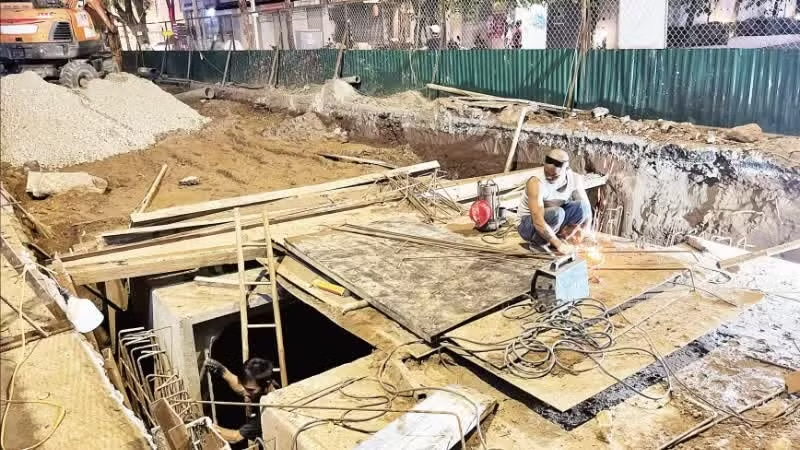
Although their shift officially begins at 10 pm, workers on the underground drainage system along Phan Chu Trinh Street, from the Hai Ba Trung intersection to Ly Thuong Kiet Street, arrive around 30 minutes early to prepare the site.
Nguyen Van H, a worker at the site, said that heavy rain in the early hours of April 23 signalled the imminent arrival of the rainy season, prompting contractors to mobilise maximum manpower and machinery. Crews work overnight, dismantling barriers, setting up warning signs and clearing the site after each shift to restore road surfaces for traffic.
Nearby, the construction of an underground retention tank in front of Hang Da Market is also progressing overnight. Major components—including sheet piling, excavation and installation of box culverts—have largely been completed. Workers are now finalising the structure, which is expected to help address long-standing flooding in Duong Thanh, Bat Dan and Nha Hoa streets.
At the Thuy Phuong 2 Lake project in Dong Ngac Ward, designed to hold approximately 500,000 cubic metres of water, the final concrete elements of the embankment foundation have been installed. According to the contractor, this is a crucial step in forming the lake basin and enabling subsequent works such as embankment construction and surrounding walkways. Other tasks—including dredging, soil transport and drainage connections—are also on track, ensuring the facility can store water from early May.
Elsewhere, urgent flood-control projects—including the upgrading of Thuy Phuong canal, water supplementation for the To Lich River, expansion of pumping stations, installation of mobile pumps, and construction of drainage systems along Thang Long Boulevard, as well as retention lakes in Phu Do, Yen Nghia and Me Tri (Dong Bong 2)—are being implemented at an accelerated pace.
A representative of the Ha Noi Infrastructure and Agricultural Construction Project Management Board, which is leading most of the city’s 12 emergency projects, said construction is being carried out in continuous shifts. Key flood-control components have largely been completed, with many projects reaching around 70% of total workload. Coordination is under way with relevant departments to integrate new facilities into the city’s overall drainage system.
Implementing an urban flood-mitigation plan
These results follow careful planning by Ha Noi authorities, who have assessed the scale and nature of projects in line with the capital’s overall drainage master plan.
After severe flooding caused by storms in 2025, the city introduced a combination of short-, medium- and long-term measures. Immediate priorities focus on boosting drainage capacity, reducing flood-prone areas and limiting inundation during heavy rainfall exceeding system design capacity. Retention lakes are a key component, helping to store excess water and mitigate peak flows when pumping stations are unable to discharge water quickly enough.
The city has also issued emergency construction orders, introducing special mechanisms to streamline administrative procedures, expedite land clearance and secure investment resources. As a result, major components of these urgent projects are now largely complete and ready to contribute to drainage operations.
According to the Ha Noi Department of Construction, the municipal People’s Committee has tasked the department with coordinating with the Department of Agriculture and Environment to establish operational regulations linking urban drainage systems with rural canals and rivers, thereby improving overall efficiency.
Le Van Du, head of the Water Supply and Drainage Infrastructure Division, noted that while Ha Noi has invested significantly in drainage infrastructure in recent years, development has not kept pace with rapid urbanisation. Only the To Lich River basin has a relatively complete drainage system, while systems along both banks of the Nhue River are still under construction and currently meet only about 20% of planned capacity. Similarly, the capacity of pumping stations and retention lakes remains at roughly 20% of targets.
In addition to ongoing emergency projects, the city plans further investments, including drainage systems for the Nhue River basin, flood mitigation in peri-urban areas, the Vinh Thanh drainage and retention project, upgrades to Phuong Trach pumping station, construction of Viet Hung–Cau Bay and Long Bien–Cu Khoi canals, and Cu Khoi pumping station.
Ha Noi is finalising and preparing to implement a comprehensive urban flood-control plan for the upcoming rainy season, including contingency measures for rainfall exceeding design capacity and targeted solutions for specific flood-prone locations, with the aim of addressing persistent bottlenecks in urban drainage.