Requirements from reality
Amid increasingly severe climate change, pressure for green development has become more evident for Ho Chi Minh City, the country’s largest economic centre, which contributes about one-third of the national budget. If green transition was previously viewed mainly as an environmental responsibility, it has now become a competitive requirement for enterprises in many fields, especially in global supply chains.
Nguyen Ngoc Thang, Deputy General Director of Saigon Co.op, said that although investment costs for green criteria and ESG, namely Environmental, Social and Governance standards, are very high, the unit remains committed to accompanying green enterprises in bringing quality products to consumers.
In the field of high-tech agriculture, green transition is also a journey that requires great persistence. Lam Thuy Ai, General Director of MEBI FARM, said the enterprise spent 10 years building a green, clean and circular livestock farming model located far from residential areas. Trees are used as a biological air barrier, rooftops are fitted with solar power systems, and the entire process is automated to save energy.
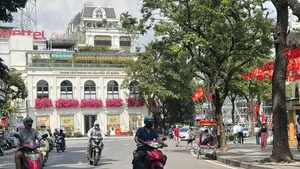
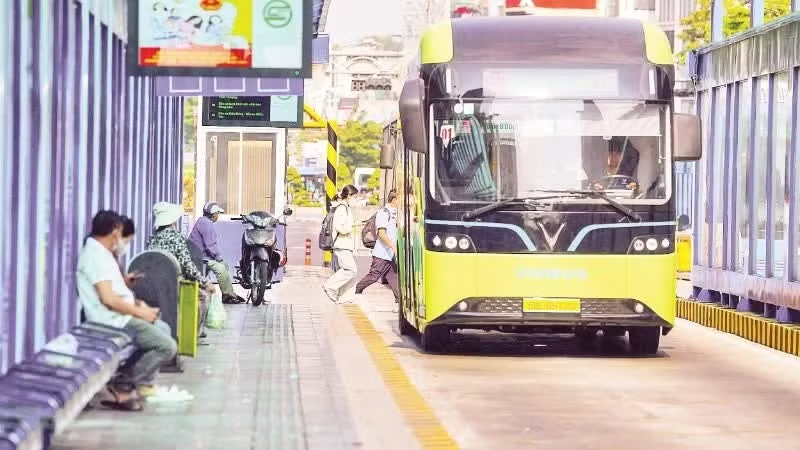
However, green transition remains a major challenge in many sectors. Following its merger, Ho Chi Minh City has more than 14 million people, with about 11.4 million motorbikes and 1.3 million cars. This enormous number of vehicles is placing great pressure on infrastructure and air quality, emitting around 13 million tonnes of CO2 into the environment each year.
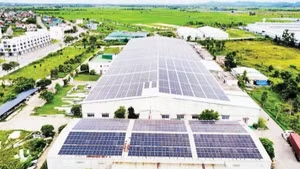
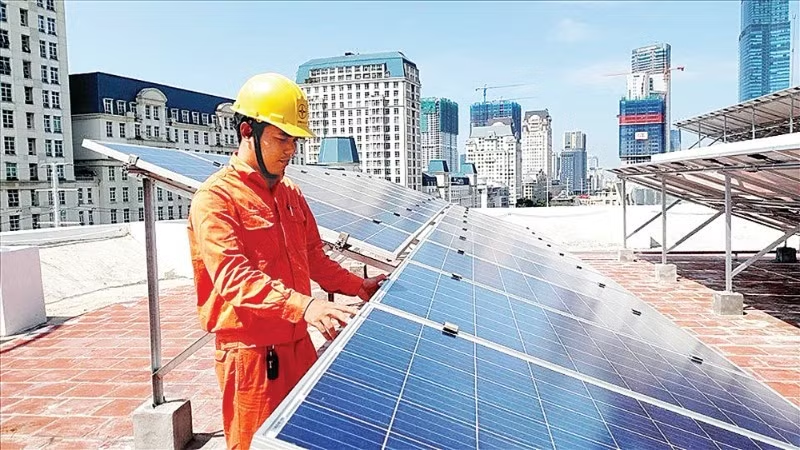
Similarly, in the energy sector, the city currently has 22,355 rooftop solar power systems with a total capacity of about 1,832MWp. Despite huge development potential, Nguyen Kim Ngoc, Deputy Director of the Ho Chi Minh City Department of Industry and Trade, said the biggest barriers at present are finance and legal mechanisms.
According to experts, while the State budget remains limited and procedures are complex, many off-budget funds are ready to support green investment with low-interest or interest-free loans. The issue is that more flexible mechanisms are needed to mobilise and use these resources effectively.
Unlocking room for green transition
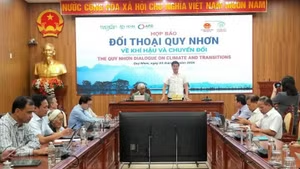
Bui Minh Thanh, Vice Chairman of the Ho Chi Minh City People’s Committee, said the Resolution of the municipal Party Congress for the 2025-2030 tenure identifies three strategic pillars: green transition, digital transformation and innovation. Accordingly, the city is implementing the Green Transition Project for the 2025-2030 period, with 10 pillars and 76 specific targets, requiring mobilised capital of about 900 trillion VND.
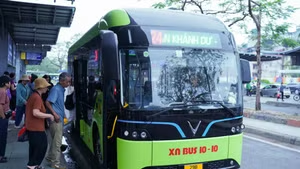
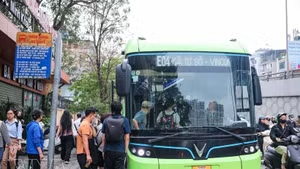
To realise this goal, the city is promoting a series of major orientations, including renewable energy development, economical and efficient energy use, green hydrogen development and the target of achieving net zero emissions by 2050. By 2030, the city aims to have all public transport vehicles powered by clean energy.
The city has also translated these orientations into many action programmes, including the Action Plan on pollution control and air quality management for the 2026-2030 period, with a vision to 2045.
Pham Binh An, Deputy Director of the Ho Chi Minh City Institute for Development Studies, proposed that the city soon designate low-emission zones in Can Gio and Con Dao, and implement them according to an appropriate roadmap in the central area.
At the same time, the city needs specific regulations for each group of vehicles; strict control over major emission sources from industrial and construction activities; stronger urban environmental sanitation and dust treatment on roads; and development of green spaces to improve air quality.
From the perspective of regional development strategy, Ho Nguyen Thai Bao from the Ho Chi Minh City Institute for Development Studies said that after the restructuring of administrative boundaries, Ho Chi Minh City’s advantages in land resources, inter-regional infrastructure and marine ecosystems will create favourable conditions for the development of carbon-neutral industrial parks, green logistics, green finance, renewable energy and green waterway transport.
Nguyen Ngoc Hoa, Chairman of the Ho Chi Minh City Business Association, said the city’s green transition picture is gaining greater depth, with both authorities and enterprises implementing practical measures instead of following movements as in the past.
Discussing solutions, Dr Phan Thuy Kieu, a representative of a research group from the Institute for Development Studies, said the city needs to soon complete its green growth policy framework in order to achieve the net zero target by 2050, especially as emissions are expected to continue increasing after urban expansion.
Green transition in Ho Chi Minh City is no longer a slogan, but has entered the stage of action. If the city makes good use of this opportunity, green transition will not only help solve environmental challenges, but also open up a new growth cycle based on innovation, clean technology and improved quality of life for residents.