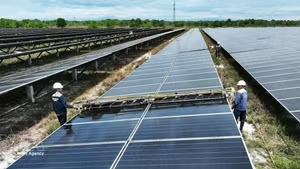
A green transition fosters socio-economic development without adversely affecting the environment, while enhancing ecosystem resilience and mitigating issues related to climate change and environmental pollution.
Viet Nam’s National Green Growth Strategy for 2021–2030, with a vision to 2050, emphasises transforming the growth model by greening economic sectors and applying a circular economy through the efficient and economical use of natural resources and energy, grounded in science and technology, digital applications, and digital transformation. It also underscores the development of sustainable infrastructure to improve growth quality, enhance competitive advantages, and minimise environmental impacts. Most sectors and industries have set targets to accelerate the green transition, particularly in areas such as agriculture, renewable energy, manufacturing, and services.
In practice, however, Viet Nam’s green transition is currently facing numerous challenges, the most significant of which is a lack of financial resources. Dr Ha Thi Hong Van of the Viet Nam Institute of Economics and World Economy, under the Viet Nam Academy of Social Sciences, noted that, according to World Bank estimates, Viet Nam will require approximately 368 billion USD over the period from 2022 to 2040 — equivalent to around 20 billion USD annually — to achieve its green growth and transition goals.
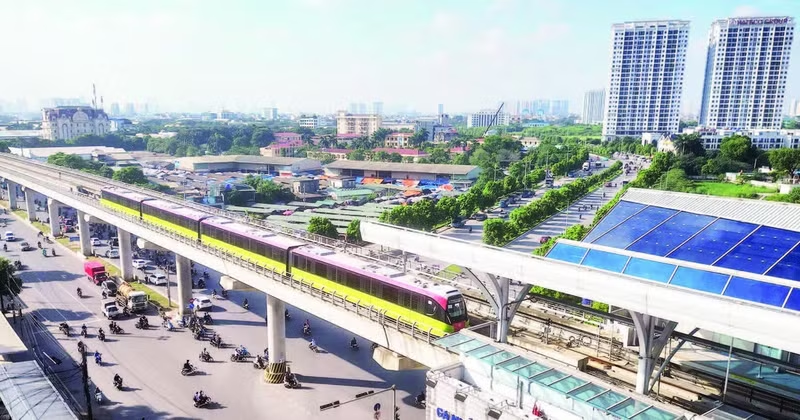
In addition, the country’s infrastructure has yet to meet the demands of the green transition. Many areas still lack modern waste collection and treatment systems; public transport remains limited and insufficiently integrated; renewable energy technologies have yet to develop strongly; and public awareness of environmental protection and the importance of the green transition remains incomplete.
Professor Truong Quang Hoc of the Institute of Natural Resources and Environment, Viet Nam National University, Ha Noi, pointed out that emerging non-traditional security issues related to nature conservation and environmental protection are also significant barriers. Viet Nam ranks 36th out of 177 countries with the highest levels of pollution globally. According to IQAir statistics, PM2.5 concentrations in Viet Nam exceed safe levels by 4.9 times, while plastic waste continues to have substantial impacts on socio-economic activities in coastal and marine areas.
Researcher Nguyen Thi Thanh Ha of Da Lat College highlighted another challenge: Viet Nam has yet to establish a unified system of indicators to measure the “greenness” of growth at both national and sectoral levels. Environmental data collection remains fragmented, insufficiently updated, and lacking transparency, while many policy evaluation reports remain formalistic and lack independent critical assessment.
Notably, Viet Nam’s key economic sectors are still largely high-emission industries, such as cement and steel production, coal-fired power generation, and textiles and garments. This makes it difficult to accurately determine which policies are effective and where the bottlenecks lie in advancing green growth.
To ensure an effective green transition, Dr Ha Thi Hong Van suggested that the Government should review and develop sets of criteria, standards, technical regulations, and guidelines for each sector and field. At the same time, a comprehensive legal framework is needed to support, encourage, implement, monitor, and enforce compliance with these standards.
According to Prof Truong Quang Hoc, Viet Nam has already issued a range of legal documents aimed at promoting sustainable development, disaster response, and environmental protection in line with green growth principles — without trading off the environment, culture, or social progress for economic gains.
Nevertheless, there remains a need to renew thinking and strengthen institutions and policies on green development and ecological protection to meet development and international integration requirements. It is essential to develop and implement green ecological models and lifestyles based on ecological thinking, ethics, and approaches; to restore and maintain environmental quality; and to conserve natural resources to support economic growth. Enhancing public awareness and training high-quality human resources for green development should go hand in hand with advancing science and technology, innovation, and international cooperation in the green transition.
The green transition cannot succeed without the active role of businesses, particularly innovative enterprises. It is therefore necessary to develop a support ecosystem for green start-ups built on three pillars: specialised business incubators, green venture capital funds, and networks of mentors and coaches with expertise in environmental technologies. In addition, public procurement policies for technology should be introduced to enable green enterprises to test and scale their solutions within Viet Nam before expanding internationally.
Transitioning to a green economy is essential to mitigate the adverse impacts of climate change and environmental pollution. It is a long and complex process that requires concerted efforts from the entire political system, the business community, and the public in order to achieve the goals of green transition and sustainable development in the future.