The world is undergoing complex geopolitical upheavals, especially in the Middle East. This reality underscores the urgent need to approach energy security from a comprehensive, long-term, and sustainable perspective.
Dr Nguyen Dinh Hoa of the Institute of Viet Nam and World Economy (under the Viet Nam Academy of Social Sciences) noted that Viet Nam is an open, developing economy that relies heavily on imported energy such as crude oil and coal. As a result, the shocks in international markets have directly affected domestic economic development.
Many experts emphasise that energy security is no longer solely an issue for the energy sector, it has become a strategic, cross-sectoral concern closely tied to macroeconomic stability and sustainable development.
Drawing on Viet Nam’s realities, Tran Quoc Khanh, former Deputy Minister of Industry and Trade, pointed to four structural challenges facing the country’s energy sector: an increasing dependence on imports, particularly coal and liquefied gas; bottlenecks in energy infrastructure, especially transmission grids, affecting system efficiency; the transition towards green, clean, and self-reliant energy requiring substantial resources in terms of technology, finance, and institutions; and Viet Nam’s commitment to achieving net-zero emissions by 2050, which necessitates a well-structured and synchronised energy transition roadmap.
Recent developments in the Middle East have shown that the global energy market is highly vulnerable, with sharp fluctuations in oil and gas prices, supply chain disruptions, and rising transport costs due to geopolitical risks. These factors not only increase production costs but also directly affect the energy security of importing countries, including Viet Nam.
In this context, the concept of energy security must be broadened, moving beyond ensuring sufficient supply at reasonable cost to encompass autonomy, flexibility, and sustainability of the system. In other words, it is not only about adequacy but also about being safe, stable, and resilient to external shocks.
Emphasising this point, Khanh stated that geopolitical volatility is not only an external shock but also a test of the resilience and self-reliance of the national energy system.
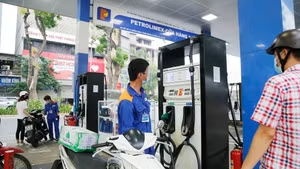
Therefore, energy security should be viewed more comprehensively, covering both supply and demand. Efficient use of electricity and petroleum can help to ease the pressure on the supply side, thereby enhancing the economy’s self-reliance.
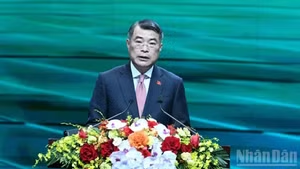
Sharing this view, Dr Ta Dinh Thi, Vice Chairman of the National Assembly’s Committee on Science, Technology and Environment, stressed that as dependence on imported primary energy increases, energy efficiency and conservation are key solutions for ensuring energy security in a self-reliant, flexible, and sustainable manner. At the same time, the transition to green energy should be established as a pillar of the national energy development strategy.
Promoting the energy transition not only demonstrates Viet Nam’s international commitments but also helps reduce reliance on imported fossil fuels, which are highly susceptible to geopolitical fluctuations.
At present, Viet Nam holds significant advantages in developing renewable energy, including solar and wind power, as well as other clean energy sources. Effectively harnessing these resources is therefore critical.
In addition, experts note that current volatility in fossil fuel markets is becoming a driving force behind the green transition, supporting the goal of achieving net-zero emissions by 2050.
Relevant agencies must swiftly and effectively implement the policies and measures that are already in place. Specifically, efforts must be intensified to implement the prime minister’s directive on strengthening energy conservation nationwide.
Alongside this, the rollout roadmap for E5 and E10 biofuels must be accelerated to gradually reduce dependence on fossil fuels and move towards a clean and sustainable energy system.
In a world marked by unpredictable fluctuations, proactive efforts to conserve electricity and petroleum and to promote the green energy transition will help safeguard national energy security and lay the foundation for rapid and sustainable socio-economic development.