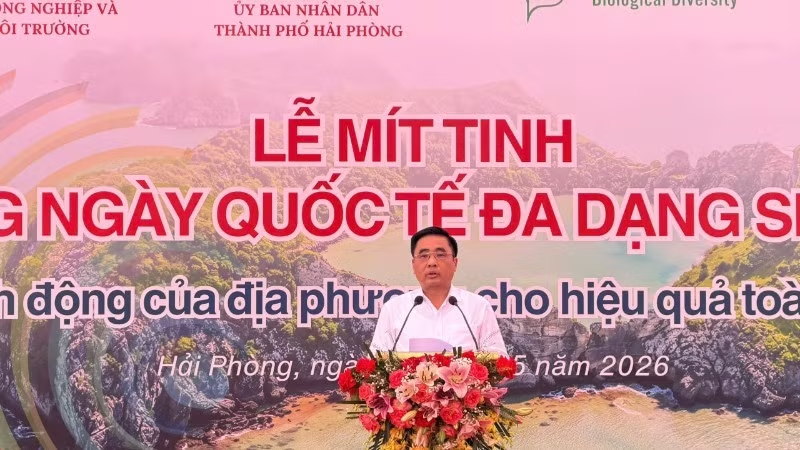
The event drew participation from central and local agencies, international organisations, research institutes, businesses, social organisations, and local communities.
With the theme “Local Action for Global Impact,” the 2026 International Day for Biological Diversity emphasised the message that global goals on nature conservation and the sustainable use of biodiversity can only be realised through concrete, well-resourced, and measurable actions at local levels, within each ecosystem and community.
This year’s theme carries particular significance as Viet Nam intensifies implementation of the National Biodiversity Strategy to 2030, with a vision to 2050, while also promoting the implementation of the Kunming–Montreal Global Biodiversity Framework (GBF) under the Convention on Biological Diversity.
This marks an important phase in translating international commitments into practical actions, integrating biodiversity into economic sectors, development planning, and social life.
Speaking at the ceremony, Deputy Minister of Agriculture and Environment Nguyen Quoc Tri affirmed that Viet Nam continues to demonstrate its role as an active and responsible member in implementing the Convention on Biological Diversity and the Kunming–Montreal Global Biodiversity Framework.
He also added Viet Nam is gradually institutionalising and concretising global goals into national strategies, planning frameworks, development plans, and programmes, with the consistent view that nature conservation must become a foundation for sustainable development, green growth, and improving people’s quality of life.

In recent years, Viet Nam has achieved significant results in nature conservation, ecosystem restoration, and promoting development in harmony with nature.
To date, Viet Nam has established a network of 180 terrestrial and marine protected areas, including special-use forests, marine protected areas, and wetland reserves, covering a total area of more than 2.67 million hectares. Forest coverage has remained stable at over 42%, making an important contribution to biodiversity conservation, water resource protection, climate change adaptation, and carbon absorption.
In addition, Viet Nam has continued to expand and enhance the international standing of its nature conservation designations, with numerous Ramsar sites, World Biosphere Reserves, and ASEAN Heritage Parks receiving international recognition.
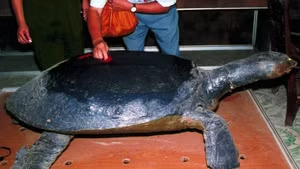
Alongside in-situ conservation, efforts to protect endangered wildlife species have also been strengthened through rescue programmes, conservation breeding, reintroduction into the wild, control of illegal wildlife trade, and habitat restoration.
The legal framework and inter-sectoral coordination mechanisms for biodiversity management continue to be improved in order to strengthen enforcement effectiveness and control violations. Biodiversity is also being integrated into national, sectoral, and local development strategies and planning, while financial mechanisms for nature conservation are being diversified.
Viet Nam has also actively promoted a whole-of-society approach to biodiversity conservation, increasing the participation of local communities, women, youth, businesses, and social organisations.
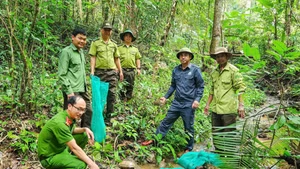
Numerous models of co-management of natural resources, sustainable livelihoods, and community-based conservation have demonstrated clear effectiveness in reducing pressure on natural resources and enhancing ecosystem resilience.
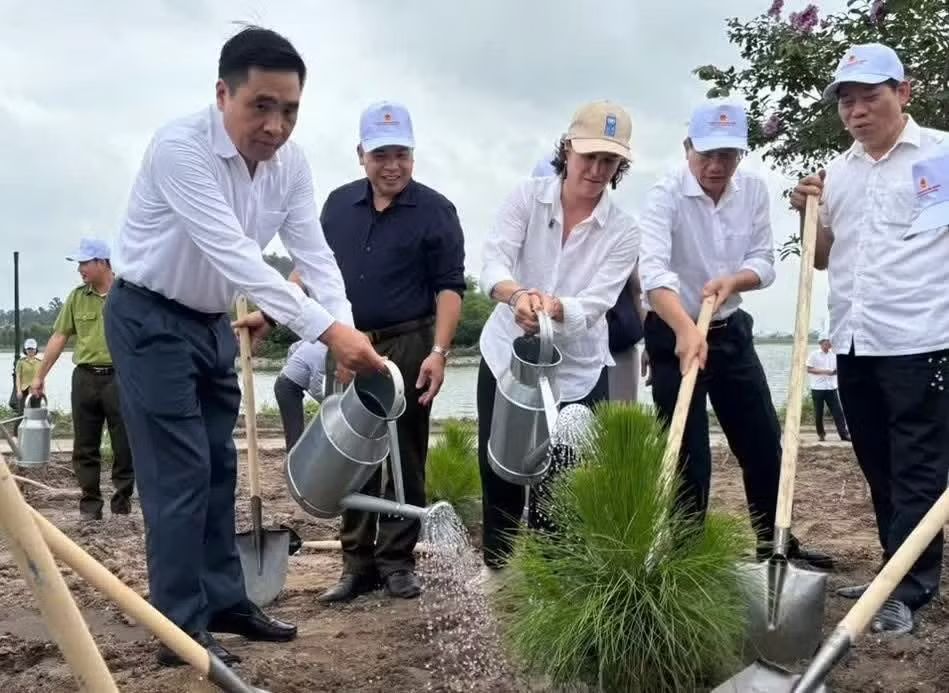
Deputy Minister Nguyen Quoc Tri stated that in the coming period, Viet Nam will continue prioritising stronger implementation at the local level, while enhancing capacity for grassroots authorities, management boards of protected areas, and local communities.
At the same time, greater emphasis will be placed on the application of science, technology, and digital transformation in natural resource management to improve biodiversity conservation effectiveness. Modern technologies such as geographic information systems (GIS), remote sensing, camera traps, environmental DNA (eDNA), unmanned aerial vehicles, and smart monitoring systems are gradually being deployed, contributing to improved monitoring, supervision, and management of natural resources.
Accompanying Viet Nam throughout this process, Francesca Nardini, Deputy Resident Representative of UNDP in Viet Nam, stated that UNDP is proud to cooperate with the Vietnamese Government and partners in strengthening institutions, mobilising financial resources for biodiversity, and promoting nature-based solutions.
According to her, current support activities focus on preparing Viet Nam’s Seventh National Report on the implementation of the Convention on Biological Diversity; restoring and sustainably managing forests, mangroves, wetlands, and coastal ecosystems; while also strengthening the participation of local communities in nature conservation efforts.