Positioning forestry sector in the new era
Over 40 years of renewal, Viet Nam’s forestry sector has achieved remarkable progress. By the end of 2025, the country’s forest area had reached around 14.8 million hectares, maintaining a stable forest coverage rate of approximately 42.02%.
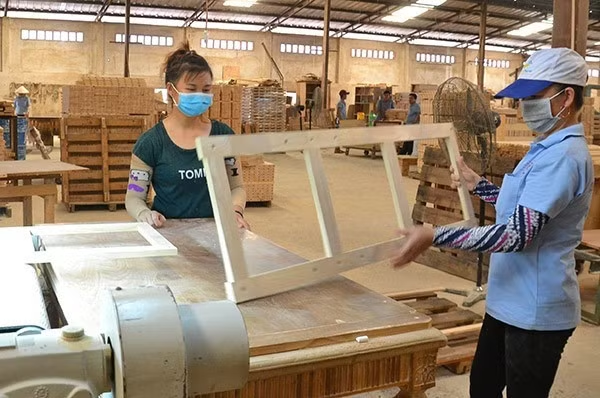
Alongside the greening of barren hills and degraded land, the forestry sector has emerged as a major export industry, with timber and forest product export value worth over 17 billion USD in 2025, placing Viet Nam among the world’s leading exporters and ranking first in Southeast Asia.
However, as the country enters a new development stage, the growth model based on intensive land use, low-cost labour, and export of raw products is now exposing ecological limitations.
With the target of achieving double-digit economic growth, the challenge is no longer merely expanding in terms of scale but rather shifting towards a new development model based on science, technology, and innovation, in which businesses play a central implementation role.
The forestry sector needs a strategic “mindset reversal”, transitioning from traditional forestry production to a platform economy and carbon economy.
Ecosystem services and the carbon economy
At the COP26, Viet Nam committed to achieving net-zero emissions by 2050. This commitment is not only an international responsibility but also a driving force for economic restructuring. Forests absorb and store vast amounts of carbon, while forest ecosystems create enormous CO2 reservoirs.
It is estimated that Viet Nam’s forests could reduce greenhouse gas emissions and increase carbon absorption by around 166 million tonnes of CO2 equivalent during the 2021–2030 period.
If these potential emission reduction results are successfully commercialised, it could generate average revenue of about 1.3 trillion VND per year. The clearest example is the Emission Reductions Payment Agreement (ERPA) in the North Central region signed with the World Bank (WB), under which Viet Nam transferred 10.3 million tonnes of CO2 and earned 51.5 million USD. This marks the beginning of a promising market.
Globally, forests are estimated to be worth between 50 trillion USD and 150 trillion USD, with commercial value from timber exploitation accounting for only a small share of about 5% to 20%. Most of the value lies in climate regulation and ecosystem services.
Viet Nam recognised this trend early through its forest environmental services payment policy.
Viet Nam’s forests could reduce greenhouse gas emissions and increase carbon absorption by around 166 million tonnes of CO2 equivalent during the 2021–2030 period.
During the 2017–2022 period, the Forest Protection and Development Fund collected 16,698 billion VND, becoming a sustainable financial source that significantly reduced pressure on the state budget.
To turn these figures into growth driving force and contribute to the realisation of double-digit growth targets of localities, the carbon credit supply chain, value added, and upstream basin co-governance strategies must be considered as three inseparable pillars that determine the sustainability of carbon credit trading strategies.
Innovation is the key driving force
The transition to an STI-led model cannot be only on paper but must be implemented through economic actors. Business restructuring is the practical entry point for the transformation of the development model.
The shift from pure manufacturing enterprises to platform enterprises, where value is created through organising, connecting, and exploiting ecological data, is a mandatory requirement.
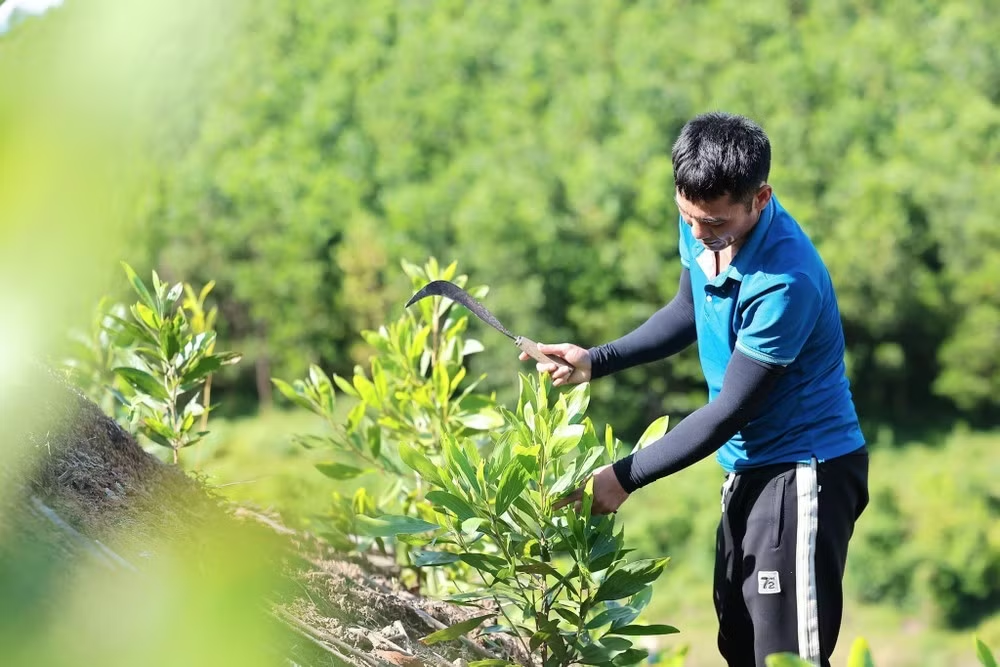
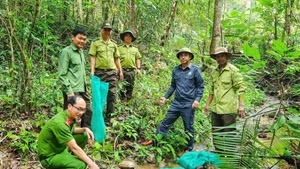
Alongside businesses, resident communities remain the most loyal “guardians” of forests.
Currently, more than 10,000 communities in Viet Nam are managing and using nearly one million hectares of forest. Resident communities are recognised as one of the seven categories of forest owners under the 2017 Forestry Law.
However, the legal status of the resident community has not been recognised as legal entities in the Civil Code, limiting their ability to mortgage or contribute forest-use rights as capital. Unlocking the productive potential of this force is essential to protecting forests at their roots.
At the same time, agroforestry must be regarded as a national landscape solution.
Agroforestry is no longer a separate space between agriculture and forestry, it has become a platform for harmonising land use policies.
With the potential of expanding to 3.8 million hectares nationwide, integrating timber trees on agricultural land and annual crops under forest canopies not only restores ecosystems and protects soil and water resources but also diversifies livelihoods, helping local people to remain closely connected to forests.
Vision for Viet Nam’s forestry sector
To implement the Net Zero 2050 commitment while contributing to the country’s double-digit growth targets, the forestry sector should focus on three breakthrough pillars.
First, the sector must complete the carbon economy institutional framework and upgrade forest governance. A solid legal system on forest carbon rights linked to forest ownership and use rights is needed.
Detailed regulations on carbon credit investment and trading, as well as measurement, reporting, and verification (MRV), should be introduced to create a secure framework for business to invest. Transparent co-management mechanisms involving forest owners, carbon emitters, independent arbiters, authorities, and media should also be established to ensure fair carbon credit trading and equitable benefit-sharing with indigenous communities.
Second, it is necessary to restructure the value chain and building core enterprises. According to the government's orientation, it is essential to design policy sandboxes for pioneering forestry enterprises with the capacity to integrate value chains.
Businesses should be encouraged to undergo digital transformation, develop material region management platforms and implement transparent timber traceability systems meeting the European Union’s VPA/FLEGT standards. The development of intensive large-timber plantations with sustainable forest management certification such as Forest Stewardship Council (FSC) and Programme for the Endorsement of Forest Certification (PEFC) should also be promoted to increase added value and help Viet Nam penetrate deeply into high-end global supply chains.

Third, agroforestry and the bioeconomy under forest canopies should be promoted. A national target programme or policy framework on agroforestry is needed to unlock the potential of more than 3.3 million hectares of forest land currently under temporary management by commune-level People’s Committees.
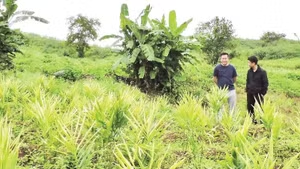
Value chains for “under-canopy economies”, including precious medicinal herbs such as Ngoc Linh ginseng and black cardamom, as well as ecotourism, should be developed. This represents a joint solution that prevents land degradation and reduces emissions while creating millions of jobs and increasing incomes for people in rural and mountainous areas.
Forests are not only resources but invaluable natural capital and the lifeblood of a nation. In the new era, the development of Viet Nam’s forestry sector should not be measured solely by timber export volumes, but by the richness of ecosystems, the level of technology and innovation embedded in each carbon credit, and the prosperity and smiles of forest keepers.
Implementing the Net Zero 2050 commitment is an opportunity for Viet Nam’s forestry sector to reposition itself on the global green economy map.
Following the Party's guidelines, with creative institutions, the commitment of platform enterprises and the strength of communities, Viet Nam’s forestry sector will certainly become a strong pillar, contributing positively to macroeconomic growth and helping the country realise its vision of becoming a developed, high-income nation by 2045.