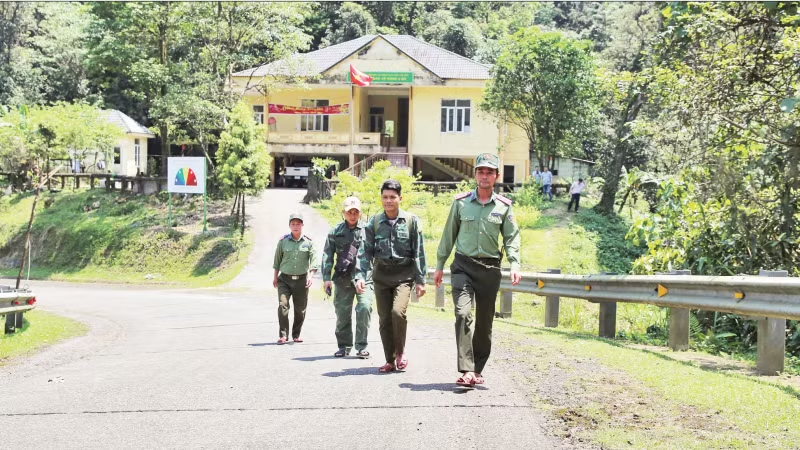
Despite the harsh weather, lack of electricity and weak mobile phone signals, the forest rangers continue steadfastly with their duties, helping preserve the tranquillity of a world natural treasure.
Quiet efforts to overcome hardships for forest protection
At an altitude of nearly 1,000 metres above sea level, on clear days the coast of Nhat Le in Dong Hoi can be seen with the naked eye from the summit of U Bo. At such moments, the forest and the sea seem to merge into one sweeping landscape.
The station headquarters, built in the style of a stilt house, emerged amid endless layers of forest. In the courtyard, the national flag fluttered proudly in the wind, inspiring both the forest guardians and travellers passing along the historic route.
Station chief Dang Quang Tuan said the station has 10 personnel, including public employees and contracted forest protection staff, responsible for managing 4,600 hectares of special-use forest and 127 hectares of protective forest. The area under the station’s protection has many access points connecting to villages, while the western branch of the Ho Chi Minh Trail cuts through it, creating favourable conditions for wrongdoers to enter the forest illegally, destroy woodland and hunt wild animals. Despite the harsh weather conditions on U Bo Peak, the forest protection force remains firmly stationed in the area, carrying out an average of 11 forest patrols each month, including arduous multi-day expeditions deep into the jungle.
Veteran forest ranger Tran Van Chuan explained that during long patrols, the team must carry heavy loads of rice, fish sauce, cooking utensils and hammocks, yet they still press on with walking sticks while climbing steep rocky slopes or making their way through dense forests. However, the greatest danger comes from unexpected weather conditions during patrols.
“In early July 2025, the station organised a five-day forest patrol as planned. On the fourth day, we encountered torrential rain that caused severe flooding in the middle of summer, blocking our route back. We were stranded in the forest for more than three days. All the food we had brought was gone, so we survived on wild vegetables and water taken from forest palm stems. When the stream levels finally subsided, the group managed to return to the station headquarters, exhausted from hunger and physical strain. Meanwhile, Station Chief Dang Quang Tuan was deeply worried that something might happen to us in the dangerous depths of the forest,” Chuan recalled of the unforgettable journey.
“Catching a signal” in the heart of the great forest
Due to the extremely high humidity, staff at the station have never been able to fully dry their clothes after forest patrols. Although the station buildings were solidly constructed not long ago, the walls have already begun peeling and deteriorating due to the damp conditions. As a result, Tuan has arranged for staff to take turns returning home to dry their clothes. “Fortunately, most of our homes are not too far away, so it is fairly convenient for us to return home to dry clothes and bring additional food supplies back to the station,” he said.
There is no access to the national power grid at the station. In the past, solar power equipment was installed, but the lack of sunlight and excessive humidity meant it functioned for only a short period before breaking down. The unit was later given a generator, yet due to fuel shortages it is used sparingly, mainly to charge torches and mobile phones.
There is no mobile phone signal at the station itself. Staff members have to carry basic vintage phones from one hilltop to another section of road in search of reception. After a long period of trial and error, they eventually discovered a “signal spot” on a hillside beside the road, around 200 metres from the station headquarters.
Station chief Dang Quang Tuan joked that once the signal was found, the station immediately established an “information centre” there, because moving just a few steps away would result in losing reception.
About 40 metres above the roadside stood a makeshift tent precariously erected on the slope, with several hammocks hanging inside. Tuan tied a mobile phone to a horizontal bamboo pole to search for a signal. He recounted that whenever the central authorities organise online sessions to study Party resolutions, Party members gather inside the tent, focusing intently on the mobile phone fixed at that very spot to attend the virtual meetings.
From this “information centre”, the station chief communicates with leaders of the Phong Nha-Ke Bang Forest Protection and World Heritage Centre, while staff members contact their families. When out in the forest there is little choice, but whenever he is on duty at the station, Tuan climbs up to the “information centre” several times a day to tie his phone to the bamboo pole in order to report to or receive instructions from agency leaders based in Phong Nha Commune.
Whenever they are not on patrol and begin to miss their families, many staff members climb to the tent to make phone calls, use their phones for entertainment or even spend the night sleeping in the hammocks there.
“In the middle of the vast Truong Son forests, we are fortunate that this spot can ‘catch’ a phone signal. It helps ease the loneliness for the staff here and makes our work more timely and effective,” Tuan said candidly.
Assisting travellers on Truong Son peak
Famed for its majestic scenery, pristine landscapes and mysterious beauty, the western branch of the Ho Chi Minh Trail running through Quang Tri Province has become increasingly attractive to both domestic and international travellers passionate about adventure riding and nature exploration. U Bo has gradually turned into a resting stop for travel groups passing along the route.
However, the road is extremely long and isolated, with no mobile phone signal, few inhabited areas and no roadside shops. Should travellers encounter problems such as running out of fuel, punctured tyres, or shortages of food and drinking water, they can quickly find themselves in serious difficulty. In such situations, many have sought assistance from the U Bo Forest Protection Station.
In mid-2025, station staff proactively began organising support services for travellers while combining them with awareness campaigns on protecting the heritage forest. The station erected English-language signboards along the roadside near its headquarters to make it easier for people and visitors to recognise the location.
Sometimes it is only a packet of instant noodles, a quickly made cup of coffee, a litre of petrol, or a tyre patching kit, yet the staff at U Bo Station have helped many travellers regain confidence and safely continue their journeys through the long and deserted stretches of road. Moved by the kindness of the forest guardians, many foreign visitors have left behind heartfelt handwritten messages.
Vicky, a visitor from United Kingdom, wrote that he was truly touched by the help from the station’s staff. He gave sincere thanks to them for their kindness and hospitality.
Dang Quang Tuan shared: “The money used to buy supplies for assisting travellers comes from the station members themselves. Recently, many visitors whom we helped have left us small cash donations in return. With that funding, we continue helping others whenever they are in need. Our actions may be modest, but they help spread a positive image of friendly and hospitable tourism in Phong Nha-Ke Bang National Park.”




![[In Pictures] Nui Chua Rock Park: A million-year-old outdoor museum of landforms on the Khanh Hoa coast](https://en-cdn.nhandan.vn/images/nyM650OGFWrOVWc-xajqNz57td8idIAL_VG9puyG2UZEKOnmq1DVlT1--ZclbO3z2WBaWZhbt6O3e8kjPZqJMWkfEz7RO9qhcwg8o8LQFK8/ndo-br-cao-nguyen-da-moi.jpg.avif)