A dual advantage: electricity and water
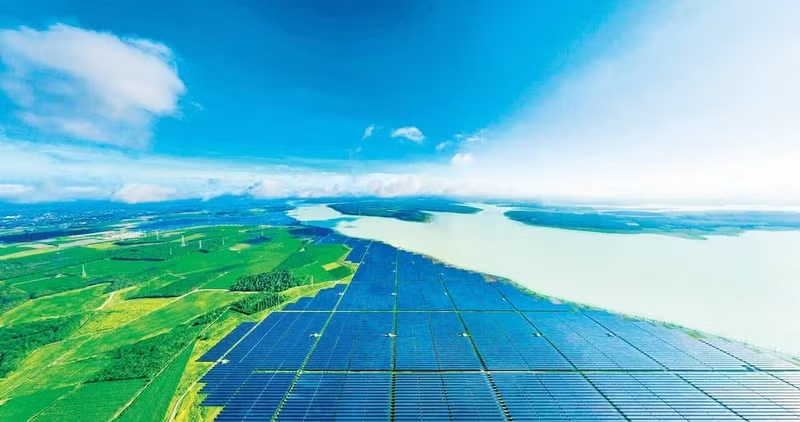
The floating photovoltaic (FPV) complex at Dau Tieng Lake – Viet Nam’s largest artificial reservoir, covering around 27,000 hectares – is a prime example of a new energy trend.
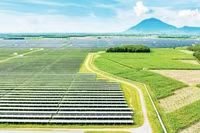
The Dau Tieng 1, 2 and 3 cluster, with a combined capacity of about 500 MWp (potentially up to 600 MWp), has been in operation since 2019, generating up to 1.56 billion kWh annually – equivalent to the electricity demand of all of Tay Ninh Province.
A new component, Dau Tieng 5 (450 MWp), is set to break ground this year, promising to add nearly 800 million kWh of clean electricity each year.
Notably, most of the panels are not installed on land but make use of the reservoir’s semi-submerged areas, which were previously left largely idle in economic terms. Rows of concrete pillars more than two metres high support the panels, designed to accommodate seasonal water level fluctuations. With water below and sunlight above, a new energy ecosystem is taking shape.
The story at Dau Tieng offers a vivid snapshot, yet the overall picture is far broader. As outlined in Power Development Plan VIII, Viet Nam’s total technical potential for FPV is estimated at around 77,000-77,400 MW – an energy reserve capable of reshaping the national power mix.
The country’s roughly 385 operational hydropower reservoirs alone could support around 7,500 MWp of FPV capacity. More broadly, utilising the water surface and semi-submerged areas of existing irrigation reservoirs could yield about 15,000 MW – more than three times the country’s current solar capacity.
Viet Nam has nearly 7,000 irrigation reservoirs and more than 700 hydropower reservoirs – a vast water infrastructure network. Among these, at least 13 reservoirs have surface areas exceeding 5,000 hectares, making them suitable for large-scale projects. With an average surface-area requirement of about 1.2 hectares per MW, covering even a small portion of these water surfaces could generate substantial electricity without using a single additional square metre of land.
Moreover, shading the water surface can reduce evaporation by 60-70%, offering meaningful benefits for irrigation management and water conservation during drought periods.
Viet Nam has seen rapid growth in solar power in recent years, with installed capacity exceeding 4,500 MW and surpassing its targets. However, most of this capacity is ground-mounted solar, which requires large land areas and strains land-use planning.
By contrast, water surfaces remain underutilised. FPV therefore offers an alternative pathway: no competition for land, efficient use of reservoir infrastructure, and strong alignment with Viet Nam’s natural conditions.
Thanks to the natural cooling effect of water, FPV systems can improve generation efficiency by around 5-9%. When combined with hydropower, FPV also enables flexible operation: solar power can be used during the day to conserve water, while hydropower can fill the gap at night or during periods of low sunlight.
Professor Pham Hong Giang, former Deputy Minister of Agriculture and Rural Development, noted that FPV development policy is well-founded, as it leverages the multipurpose functions of reservoirs, reduces dependence on coal-fired power, and cuts emissions.
Removing bottlenecks to develop clean power on water
At the strategic level, the development direction is clear. Power Development Plan VIII targets renewable energy accounting for 67.5-71.5% of total installed capacity by 2050. A new feature is the “self-production, self-consumption” mechanism, which allows organisations and businesses to invest in power generation for their own use. However, the 20% cap on surplus electricity sold to the grid and procedures for large-scale FPV projects remain notable constraints.
The government decree on direct power purchase agreements (DPPA) between renewable energy producers and large consumers opens up new offtake options for FPV projects. Nevertheless, this mechanism still requires time to be fully developed and effectively implemented. The key systemic bottleneck lies not in technology or electricity pricing, but in water surface use rights.
At present, reservoir water surfaces are managed by multiple entities: irrigation reservoirs are operated by irrigation authorities, while hydropower reservoirs are managed by power generation companies.
As a result, FPV projects must pass through multiple approval stages. Overlapping jurisdiction is an inevitable consequence: a single area may fall under irrigation planning, power planning, and even mineral planning. Even a minor conflict can delay a project.
In practice, many FPV projects spend years just trying to determine which authority has the power to lease the water surface. Meanwhile, investors must press ahead with surveys and project preparation, bearing significant financial risks.
To turn potential into reality, a coordinated approach is required: developing integrated planning maps, establishing clear mechanisms for water surface leasing, upgrading grid infrastructure, and promoting the deployment of energy storage systems.
At the same time, long-term issues such as panel recycling and ecosystem protection must be addressed to ensure a genuinely sustainable energy transition.
Nguyen Thi Thanh Binh, Vice President of the Viet Nam Energy Association, observed that geopolitical volatility is disrupting supply chains, forcing Viet Nam to accelerate its pursuit of energy self-reliance.
Despite FPV’s strong advantages, turning potential into actual capacity and ensuring sustainable operation require three key conditions: a stable policy framework, a grid capable of absorbing the additional output, and corporate governance aligned with modern market standards.
"FPV has enormous potential and is attracting significant business interest, but its development must go hand in hand with strict environmental protection requirements, ensuring no adverse impact on water quality and safeguarding the reservoir’s irrigation functions."
Nguyen Hoang Hiep
Deputy Minister of Agriculture and Environment