Opportunities and challenges in green transition
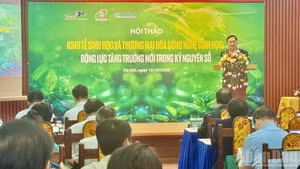
Associate Professor Dr Nguyen The Chinh, Vice President of the Viet Nam Association of Environmental Economics, said that prioritising the development of science and technology, particularly Resolution No. 57-NQ/TW of the Politburo, presents a favourable opportunity to implement the green transition, establishing a foundation for production and business activities to meet competitive green criteria in both domestic and international markets.
According to several experts, the National Green Growth Strategy for the 2021–2030 period, with a vision to 2050, which is being implemented along four key directions and supported by four major groups of solutions, will form institutional, scientific-technological, human resource, and financial foundations to serve the green transition process.
Greening the economy is identified as the central pillar, associated with innovating production models and restructuring the economy towards efficient use of energy, water, and materials; developing environmentally friendly industries, products, and services; and encouraging enterprises to invest in clean technology, renewable energy, and the circular economy.
However, achieving breakthroughs in science and technology development to promote green transition and sustainable development still faces numerous difficulties. Awareness of green transition remains limited in some aspects; inconsistencies persist among policies and laws in implementation, particularly regarding incentive policies, support mechanisms, and loan arrangements.
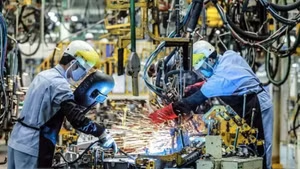
Notably, implementing the green transition requires technological changes, especially in production technologies, to generate high-quality, environmentally friendly products with economic efficiency. Yet, in the current context, production technologies in Viet Nam largely remain outdated.
From a practical perspective regarding small and medium-sized enterprises, Associate Professor Dr Dang Hoai Bac of the Posts and Telecommunications Institute of Technology pointed out that the greatest challenge is access to capital, as initial investment costs for clean technologies, sustainable production processes, and machinery upgrades often exceed the financial capacity of most enterprises. Around 90% of Vietnamese enterprises are not yet ready for the green transition journey due to capital constraints.
The business ecosystem shows a divide: on one side are large corporations and high-tech start-ups capable of accessing green finance; on the other are small and medium-sized enterprises (accounting for up to 97% of the total number of enterprises), many of which are still struggling with basic barriers. The prevailing mindset still views environmental investment as a compulsory cost rather than a strategic opportunity to enhance competitiveness and generate long-term value.
In addition, there remains a shortage of high-quality human resources to implement and operate new and modern technologies and digital transformation to meet the requirements of the green transition process. Many training programmes remain at the level of “introducing concepts”, without equipping learners with practical skills or international technical standards. This creates a significant gap between the demand for human resources for green transition and the supply capacity of the education, science and technology system.
Creating breakthroughs in science and technology development
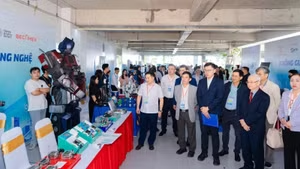
To address these limitations and create breakthroughs in science and technology development to promote green transition and sustainable development, Dr Nguyen Dinh Dap of the Viet Nam Academy of Social Sciences suggested building a robust innovation ecosystem linking the state, enterprises, research institutes, and universities.
At the same time, investment should be increased in research and application of advanced technologies, particularly in the circular economy, digital economy, and low-carbon technologies; international cooperation on technology transfer and mobilisation of green financial resources should also be strengthened.
Associate Professor Dr Dang Hoai Bac emphasised the need to promptly finalise and introduce controlled policy sandbox mechanisms for breakthrough green business models and technology applications. This would minimise legal risks for pioneering investors while creating a flexible legal corridor for initiatives to scale up.
Meanwhile, comprehensive reform of the higher education and vocational training system is required, along with the implementation of interdisciplinary training programmes in green economy, ESG governance, and environmental technology to address the shortage of high-quality human resources; scientific research should focus on core technology fields with potential, such as carbon capture and utilisation technologies, energy storage, and digital technologies serving resource governance.
The Ministry of Science and Technology has identified five strategic breakthroughs to ensure science and technology truly become the principal drivers of green transition and sustainable development, including: renewing management thinking; developing digital and data infrastructure; reforming financial mechanisms; developing the innovation ecosystem; and prioritising green transition.
Institutional breakthroughs are required, including the completion of detailed regulations and guidance documents related to the implementation of the Law on Science, Technology and Innovation. Breakthroughs in developing “green-digital” human resources are also needed, alongside attracting overseas Vietnamese experts and expanding international cooperation in clean, circular, and low-carbon technologies, in order to create breakthroughs in science and technology development that promote green transition and sustainable development.