Completing the legal framework and data platform
2025 marks a significant effort in completing the institution on resources, environment, and climate. In just one year, the Ministry of Agriculture and Environment submitted and issued 17 decrees, two resolutions of the government, two decisions of the Prime Minister, and 66 circulars, covering all key areas from land, minerals, water resources, and marine environment to greenhouse gas emission reduction. It demonstrates the urgent need of practice and the determination to build a legal framework for sustainable development.
A fundamental milestone is the digital transformation in land management. The "90-day campaign to enrich and clean up land databases" has helped synchronise 41.19 million out of 53.72 million land plots nationwide, with 20.55 million plots meeting standards. 32 out of 34 provinces and cities have established land plot identification codes. This is the primary data layer that helps to increase transparency in the land market, reduce disputes, and improve resource utilisation efficiency.
In the field of environmental protection, the rate of collection and treatment of solid household waste reached 97.28% in urban areas and 83% in rural areas; approximately 95% of industrial zones now have centralised wastewater treatment systems meeting standards; and 122 hazardous waste treatment facilities are operating nationwide, with a collection and treatment rate of about 98%.
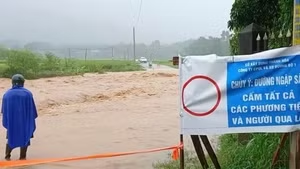
In 2025, Viet Nam accelerated the implementation of its climate change commitments, such as the Methane Emissions Reduction Action Plan by 2030, the National Climate Change Adaptation Plan, the development of the Fourth National Communication, and the Biennial Transparency Report (BTR1) to the United Nations Framework Convention on Climate Change, laying the technical and legal foundation for a roadmap towards Net Zero by 2050. However, the achieved results are not enough to mitigate the devastating impacts of climate change and the long-standing problems. In 2025 alone, natural disasters left 420 people dead or missing, while causing economic losses estimated at approximately 97,115 billion VND, with 21 typhoons and tropical depressions having occurred in the East Sea/South China Sea, a rare high level in many years. In addition, air pollution in major cities has not been sustainably improved.
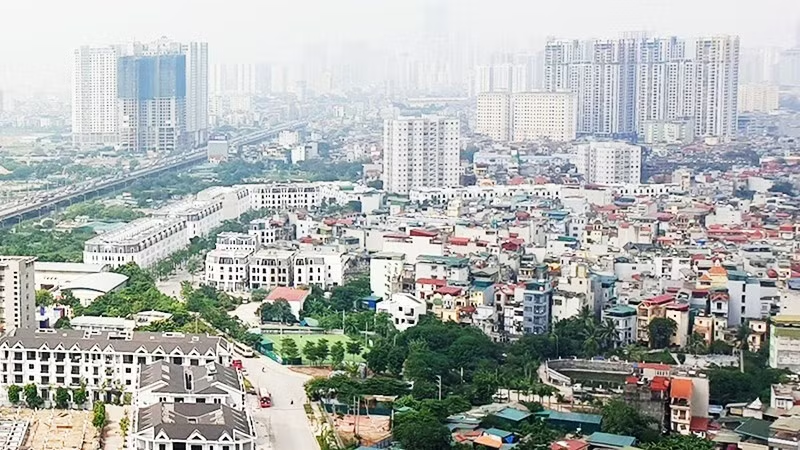
According to experts, urban pollution reflects a passive and hesitant approach in management. Each time there's a fine dust pollution episode in the city, the common response is to advise people to take self-protective measures rather than implementing sufficiently strong emission control measures. A clear action plan is needed, specifying when to crack down on construction dust, restrict traffic vehicles, or conduct surprise inspections of facilities causing emission sources, and coordinating with local authorities to deal with pollution sources. Furthermore, water pollution in many inter-provincial river basins remains complex; the management of solid household waste, the landfill rate remains high, at around 59%, and waste sorting at source is still slow to implement, indicating that the circular economy has not been widespread.
Regarding the Net Zero goal, the carbon market has not formed clearly. Many localities and businesses are still struggling to translate emission reduction targets into concrete projects.
Accelerating implementation of green transition
Entering the accelerated phase of green transition, the industry is required to organise implementation so that policies are put into practice, creating measurable changes in the environment, resources, and quality of life for the people.
First of all, it is necessary to improve mechanisms and policies to support green projects, promote green credit, and invest in environmentally friendly economic sectors. In water resource management — a field heavily impacted by climate change — the focus is no longer on handling situations when droughts, saltwater intrusion, or pollution occur, but rather on proactive long-term risk management basing on river basins. Building a National Water Resources Strategy to 2030, with a vision to 2050; completing water resource planning in major river basins, such as those of the Ma, Ca, Vu Gia-Thu Bon, Ba, and Kon-Ha Thanh river systems, is the foundation for managing water regardless on administrative boundaries, but according to the natural rules of flow and ecosystems.
Along with planning, plans, programmes, and projects to restore degraded, depleted, and polluted water sources will need to be built, such as pilot restoration projects in the Bac Hung Hai, Nhue, Day, and Ngu Huyen Khe rivers, not only to address pollution but also to find a sustainable water management model for key economic regions.
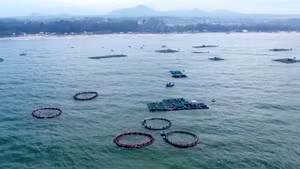
The implementation of the National Marine Spatial Planning and the Master Plan for Sustainable Exploitation and Use of Coastal Resources, along with the development of the Law on Marine and Island Resources and Environment (replacement), aims to create a more comprehensive and modern legal framework for marine governance. In addition, the implementation of the Viet Nam Marine Economic Sustainable Development Strategy, basic research and communication programmes on the sea and oceans until 2030, with a vision to 2045, will serve for development while conserving and preserving marine ecological space.
Regarding environmental protection, 2026 has been identified as the year to accelerate the shift from pollution treatment to prevention and sustainable management.
Regarding environmental protection, 2026 has been identified as the year to accelerate the shift from pollution treatment to prevention and sustainable management. The sector needs to improve the effectiveness of inter-sectoral and inter-local coordination in implementing the Environmental Protection Law 2020, especially in the management of solid household waste. The focus is on guiding the transformation roadmap to advanced environmentally-friendly waste treatment technologies, striving to reduce the rate of direct landfilling to below 30% by 2026. At the same time, environmental control in concentrated production, business, and service areas and industrial clusters needs to be prioritised.
Regarding air pollution, the industry needs to continue implementing the National Plan on Air Quality Management for the 2026-2030 period; strengthen management and control of monitoring quality, prioritising cities with poor air quality; and promptly publish monitoring results and warnings to the community. Furthermore, the National Environmental Monitoring Master Plan should be implemented, and areas with soil and serious pollution should be reviewed, identified, and addressed, with support provided to localities in dealing with residual pesticides.
Climate change response will continue to be the backbone of the entire action programme in 2026. The industry needs to focus on domesticating new international regulations on climate change, paying attention to issues related to carbon markets and carbon credit trading; implementing the National Climate Change Adaptation Plan; operating a national-level monitoring and evaluation system for adaptation activities; and integrating climate content into development strategies and plans.
According to Minister of Agriculture and Environment Tran Duc Thang, green development and climate change response are no longer the responsibility of a single sector but rather a cross-cutting requirement for the entire economy. All future development decisions must be linked to the goal of net zero emissions.