Institutional improvement
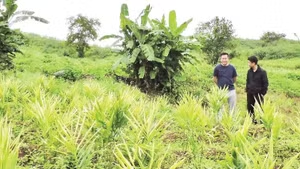
The 2021-2025 period is considered a pivotal stage in improving the institutional framework for resource management, environmental protection, and climate change adaptation. During the 13th National Congress, the system of policies and laws on land, minerals, marine resources, environment, and climate has been comprehensively reviewed, amended, and supplemented. Many important decrees and decisions have been issued, contributing to overcoming long-standing bottlenecks, strengthening decentralisation coupled with power control, enhancing the effectiveness of state management, and creating a legal framework for green development models, circular economy, and environmentally friendly investment.
According to Mai Van Phan, Deputy Director of the Land Management Department under the Ministry of Agriculture and Environment, after one year of implementing the Land Law, the land management sector has made a breakthrough in thinking, institutions, and management methods. The Land Law has clarified the rights of the State as the representative owner of land, clearly distinguishing between the right of representative ownership and the right of state management, creating a transparent legal framework for effective and efficient implementation.
Not only has the institutional framework been improved, but administrative procedures have also been reformed on a large scale, eliminating intermediaries, simplifying paperwork, and integrating related procedures. 46 out of 48 administrative procedures related to land have been thoroughly decentralised. In addition, the digital transformation of the land sector has initially formed a national land database, synchronising data and creating land parcel identification codes.
Along with land management, basic geological and mineral resource surveys continue to be implemented systematically, with the creation of large-scale geological maps for most of the mainland and sea areas. The licensing of mining operations, mine closure, and approval of mining rights fees are being carried out more strictly, thereby tightening discipline in the exploitation and use of non-renewable resources, minimising negative impacts on the environment, and ensuring long-term benefits for sustainable development.
In the environmental field, management thinking has clearly shifted from passive response to proactive prevention. The system of regulations on emission control, air quality management, greenhouse gas emission reduction, and ozone layer protection has been issued synchronously, creating a legal basis for controlling pollution at the source. Notably, urgent solutions to control water pollution in several key river basins have been implemented decisively, linked to specific action plans and clear responsibilities of all levels and sectors, including the issuance of Directive No.02/CT-TTg dated January 24, 2025, and the accompanying implementation plan.
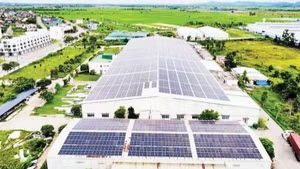
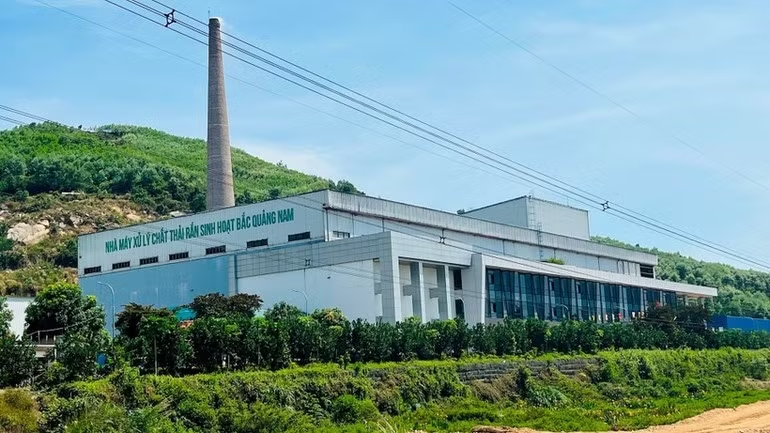
In addition, the management of household solid waste is gradually becoming more systematic, with solutions promoting source sorting, recycling, reuse, minimising plastic waste, and strictly handling violations according to the Law on Environmental Protection. Environmental control in industrial zones, production clusters, and concentrated business and service areas has been strengthened, linked to the preparation of the 2024 National Environmental Status Report (on the theme of urban and industrial zone environment) ...
Besides the achievements, the Ministry of Agriculture and Environment also frankly acknowledged some existing limitations: Forecasting, situation assessment, and policy responses to some emerging and urgent issues remain passive; some proposed solutions, while focused, have not been implemented decisively and have not met the requirements of reality. There are still overlapping legal regulations that create difficulties for people and businesses; administrative procedures in some areas remain complex and have not been amended or supplemented in a timely manner.
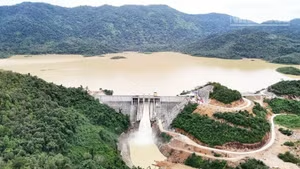
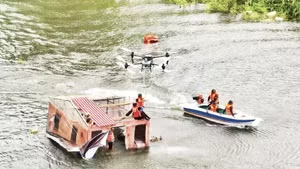
Addressing difficulties and obstacles for localities, people, and businesses in some cases has not received adequate attention, and has not been resolved definitively or on time. The capacity to respond to and mitigate the harmful effects of natural disasters and climate change has not met the requirements. The management and utilisation of natural resources, especially land and water resources, are not highly effective in some areas. Natural disasters are becoming increasingly extreme, unusual, and unpredictable, lasting for many days, covering a wide area, and exceeding historical levels. Many areas are continuously affected by various types of natural disasters, and many meteorological and hydrological values have exceeded historical values, leading to the inability of disaster prevention and mitigation structures and infrastructure to withstand them.
Creating a new momentum for the 2026-2030 period
According to Tran Duc Thang, Minister of Agriculture and Environment, entering a new phase, difficulties and challenges are expected to continue to increase, especially as the impacts of climate change become increasingly profound and complicated. Land, water, and forest resources continue to decline; environmental quality in some areas remains severely polluted. Implementing international commitments on reducing greenhouse gas emissions and promoting green growth places great demands on resources, data, science and technology, and management capacity.
Therefore, the goals set for the agriculture and environment sector in 2026 and the following years must continue to strengthen resource management, environmental protection, and enhance resilience to climate change; simultaneously, effectively utilise land, water, forest, and biodiversity resources...
The achievements during the 13th National Congress term have affirmed the pivotal role of the natural resources and environment sector in protecting development resources, controlling pollution, and responding to climate change.
In land and mineral resource management, the dissemination and training on new regulations of the Land Law and related decrees will be intensified; the adjustment of the national land use plan for the 2021-2030 period, with a vision to 2050, will continue to be perfected. In the field of water resources and environment, the sector will focus on developing the National Water Resources Strategy; while effectively managing and operating the water resources information system and database, and implementing programmes to restore degraded, depleted, and polluted water sources.
Regarding marine and island management, the National Marine Spatial Planning and the Master Plan for Sustainable Exploitation and Use of Coastal Resources for the 2021-2030, with a vision to 2050, continue to be implemented, creating a basis for the development of the marine economy associated with environmental protection, ensuring national defense, security, and sovereignty...
In responding to climate change, fulfilling international commitments at COP26 is identified as a key task. The National Climate Change Strategy to 2050, along with action plans on adapting to climate change, reducing greenhouse gas emissions, reducing methane emissions, and managing and eliminating ozone-depleting substances, continue to be implemented synchronously.
The achievements during the 13th National Congress term have affirmed the pivotal role of the natural resources and environment sector in protecting development resources, controlling pollution, and responding to climate change. More importantly, these achievements are laying a solid foundation for Viet Nam to enter a new phase of development with a longer-term, more sustainable vision, aiming for net-zero emissions by 2050, as committed to the international community at COP26.


![[In Pictures] Bridge columns and underpasses in Ha Noi begin to turn green](https://en-cdn.nhandan.vn/images/nyM650OGFWrOVWc-xajqN-rTZ68Rlmc1fiGJOhBRYHH_N-Xs0TE8Psnfce7ORTs-KVfoJaEblqjNufFrgeF3e2xFkGtLQVaXm04VcmMKBEkANUyiOkpz4zAuIKgydVrrfBxmGez0E_YJIag0u_Uil0E7jpuJXsIxeMmGjoY1-W4/1791863309074-2994714492692222878-2994714492692222878-adb9ff3f4175c70066ed8bb80cfbead9.jpg.avif)