That teaching was not merely an educational maxim, but also the starting point of a philosophy that, half a century later, the United Nations would define as sustainable development. As the nation welcomes the new spring and moves forward with the successful implementation of the Resolution of the 14th National Party Congress, that spirit once again burns brightly in the aspiration for green transformation. From the trees he planted during Tet in years past to the commitment to achieve Net Zero by 2050, it is a persistent journey undertaken by many generations so that the country truly becomes a nursery of talent living in a green and clean environment, for a strong, prosperous, and enduring Viet Nam.
From President Ho Chi Minh’s philosophy of “Planting trees – cultivating people”
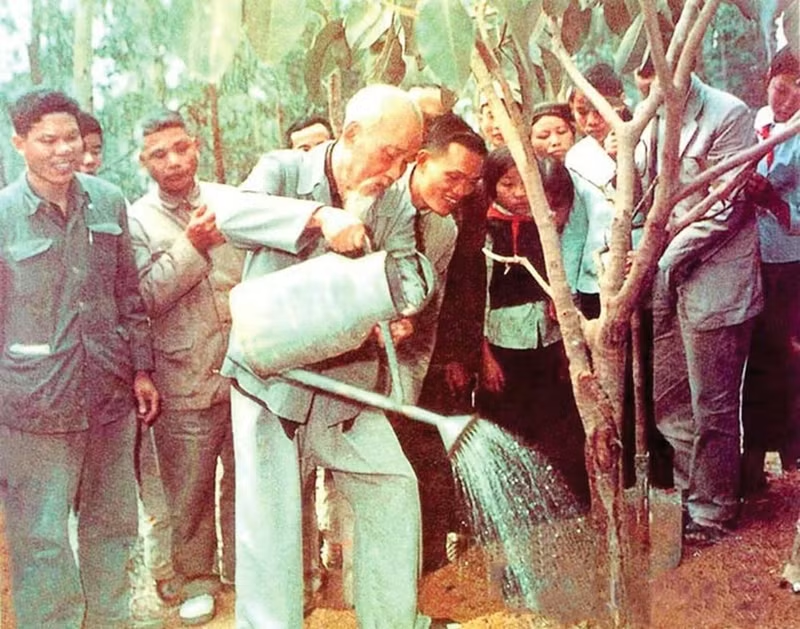
In the thought of President Ho Chi Minh, “planting trees” and “cultivating people” were never separate acts. He regarded transforming nature and nurturing people as two sides of the process of building a new society. The “Tree-Planting Festival” he initiated was not merely to obtain timber or shade, but fundamentally to “make our country’s landscape ever more beautiful” while creating a healthy living environment for the people.
His perspective went far beyond biological or conventional environmental protection concepts. “Cultivating people” meant fostering generations with sufficient virtue and talent to shoulder the revolutionary cause. And to “cultivate people” successfully, a green ecological “nursery” is indispensable. This dialectical relationship constitutes the core of sustainable development that the world today is striving to build and pursue. From calling for the organisation of the “Tree-Planting Festival” to urging each person to plant a tree, he sought to instil in every citizen a sense of responsibility towards the community and the environment — foundational qualities of the new socialist citizen.
Forty years of Doi Moi — A maturation in awareness for sustainable development
Looking back on 40 years of Doi Moi (1986–2026), we can see a clear shift in the Party’s direction and leadership regarding the relationship between the economy and the environment. If in the early years the foremost priority was to escape poverty and pursue growth at all costs, in later stages awareness of resource protection and adaptation to climate change became increasingly pronounced.
The report reviewing 40 years of Doi Moi clearly states that the Party has moved from a mindset of passive response to one of proactive prevention, control, and environmental restoration. The principle of not trading the environment for mere economic growth has become a guiding orientation in development strategies. It has been recognised that if we “cultivate people” in a polluted, resource-depleted environment, the price of development will become a burden for future generations.
The Party’s theoretical system through successive congresses, particularly from the 11th to the 13th, and now at the 14th Party Congress, has continually refined the characteristics of socialism in Viet Nam, in which “a prosperous people, a strong nation, democracy, equity, and civilisation” are always associated with a sustainable living environment. Environmental protection is now defined as one of the three principal pillars, placed on a par with economic and social development.
The Net Zero 2050 mission — A commitment to the future
At COP26, Viet Nam made a firm commitment to the world that it will achieve net-zero emissions by 2050. As Prime Minister Pham Minh Chinh affirmed, this is not merely a technical target of emission reduction but a “mission and commitment to action” of Viet Nam to the international community and to its own people.
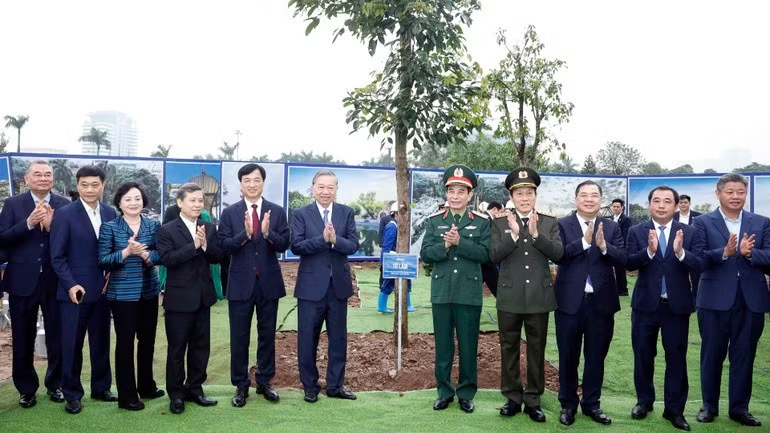
Net Zero is a green revolution requiring comprehensive change from energy structures and production models to the lifestyle of every individual. In the Political Report to the 14th National Party Congress, the Party continues to firmly pursue this path, considering green transformation a principal driver to lead the country into a new era — the era of the nation’s rise.
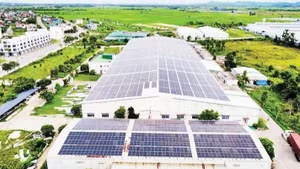
Realising Net Zero is the great continuation of Uncle Ho’s teaching. If in the past he called for “each person to plant a tree”, today we are implementing renewable energy projects, circular economy models, and biodiversity conservation on a national scale. Even in civil aviation — regarded globally as one of the most difficult and costly sectors to achieve Net Zero — Viet Nam has taken decisive action. Phu Quoc International Airport is set to become a green airport on green Phu Quoc Island, serving as a nursery for the world’s most advanced, modern, safe, and green technologies and fuels such as ACDM, PBN, SAF, EMAS, and XSIGHT, which are being studied and applied in preparation for APEC 2027. The ultimate objective remains building and safeguarding the Vietnamese “nursery” for future generations, so that those of 2050 may breathe clean air and live in a green and humane nation.
People at the centre of green transformation
In all strategic plans, people are always identified by the Party as the centre, the subject and the goal of development. Green transformation cannot succeed without “green people” — those with knowledge, skills and environmental ethics. Party General Secretary To Lam affirmed at the P4G Global Summit that Viet Nam will build three pillars: green technology, green institutions, and green human resources.
“For the benefit of a hundred years, cultivate people” in the Net Zero era means training generations of talent capable of mastering science and technology, applying AI and digital transformation to address global challenges. Investment in education and science and technology is affirmed as a top national policy and a strategic breakthrough.
More importantly, “cultivating people” also means revitalising social ethics and building a system of Vietnamese human values characterised by love for nature and responsibility to the community. The standards of patriotism, solidarity, self-reliance, responsibility, and creativity, as once emphasised by late Party General Secretary Nguyen Phu Trong, form the foundation for every citizen to become a green ambassador.
For the nation to truly become a nursery of talent
We stand on the threshold of the 14th National Party Congress with forecasts of a breakthrough development phase ahead. By 2045, Viet Nam is expected to become a developed, high-income country. However, such prosperity will only be meaningful if accompanied by happiness and sustainability.
For the nation truly to become a nursery of talent as President Ho Chi Minh wished in his lifetime, development policies must be inclusive and sustainable. Building a multi-layered social security system with universal coverage, ensuring that no one is left behind, is how we nurture every “sapling” in that nursery.
When the environment is protected and Net Zero is realised, Vietnamese children will grow up in a safe ecosystem, free from the fear of severe natural disasters or climate-induced diseases. That is the most ideal environment for their comprehensive physical and intellectual development.
The journey of endurance
The journey from the “Planting Festival” to “Net Zero 2050” stands as testimony to the consistency and foresight of our Party, faithfully inheriting the ideological legacy of President Ho Chi Minh. It is a journey without an end, for “planting trees” and “cultivating people” are enduring missions.
Beyond growth figures or technical targets, green transformation is, above all, a profoundly human journey — a journey for people. Every tree planted today, every green policy implemented now, is for the long-term benefit of future generations. Viet Nam will not only be a new global bright spot in economic development but also a model of harmony between development and nature, a radiant nursery of talented individuals with both integrity and vision in a sustainable green world. That is how we pay tribute to our beloved President Ho Chi Minh, and how we affirm Viet Nam’s standing on the map of world civilisation.