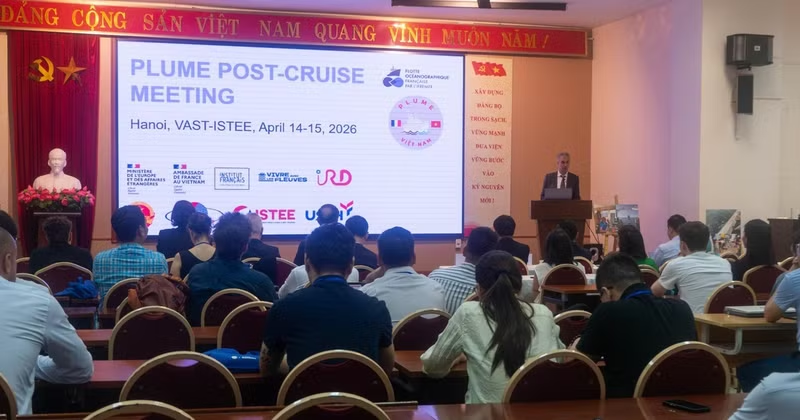
Hosted by the Viet Nam Academy of Science and Technology, the event brought together around 50 scientists to share early results from data analysis following the joint oceanographic mission conducted nearly two years ago.
The initiative, carried out in partnership with France’s Institute of Research for Development (IRD), focuses on the transport of river-borne materials and their impact on Viet Nam’s coastal ecosystems.
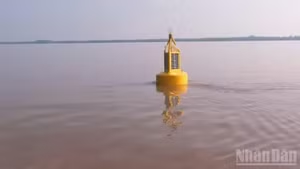
The Plume campaign took place from May 27 to July 10, 2024 aboard the French research vessel Antea. Its primary aim was to examine the movement of water, sediments and both natural and human-made materials, as well as their influence on coastal environments during the rainy season.
Speaking at the workshop, Professor Chu Hoang Ha, Vice President of the academy, highlighted that the programme’s early outcomes reflect strong coordination between research teams and contribute meaningfully to the Viet Nam–France comprehensive strategic partnership in science and technology.
French Ambassador to Viet Nam Olivier Brochet also welcomed the promising results, describing the project as a vivid illustration of the enduring and trusted partnership between IRD and its Vietnamese counterpart.
Participants noted the growing relevance of such research amid global challenges including climate change, ocean acidification and biodiversity loss. The programme has provided valuable insights into oceanography, marine physics and microbial ecosystems.
Spanning a 4,800km route from Hai Phong to Ho Chi Minh City, the expedition involved nearly 60 scientists, covering 77 monitoring stations and collecting over 100GB of data alongside more than 2,000kg of samples for analysis in Viet Nam and France.
![[In Pictures] Bridge columns and underpasses in Ha Noi begin to turn green](https://en-cdn.nhandan.vn/images/nyM650OGFWrOVWc-xajqN-rTZ68Rlmc1fiGJOhBRYHH_N-Xs0TE8Psnfce7ORTs-KVfoJaEblqjNufFrgeF3e2xFkGtLQVaXm04VcmMKBEkANUyiOkpz4zAuIKgydVrrfBxmGez0E_YJIag0u_Uil0E7jpuJXsIxeMmGjoY1-W4/1791863309074-2994714492692222878-2994714492692222878-adb9ff3f4175c70066ed8bb80cfbead9.jpg.avif)