Strategic policy frameworks and the shift towards sustainable power
The Party and State have clearly defined their commitment to the energy transition through numerous resolutions, decisions, and directives. These include the Politburo’s Resolution No. 55-NQ/TW dated February 11, 2020 on the orientation of the National Energy Development Strategy of Viet Nam to 2030, with a vision to 2045; Politburo’s Resolution No. 70-NQ/TW dated August 20, 2025 on ensuring national energy security to 2030, with a vision to 2045; Prime Minister’s Decision No. 1658/QD-TTg dated October 1, 2021 on the National Strategy on Green Growth for the period 2021-2030; Prime Minister’s Decision No. 500/QD-TTg dated May 15, 2023 on Power Development Plan VIII; and Prime Minister’s Directive No. 44/CT-TTg dated December 9, 2024 on some key tasks and solutions to accelerate the implementation of the National Strategy on Green Growth for the period 2020-2031.
According to data from the Ministry of Industry and Trade, the total supply of primary energy has achieved an annual growth rate of over 8% for several consecutive years. However, this progress has been accompanied by the rapid exhaustion of traditional energy sources and raw materials.
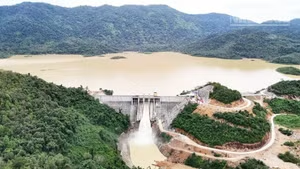
Over the past decade, the proportion of imported primary energy—including raw materials for thermal power—has climbed from 8.4% to 39.4%. Traditional sources such as hydropower have largely reached their full capacity, while raw material production industries have declined. This lack of supply capacity has led to local power shortages and rotational blackouts in various regions, impacting both industrial production and civilian livelihoods.
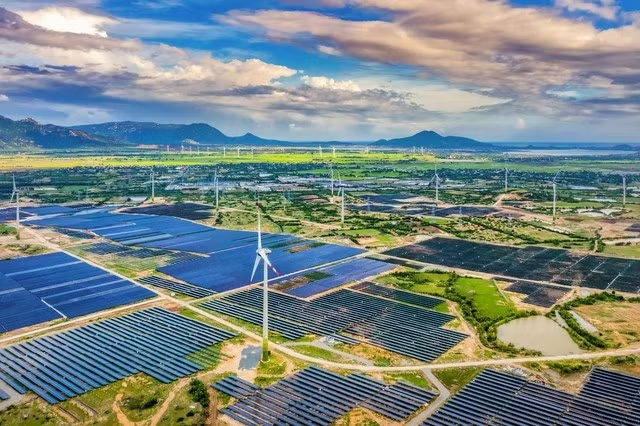
Meanwhile, energy management, operational capacity, and infrastructure have yet to meet modern requirements. Although renewable energy has developed rapidly, it is heavily concentrated in the central region. This, combined with difficulties in connecting to the national transmission grid, means these energy sources have not yet achieved their intended effectiveness. Certain strategies and plans regarding national energy development remain limited in scope and slow to adapt.
To date, electricity output from renewables accounts for only about 20% of the sector's total installed capacity. In the context of current economic, industrial, and urban development, the shift toward green energy within agencies and units carries strategic importance. Resolution No. 70-NQ/TW sets ambitious targets for 2030: renewable energy should account for 25% to 30% of total capacity, energy savings should reach 8% to 10%, and greenhouse gas emissions should be reduced by 15% to 35%.
Utilising renewable electricity contributes to energy security, cost savings, and self-reliance through stable, sustainable power sources.
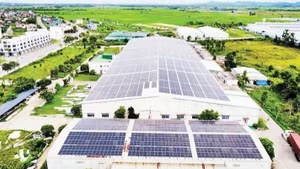
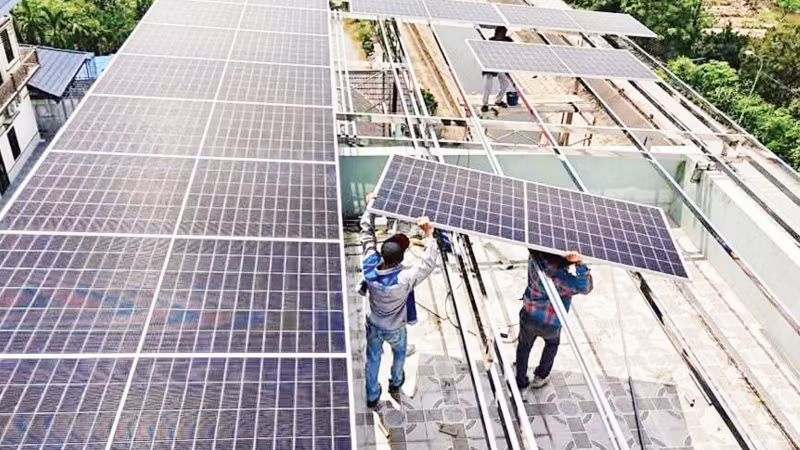
The concept of green energy transformation is well-established globally. In Viet Nam, many ministries, sectors, economic organisations, and private households have already installed rooftop solar panels. Major domestic groups such as Viet Nam National Industry - Energy Group (PetroVietnam), the Viet Nam Electricity (EVN), the Viet Nam National Coal and Mineral Industries Holding Corporation Limited (Vinacomin) have developed strategic plans for sustainable green transformation. These include solutions for energy efficiency, renewable integration, the "greening" of production facilities, and the provision of financial and technical support.
Utilising renewable electricity contributes to energy security, cost savings, and self-reliance through stable, sustainable power sources. These solutions are highly applicable for agencies and units, particularly those located in coastal areas or regions with abundant solar and wind resources.
Implementing pilot models and overcoming systemic barriers to transition
A report from the Health Department under the Ministry of Public Security reveals that most units in the sector still rely on the national grid. However, power sources in disadvantaged areas, border regions, and islands remain unstable, which complicates the execution of emergency tasks and urgent responses.
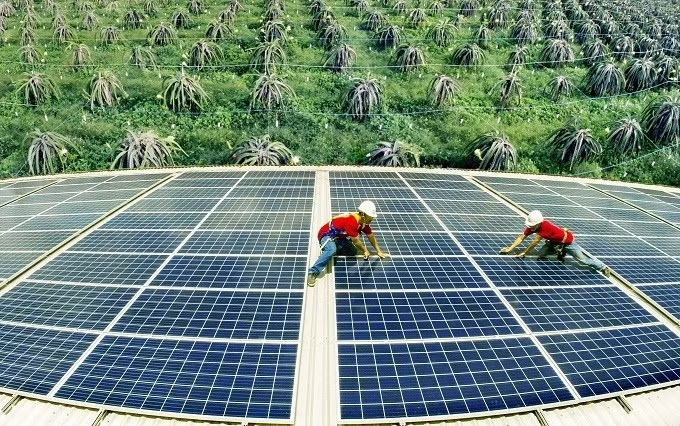
Several pilot models have already been implemented at the headquarters of the Ministry of Public Security’s Health Department, including a rooftop solar system with a total capacity of 42 kWp/day. A rooftop solar project at Hospital 199 is currently undergoing investment policy approval, with a projected capacity of 1,314,000 kWh/year.
These models prove that energy transformation is a viable direction for specialised sectors. Based on research and practical conditions, the Department of Construction and Barracks Management (Ministry of Public Security) has proposed three solution groups for the People's Public Security forces: planning and architectural design; energy and technical systems; and resource conservation. On average, each rooftop solar system is expected to recoup its investment within 5 to 6 years.
Transitioning from traditional sources to renewables is an inevitable, era-defining requirement for the entire economy.
In the short term, the Department proposes a pilot phase at key units (Phase I, 2025–2026) to achieve "Green Unit" status. Phase II (2027–2030) will involve a nationwide rollout, prioritising units with roof areas over 500m². Phase III (from 2030) will focus on integrated systems combining solar power with electric vehicles, smart lighting, and green data centres to create "Self-Sufficient Energy Zones."
According to Professor Tran Dinh Thien, an economist, transitioning from traditional sources to renewables is an inevitable, era-defining requirement for the entire economy. He noted that harnessing natural energy requires the establishment of green standards and a robust "operating system" for management and support. This must be backed by an action-oriented apparatus utilising modern technology such as Artificial Intelligence (AI), the Internet of Things (IoT), and Big Data.
Furthermore, replacing traditional energy with green alternatives must overcome challenges related to coordination, data sharing, and administrative simplification between ministries. Public investment for these projects is not yet prioritised, and mechanisms for mobilising private capital remain unformed. Finally, it is essential to develop a skilled workforce and unify regulations for grid connection to serve the nation’s long-term energy security objectives.

![[In Pictures] Bridge columns and underpasses in Ha Noi begin to turn green](https://en-cdn.nhandan.vn/images/nyM650OGFWrOVWc-xajqN-rTZ68Rlmc1fiGJOhBRYHH_N-Xs0TE8Psnfce7ORTs-KVfoJaEblqjNufFrgeF3e2xFkGtLQVaXm04VcmMKBEkANUyiOkpz4zAuIKgydVrrfBxmGez0E_YJIag0u_Uil0E7jpuJXsIxeMmGjoY1-W4/1791863309074-2994714492692222878-2994714492692222878-adb9ff3f4175c70066ed8bb80cfbead9.jpg.avif)