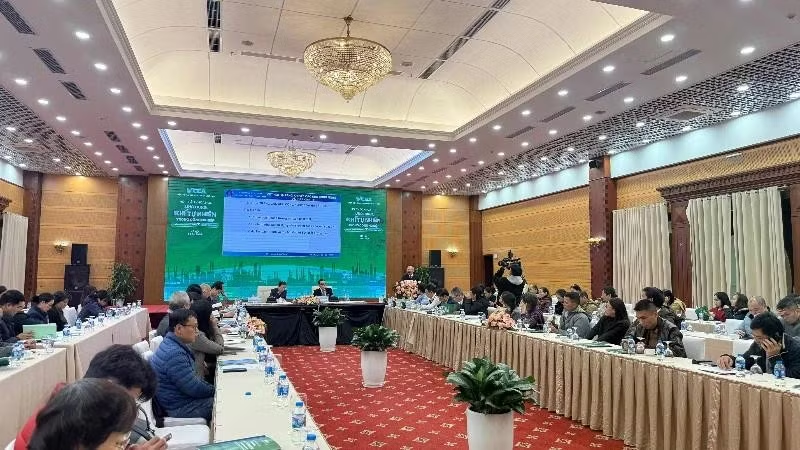
In implementing international commitments to reduce greenhouse gas emissions and moving towards the goal of net-zero emissions by 2050, on January 22, the Viet Nam Clean Energy Association organised the “Scientific Workshop: Applying Natural Gas in Industry – Towards Green Production and Net Zero 2050”.
According to energy outlook forecasts, from now until 2050, Viet Nam’s energy demand—particularly in the industrial, residential and service sectors—is expected to rise sharply, placing significant pressure on supply systems as well as on emissions reduction targets. Meanwhile, Viet Nam is among the countries most severely affected by climate change, with estimated economic losses equivalent to around 3% of GDP per year. This poses an urgent requirement to restructure the energy system in a greener, cleaner and more sustainable direction.
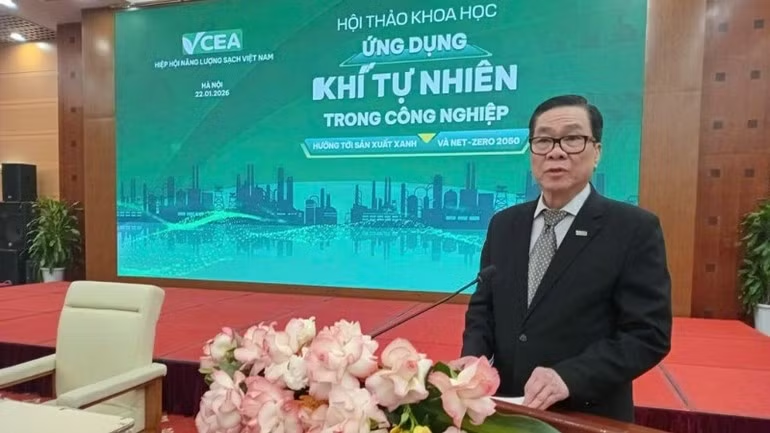
In his opening remarks, Mai Duy Thien, Chairman of the Viet Nam Clean Energy Association, stressed that the green energy transition is not only an inevitable trend but also a mandatory requirement in the context of increasingly stringent environmental standards. This transition will help fulfil international commitments, ensure energy security and enhance the competitiveness of the economy.
Natural gas is considered by many countries to be an important transitional fuel thanks to its lower emissions compared with coal and oil, while also meeting the requirements for improving energy efficiency. The application of natural gas in industrial production not only contributes to emissions reduction and environmental improvement but also creates conditions for integrating new energy technologies in the future.
At the workshop, Nguyen Khac Quyen, Deputy Director of the Institute for Industrial Strategy and Policy Research, provided an in-depth analysis of the orientation for the development and use of natural gas in industry during the 2025–2035 period. Accordingly, natural gas will continue to play a crucial role as a transitional fuel in the context of declining domestic gas output, while demand for gas for power generation and industry continues to increase. Viet Nam is currently exploiting gas from 26 oil and gas fields, with production peaking during the 2010–2015 period, but declining markedly since 2016. During the 2021–2025 period, gas output fell to only around 5.95–8.08 billion m³ per year. In response to this situation, Viet Nam has gradually expanded imports of liquefied natural gas (LNG), with the first cargo arriving at Thi Vai port in July 2023, marking a shift from a model largely dependent on domestic gas to one combining domestic and imported gas. Notably, by January 2026, Viet Nam had signed its first long-term LNG contract between PV Gas and Shell for the 2027–2031 period, providing a more stable foundation for gas supply in the medium and long term.
Alongside the achievements recorded, experts also pointed out a number of challenges, such as the decline of domestic gas sources, dependence on imported LNG, non-synchronised gas and LNG infrastructure, and policy mechanisms that have yet to keep pace with market development requirements. On this basis, the workshop agreed on an orientation to develop natural gas in a stable and flexible manner, linked to the development of LNG-to-power, expanding the use of gas in industrial sectors beyond electricity generation, and preparing conditions for integrating lower-emission fuels such as green gas and hydrogen.
In addition, the issue of connecting gas infrastructure with industrial parks and economic zones also attracted considerable attention from experts at the workshop. According to Dr Nguyen Quoc Thap, Chairman of the Viet Nam Petroleum Association, this is a key condition for promoting green industry and enhancing national competitiveness. Natural gas and LNG not only serve power and heat generation but are also essential feedstocks for many foundational industries. However, at present, gas infrastructure mainly serves power generation and fertiliser production, while direct connections to industrial parks remain limited.
To address this, experts proposed synchronised development of gas–power–industrial park infrastructure; deployment of flexible connection models such as direct pipelines, satellite LNG systems and integrated energy hubs; and inclusion of gas infrastructure in the list of essential infrastructure for industrial parks and economic zones, accompanied by PPP mechanisms (public–private partnership investment) and long-term gas purchase contracts.
With the participation of policymakers, leading experts and the business community, the workshop is expected to deliver significant scientific and practical value, helping to disseminate feasible solutions and promote the application of natural gas in industry, thereby realising Viet Nam’s goals of green production and Net Zero 2050.