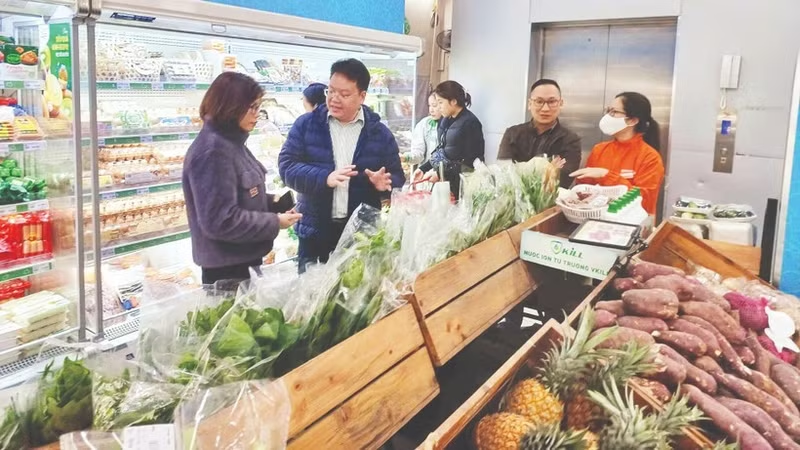
Businesses and traders face difficulties
Under Resolution No. 22/2025/NQ-HDND, from January 1, 2026 markets and convenience stores are no longer allowed to provide free non-biodegradable plastic bags; hotels and tourist areas are prohibited from circulating and using single-use plastic products.
At the same time, the resolution requires online retailers to reduce the use of plastic packaging and plastic shock-absorbing materials, or to retrieve such packaging and materials to prevent them from leaking into the environment.
These measures are the first steps in Ha Noi’s roadmap to reduce plastic waste and protect the capital’s environment, moving towards a ban on single-use plastic products and non-biodegradable plastic packaging at markets, convenience stores and city-affiliated agencies, organisations and mass organisations by 2028, and a halt to the production and import of single-use plastic products and non-biodegradable plastic packaging from January 1, 2031.
After more than a week of implementation, surveys show that many accommodation facilities have started to comply with the ban on single-use plastics, but continue to face numerous difficulties.
Dang Trung Thanh, a hotel owner in Cua Nam Ward, Ha Noi, said that to replace single-use items, hotels can switch from plastic-tipped cotton buds to bamboo ones, and replace small toothpaste tubes with larger, refillable containers. However, items such as toothbrushes and shower caps are very difficult to source in alternative forms.
At traditional markets and convenience stores, changes remain limited. According to several traders at Linh Lang Market, Ba Dinh Ward, although they have been informed and educated about the policy, the absence of penalties and a lack of alternative products mean that plastic bags are still being used to pack goods for customers.
In convenience stores, the use of plastic products, especially plastic bags for packaging, remains widespread.
Hang, manager of a convenience store on Hang Trong Street, said: “We have been instructed not to provide free plastic bags when selling goods and have started to comply. Many customers, however, are not enthusiastic about environmentally friendly alternatives such as cups and straws, as they are harder to use, more fragile and come at an extra cost.”
Although not yet mandatory, some supermarkets and stores in Ha Noi have proactively stopped offering free non-biodegradable plastic bags. Even so, relatively few shoppers are choosing these alternatives.
According to Nguyen Van Quy, Head of the Solid Waste Management Division at the Ha Noi Department of Agriculture and Environment, reducing plastic emissions is a long-term process that requires persistence and strong determination. The city, he said, is committed to implementing the policy decisively and seeing it through.
The Ha Noi Department of Agriculture and Environment has established inspection teams. In the coming period, the city will publish lists of compliant and non-compliant establishments, promote the replication of plastic-waste-free models in residential areas, schools, markets and shopping centres, gradually spreading environmentally friendly lifestyles, while stepping up inspections and strictly handling violations.
Coordinated and effective solutions needed
As many accommodation facilities and restaurants report difficulties in sourcing alternative products, several opinions suggest that the problem is not a lack of solutions, but rather the absence of effective channels connecting suppliers with users, as well as insufficient State support policies.
According to leaders of BUYO Technology Solutions Company, the firm’s 100 per cent bio-based plastic products—made entirely from natural materials and winner of the top prize at Techfest 2023—fully meet technological and production requirements to replace single-use plastic products.
In recent years, the company has supplied biodegradable packaging and single-use bio-products to businesses such as Marou Chocolate Joint Stock Company and the Com Tam Moc restaurant chain.
In practice, supplying a full set of single-use products to the Trang An tourist site has resulted in costs rising by around 30–50 per cent, a factor that makes many establishments cautious about switching.
For Ha Noi’s plastic reduction regulations to truly take hold, there is a strong need for activities that connect product suppliers with hotels, accommodation facilities, restaurants and supermarkets.
When supply meets demand, the transition to environmentally friendly products will be smoother and faster.
One business also expressed hope that Ha Noi’s policy would be replicated in other localities. “Recently, Ho Chi Minh City authorities have shown interest in introducing environmentally friendly plastic products to Con Dao, where plastic waste treatment conditions remain limited. When the State takes the lead in using environmentally friendly products, it not only delivers tangible environmental benefits but also opens up development opportunities for domestic enterprises,” the company said.
According to experts from the Viet Nam Academy of Science and Technology, restricting single-use plastic products requires clear distinctions between genuinely disposable items and those that can be reused or recycled. The crux of reducing plastic emissions lies in waste separation at source.
If non-biodegradable plastic bags are properly separated, they can still be used as raw materials for recycling or waste-to-energy incineration. Replacing single-use plastics therefore needs to go hand in hand with policies that invest in scientific research, large-scale production of bio-based plastics, and the completion of waste treatment infrastructure.