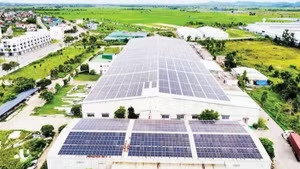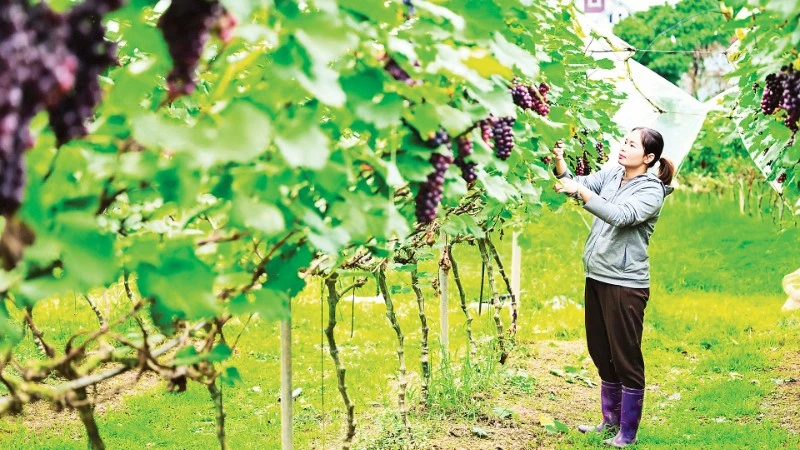
In practice, raw material zones not only help localities proactively secure inputs for production but also serve as a “passport” for products in international markets.
From fields to a sustainable ecosystem
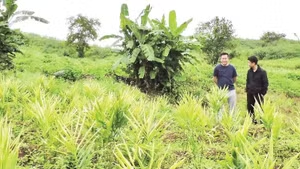
An Giang is one of the localities participating in the project to develop concentrated raw material zones, with the goal of building one million hectares of high-quality rice. In 2025 alone, the area participating in the province’s model exceeded 44,000 hectares.
Leaders of the provincial Department of Agriculture and Environment said that with this scale, the agricultural sector can develop large-volume, high-quality raw material zones, thereby attracting enterprises to invest, link up, and consume products.
At present, average rice yields in An Giang have increased from 5.8 to 6.5 tonnes per hectare, equivalent to a 12% rise; the average household income in project areas has increased from 38 million to 47 million VND per person per year. The project has also created 4,500 new jobs (1,500 permanent and 3,000 seasonal), mainly in the operation of pumping stations, preliminary processing warehouses, and mechanisation services.
Bui Van Thanh, a member of Tay Phu Agricultural Cooperative, said that by participating in production within raw material zones, he and other farmers no longer worry about being forced to sell at low prices, as the cooperative represents them in signing contracts with companies, enabling their clean rice to be sold at prices higher than the market average for similar products.
Dong Thap Province was selected to participate in the Ministry of Agriculture and Environment’s project to develop sustainable fruit raw material zones. In the four years of implementation, fruit-growing areas have expanded rapidly. The application of science and technology, especially high technology, in production has been prioritised, contributing to higher productivity and efficiency in agricultural restructuring and new rural development.
At present, Dong Thap’s fruit raw material zones cover nearly 134,500 hectares (an increase of 10,200 hectares compared with 2022), with an estimated output of 2.5 million tonnes (an increase of more than 312,200 tonnes). In localities within the pilot scheme areas alone, the total fruit-growing area has reached nearly 107,000 hectares (up by 7,200 hectares).
The province is continuing to plan and convert land with low-quality rice and fruit crops to specialised cultivation of specialty fruit trees, adapting to climate change and the increasingly severe saltwater intrusion seen in recent years, step by step improving agricultural production efficiency and farmers’ livelihoods.
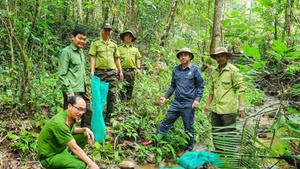
Not only rice and fruit-growing areas have been developed; plantation forest raw material zones have also seen clear changes. In Hue City, muddy roads during the rainy season have been replaced by 11 forestry roads with a total length of 21 km, becoming vital arteries connecting the large-timber plantation forest value chain among farmers, cooperatives and enterprises. As a result, the forest area of Hoa Loc Sustainable Forestry Cooperative in Hung Loc Commune has doubled to 800 hectares. Cooperative Director Ho Da The shared that the project has created roads enabling people to travel and transport goods more easily.
Scaling up the model
According to assessments by the Department of Cooperative Economy and Rural Development, in Phase 1 of the scheme, economic value per hectare increased by 20–25%, while farmers’ incomes rose by 5–10% per year. The agricultural sector aims to expand key raw material zones across five regions in 13 provinces participating in the pilot scheme to nearly 1.83 million hectares by 2030 (compared with nearly 167,000 hectares in the 2022–2025 period), with all areas covered by production and consumption linkage contracts with enterprises.
Tran Thanh Nam, Deputy Minister of Agriculture and Environment, said that the ministry invested more than 400 billion VND in transport infrastructure in Phase 1 to implement a 60,000-hectare raw material zone project practising green and sustainable agriculture, while also promoting crop and livestock insurance through social security policies. At the same time, good agricultural practices have been applied for traceability while infrastructure investment has been carried out in a coordinated manner, from transport to irrigation.
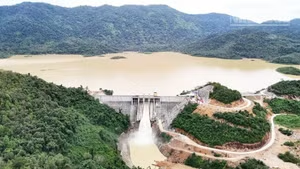
After four years of implementation, units have invested in building many infrastructure components, including more than 141 km of internal roads, nine bridges, 11 regulating culverts, five pumping stations, 6 km of irrigation canals, and the completion of four timber collection yards and two coffee storage warehouses. Once operational, these facilities have reduced transport costs by 20–35% compared with before, halving transport time, increasing rice yields in pumping station investment areas from 5.8 to 6.5 tonnes per hectare, reducing post-harvest losses by 25–30%, and creating favourable infrastructure for large-scale production.
Ngo Cong Thuc, Vice Chairman of the An Giang Provincial People’s Committee, said that current production models are still largely extensive, expanding area and relying on physical inputs (labour, capital, materials) and natural resources, resulting mainly in volume rather than high value or income. Production has not yet been effectively linked with processing and consumption stages. Products are mainly sold raw at low prices and are often subject to price pressure during bumper harvests, while the number and capacity of enterprises undertaking product off-take models remain limited and are not commensurate with rice output in the region. Therefore, increased investment is needed for localities.
From practical experience in the raw material zone project, Huynh Van Thon, Chairman of the Board of Directors of Loc Troi Group, said that after four years of implementing the scheme, his greatest aspiration is to build an ecosystem in which all stakeholders become integral components of the value chain, rather than merely partners in production linkages as at present.
Standing alongside farmers, Ngo Tuong Vy, Director of Chanh Thu Fruit Company Limited in Dong Thap Province, also expressed concerns that limited infrastructure is hindering Dong Thap’s specialty fruits. For example, for durian to reach consumers, cooperatives must hire four types of transport vehicles — motorbikes, three-wheeled vehicles, boats, and trucks — raising transport costs and extending delivery time, which reduces quality and disadvantages both producers and consumers. Therefore, to scale up the project, she proposed increased infrastructure investment and accelerated granting of planting area codes for raw material zones that fully meet technical standards.
To support cooperatives, the National Agricultural Extension Centre has organised more than 200 training courses on policy guidance, with a total of 5,680 participants, scaling up community agricultural extension groups and enhancing their capacity. It has also organised 51 study tours to raw material zones with 1,265 participants, enabling agricultural extension officers and community extension group members to access, observe, and learn from advanced, effective agricultural production models.
The agricultural sector has now launched Phase 2 of the project. Le Duc Thinh, Director General of the Department of Cooperative Economy and Rural Development, said that in the next phase, units will focus on developing raw material zones based on value chains that meet standards and requirements of agricultural processing plants and markets.
In the context of integration, maintaining and developing raw material zones is not merely a technical requirement of production but a strategic choice for sustainable agricultural development. In other words, raw material zones are the foundation of modern agriculture.

![[In Pictures] Bridge columns and underpasses in Ha Noi begin to turn green](https://en-cdn.nhandan.vn/images/nyM650OGFWrOVWc-xajqN-rTZ68Rlmc1fiGJOhBRYHH_N-Xs0TE8Psnfce7ORTs-KVfoJaEblqjNufFrgeF3e2xFkGtLQVaXm04VcmMKBEkANUyiOkpz4zAuIKgydVrrfBxmGez0E_YJIag0u_Uil0E7jpuJXsIxeMmGjoY1-W4/1791863309074-2994714492692222878-2994714492692222878-adb9ff3f4175c70066ed8bb80cfbead9.jpg.avif)