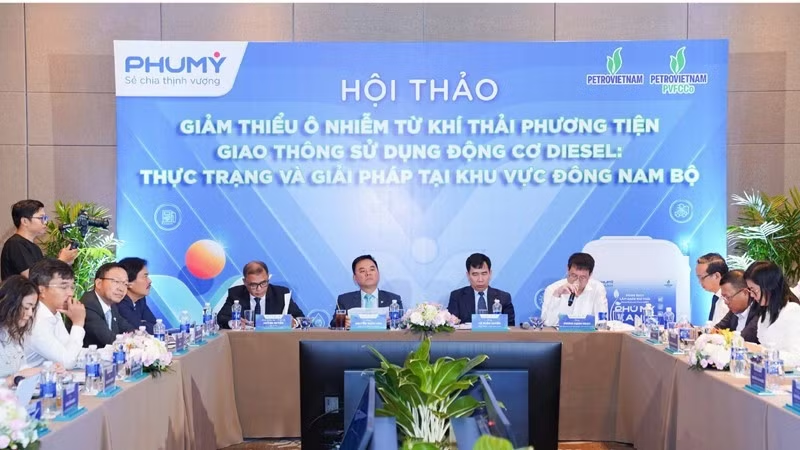
Speaking at the event, Le Xuan Huyen, Deputy General Director of Petrovietnam, stressed that as a key player in the national energy and chemical industries, the group regards supporting Viet Nam’s green transition as a long-term and consistent responsibility.
Its continued investment in technological innovation and the development of cleaner, environmentally friendly products—including solutions to cut NOx emissions from transport engines—represents a practical contribution to the Government’s strategic orientation, including the commitment to achieve net zero by 2050.
He confirmed that Petrovietnam would continue to research, expand production and supply products meeting international standards, helping localities—particularly Ha Noi, Ho Chi Minh City and provinces in the Southeast region—better control air pollution and improve citizens’ quality of life.
The workshop provided a platform for experts to examine current levels of emissions from transport, particularly diesel engines and hazardous chemicals; share lessons from major global cities; and review State policies and roadmaps for emission control. Participants also discussed modern technological solutions such as exhaust treatment systems and emission-reduction fluids for diesel engines.
Vice Chairman of Ho Chi Minh City People’s Committee Bui Minh Thanh noted that the Southeast region, as the country’s economic hub, faces intense pressure from transport emissions due to its dense logistics, interprovincial transport and waterway activity.
Scientific analysis shows that diesel-powered vehicles are major sources of PM2.5, NOx and SOx—pollutants directly affecting public health and urban environmental quality.
Ho Chi Minh City will therefore prioritise four areas: improving regulations and emission standards; promoting clean technologies and environmentally friendly fuels; developing a green logistics ecosystem; and mobilising social resources and regional cooperation for interprovincial emission-control programmes, including public–private partnerships in environmental technologies.
Experts warned that air pollution in major cities remains serious, with some areas occasionally reaching unhealthy levels. Limited public awareness, non-compliant construction practices, littering and open burning of agricultural waste, along with unfavourable weather conditions, continue to hinder air-quality management. They emphasised the need for timely legal documents and guidelines to reduce emissions.
According to Tran Vinh Loc, Deputy Director of the PVFCCo Centre for Applied Research, Viet Nam is accelerating its emission-control roadmap. From January 1, 2022, all newly manufactured and imported cars must meet Euro 5 standards, while vehicles produced from 2017 will be required to meet Euro 4 standards from January 1, 2026.


![[In Pictures] Bridge columns and underpasses in Ha Noi begin to turn green](https://en-cdn.nhandan.vn/images/nyM650OGFWrOVWc-xajqN-rTZ68Rlmc1fiGJOhBRYHH_N-Xs0TE8Psnfce7ORTs-KVfoJaEblqjNufFrgeF3e2xFkGtLQVaXm04VcmMKBEkANUyiOkpz4zAuIKgydVrrfBxmGez0E_YJIag0u_Uil0E7jpuJXsIxeMmGjoY1-W4/1791863309074-2994714492692222878-2994714492692222878-adb9ff3f4175c70066ed8bb80cfbead9.jpg.avif)