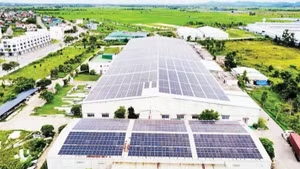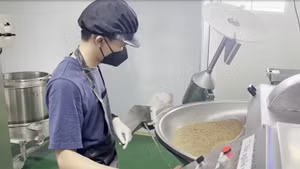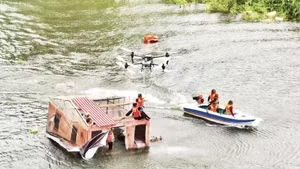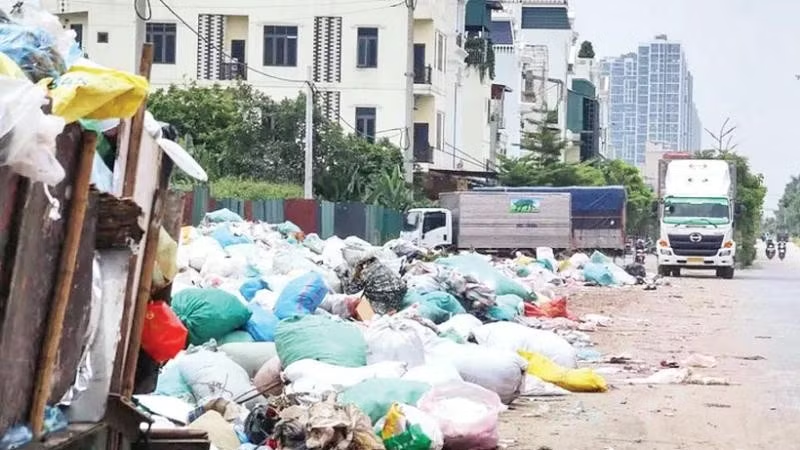
Not only household waste, waste streams from production and services also create significant pressure. Industrial zones are estimated to generate about 4.2 million tonnes of solid waste per year, including approximately 550,000 tonnes of hazardous waste. In the health sector, total waste generated is about 400 to 600 tonnes per day; hazardous medical waste accounts for about 20 to 25%. Although the volume is not large compared with household or industrial waste, the level of risk is high and requires strict treatment procedures. In agriculture, straw, rice husks and livestock waste are generated widely; if not properly treated, they will cause pollution of soil, water and air, and lead to greenhouse gas emissions.
Dr Luong Quang Huy, Department of Climate Change (Ministry of Agriculture and Environment), said that methane is mainly formed from the anaerobic decomposition process, which is decomposition under conditions lacking oxygen of organic substances. First of all is municipal solid waste, the largest emission source when treatment still depends heavily on landfilling. Because waste is not yet sorted at source, organic components such as leftover food, vegetables and fruits are mixed and buried together with other waste, decomposing in an anaerobic environment and generating large amounts of methane.
In addition, wastewater is another emission source. Treatment systems lacking control can easily create conditions for methane release, especially with untreated domestic wastewater and organic-rich wastewater from food processing and agriculture, where anaerobic microorganisms are active and produce methane. This explains why any roadmap to reduce methane must begin with changing the way organic waste is treated and upgrading wastewater collection and treatment systems.
The methane emission reduction plan in the waste sector to 2030 aims to reduce 10% of per-capita municipal waste generation through waste minimisation and sorting at source; increase the recycling rate to 35% for recyclable materials such as paper, cardboard, glass and metals; treat 32% of food waste into compost; incinerate or generate energy from 9% of combustible waste with high calorific value such as textiles, plastics, rubber and wood; and ensure that 30% of landfilled waste is disposed of in sanitary landfills with methane recovery. The total methane reduction achieved domestically by 2030 is estimated at 7.28 million tonnes of CO2 equivalent.
However, methane emission reduction in the waste sector still faces several difficulties. First is the data gap, as there is still insufficient reliable data on sources, emission factors and activity data as a basis for inventory, monitoring and evaluation of emission reduction effectiveness. At the same time, financial resources remain limited, and the mobilisation of capital from the private sector and international sources has not matched the demand for investment in infrastructure and technology. In addition, the management capacity, professional expertise and awareness of a part of officials, enterprises and the community regarding methane emission reduction have not yet met requirements.
To reduce methane emissions sustainably, the first priority is to strictly enforce sorting at source. When sorting municipal solid waste becomes mandatory, organic waste will be separated, thereby significantly reducing the amount of waste sent to landfills and immediately cutting the conditions for methane formation at the source. According to environmental experts, it is necessary to promote treatment of the organic fraction through appropriate solutions such as composting and the application of biogas technology, which both converts organic waste into fertiliser and utilises it as energy.
Alongside organic waste treatment is the roadmap to limit landfilling, gradually reducing the proportion of landfill treatment and replacing it with more advanced technologies, including waste-to-energy incineration. For existing landfills, the requirement is to strictly control emissions by installing gas recovery systems, collecting and treating generated methane, turning emission sources into clean energy sources.

![[In Pictures] Bridge columns and underpasses in Ha Noi begin to turn green](https://en-cdn.nhandan.vn/images/nyM650OGFWrOVWc-xajqN-rTZ68Rlmc1fiGJOhBRYHH_N-Xs0TE8Psnfce7ORTs-KVfoJaEblqjNufFrgeF3e2xFkGtLQVaXm04VcmMKBEkANUyiOkpz4zAuIKgydVrrfBxmGez0E_YJIag0u_Uil0E7jpuJXsIxeMmGjoY1-W4/1791863309074-2994714492692222878-2994714492692222878-adb9ff3f4175c70066ed8bb80cfbead9.jpg.avif)