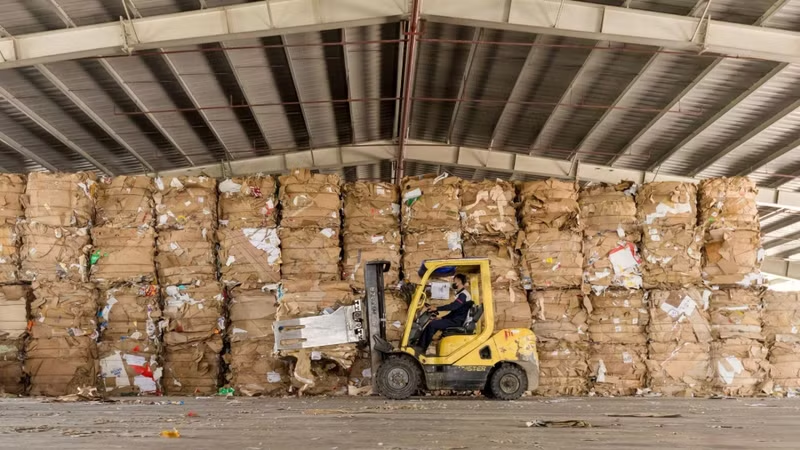
This is the story of Miza Joint Stock Company — a place where discarded scraps of paper are given a new life, forming a sustainable circular ecosystem that generates dual benefits for the environment, the economy, and society.
Forgotten “gold mines” and the suffering of the environment
On a winter morning in a suburban village of Ha Noi, when the mist has yet to lift, the pace of labour has already begun. At scrap-collection points, informal workers diligently sort through every old newspaper and every wrinkled cardboard box discarded after fulfilling its duty of protecting goods.
To most people, this is waste — something that must be removed quickly from the home. But to waste collectors, it is their livelihood. And from a broader perspective, it is a resource being squandered.
Viet Nam, a country undergoing rapid industrialisation, is facing the dark side of growth: waste. Statistics paint an alarming picture: the country generates about 6.8 million tonnes of paper waste annually, yet just over 55% of it is recovered and recycled.
So where does the remaining 45% — equivalent to millions of tonnes — go? The answer lies in massive landfills, where it decomposes and pollutes the soil and groundwater, or it is burned, releasing toxic fumes and harmful emissions. Meanwhile, to produce new paper, the traditional paper industry continues to cut down natural forests for virgin pulp. Producing paper from fresh wood not only consumes tens of thousands of litres of clean water, but it also emits large quantities of greenhouse gases, further aggravating climate change.
It was this troubling contradiction — “waste everywhere, yet resources in shortage” — that inspired the founders of Miza in 2010 to embark on a challenging but meaningful mission: building a circular-economy model in the paper industry.
Miza — from bold idea to a green ambition realised
“We didn’t only see the urgency of the environmental problem; we also recognised the opportunity to create real value from paper that would otherwise be discarded,” shared Doan Phan Duy, the project leader of Miza, recalling the early days of the enterprise.
More than a decade ago, the term “circular economy” was unfamiliar in Viet Nam, mostly found in academic documents rather than in production. Linear production thinking (Extract – Produce – Discard) still dominated. Miza’s decision to go against the grain by using waste as input was seen as bold.
The original idea was simple yet deeply philosophical: collect paper waste from the community, use technology to regenerate it into high-quality paper for packaging and printing, and at the same time create sustainable livelihoods for vulnerable groups in society.
Miza’s journey of more than 15 years has been far from easy. From its first modest production line with an output of 7,500 tonnes per year in 2010, the team had to overcome countless challenges — capital constraints, technological barriers, and the need to change consumer habits.
But with unwavering vision, they grew steadily. Today, with the expansion of a new plant in Nghi Son and upgrades to the Dong Anh plant, Miza operates three production lines with a total capacity of 200,000 tonnes per year, becoming one of the leading paper recycling enterprises in northern Viet Nam and the country as a whole.
Pioneering technology — the key to circularity
Many still assume paper recycling is a manual, dirty, and polluting process. Miza has shattered this misconception by investing heavily in state-of-the-art recycling technology.
At Miza’s factories, production is not merely about grinding old paper into new sheets. It is a technologically advanced system fully automated through a Distributed Control System (DCS). This allows strict monitoring of all technical parameters, ensuring consistently high paper quality that meets the demanding standards of Kraftliner, Testliner, and Medium grades — key materials for export packaging industries.
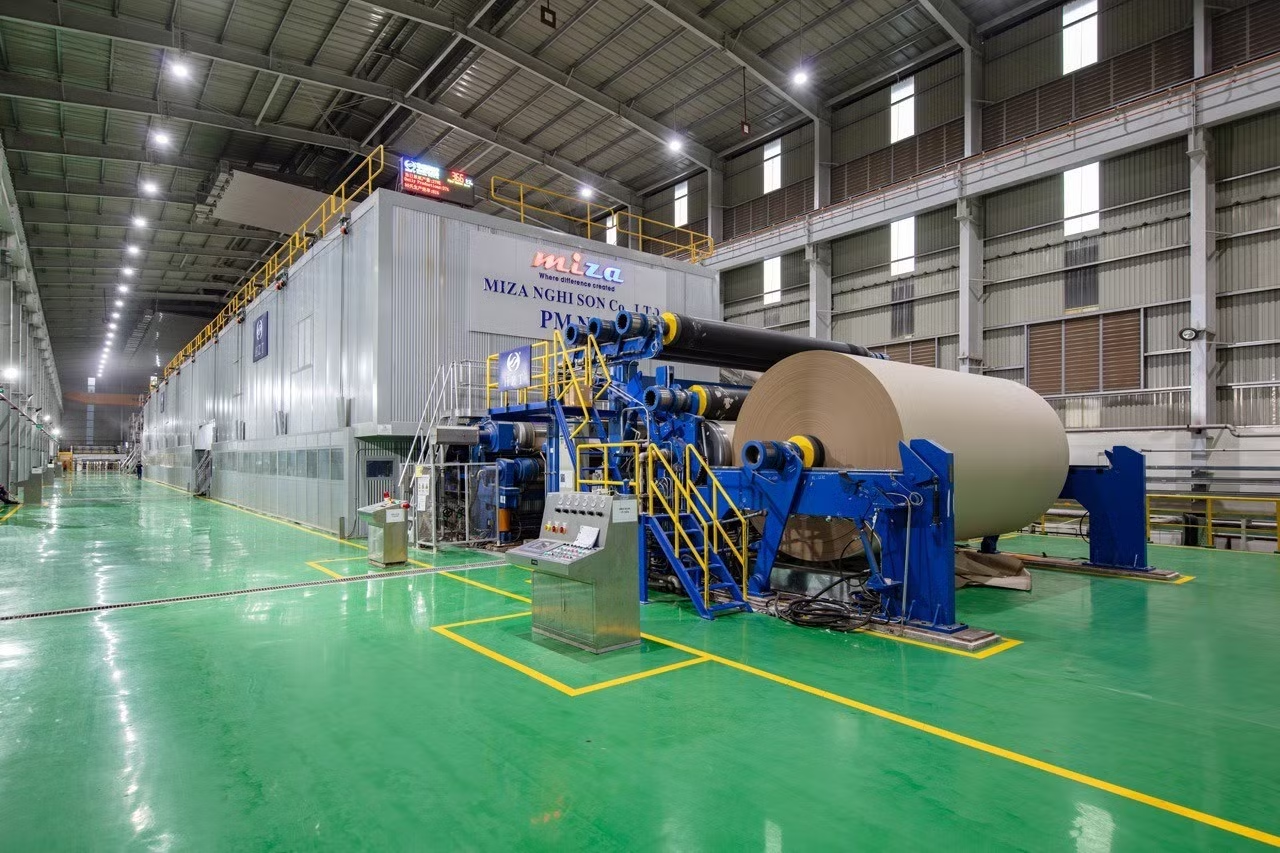
However, the most impressive aspect of Miza’s technology lies not in the product but in its environmental-treatment process. “Our model is designed to waste nothing. Up to 95% of solid waste from the recycling process is reused,” said Doan Phan Duy with pride.
Miza’s “green” process works as follows:
Wastewater: The paper industry’s most pressing issue. Miza has invested in a modern wastewater-treatment system with a total capacity of 12,000 m³, using advanced flotation and de-inking technology. Treated water meets Viet Nam’s Column A standards and, crucially, up to 50% is recirculated back into production.
Plastic waste: Contaminating nylon from waste paper is recovered and converted into thermal energy (steam) for drying paper, reducing reliance on fossil fuels.
Ash and sludge: Miza cooperates with researchers to convert these by-products into non-fired bricks, turning the very last residues into useful construction materials.
This is the most vivid demonstration of the circular-economy principle: one process’s output becomes another’s input, minimising waste released into the environment.
The numbers that speak — the macro impact
Beyond technology, Miza’s real influence becomes clear when looking at the tangible impacts over 15 years.
Since its establishment, Miza has successfully recycled nearly 925,000 tonnes of paper. To appreciate the scale: according to environmental studies, recycling nearly 1 million tonnes of paper is equivalent to saving approximately 15.73 million mature trees — trees that would have been cut down for virgin pulp. This equals thousands of hectares of forest cover preserved, keeping the planet’s green lungs intact.
The process has also saved more than 24 billion litres of water — an increasingly scarce resource.
Each year, Miza’s recycling reduces thousands of tonnes of CO₂ emissions, significantly contributing to Viet Nam’s future Net Zero commitments.
“Every tonne of recycled paper has a dual impact: easing pressure on overloaded landfills and conserving dwindling natural resources. More importantly, we want to prove that the circular-economy model can operate efficiently and profitably right here in Viet Nam — not merely in theory,” emphasised Duy.
A human-centred network — when scrap collectors become strategic partners
Beyond environmental and technological aspects, Miza’s story embodies profound humanity through the creation of a sustainable social network.
In the traditional economy, scrap collectors are often among the most vulnerable, with unstable incomes and little social recognition. Miza has changed this by building a network linked with hundreds of collection points and close cooperation with thousands of informal workers.
Instead of fragmented, small-scale operations, Miza’s logistics system and compaction stations in Bac Ninh (former administrative unit), Vinh Phuc (former administrative unit), and Nghe An have professionalised waste collection. Miza is no longer merely a buyer; it provides stable livelihoods. Waste collectors have become indispensable links in the green-material supply chain.
Miza has shown that businesses do not exist just for profit but also to serve society. From profits, the company consistently reinvests in the community — such as contributing 3 billion VND to the programme “Eliminating dilapidated housing” in Thanh Hoa to support struggling families. A corporate culture rooted in social responsibility has become the company’s compass.
Sowing green seeds in community awareness
Recognising that technology is only a tool and human awareness is the foundation of environmental protection, Miza has devoted significant effort to education and community engagement.
The project creates emotional “touchpoints” through activities such as “Paper-for-Gifts Exchanges” and creative contests using recycled materials. More than 7,000 children and local residents have participated in hands-on lessons about waste sorting and the value of recycling.
“We want environmental protection to become a joy and a daily habit, not a burdensome obligation,” said Duy. When a student sees an old discarded sheet of paper reborn as a useful new product, the lesson in conservation becomes vividly real. Miza is sowing green thinking among the younger generation — the future master of the nation — ensuring the circular economy will continue to grow vibrantly.
Future vision — more than paper, it is an ecosystem
For Miza, standing still has never been an option. Looking ahead, the leadership has set ambitious yet achievable goals.
The largest is to reach the milestone of recycling 1 million tonnes of paper, creating tens of thousands of sustainable jobs. Alongside expansion, Miza is committed to deep “greening” of the production process, aiming to reduce energy consumption per tonne of paper by 15% through advanced technologies.
Importantly, Miza is pioneering energy transition in the industry. Plans are underway to completely replace coal with biomass fuel and expand rooftop solar systems to cover 15% of the plants’ electricity needs.
Beyond factory limits, Miza aims to collaborate with social enterprises to expand collection to other potential materials such as milk cartons. The project to plant 10,000 urban trees by 2030 further demonstrates its strong commitment to nature.
Over more than 15 years, Miza’s project is not merely a success story of a paper recycling enterprise. It is living proof that Viet Nam can master technology and processes to turn the challenge of waste into an opportunity for development.
Every sheet of regenerated paper at Miza carries not only material value but also a message of connection — between informal workers and modern enterprises, between individual actions and environmental survival, and between today's efforts and a sustainable future.
As Doan Phan Duy said: “Sustainable development is not a slogan. When resources are optimised, modern technology is applied, and communities work together, we can both protect the environment and create economic opportunity while improving quality of life.” Miza has been, is, and will continue to be a pioneer, inspiring Vietnamese businesses on the journey to green the economy.