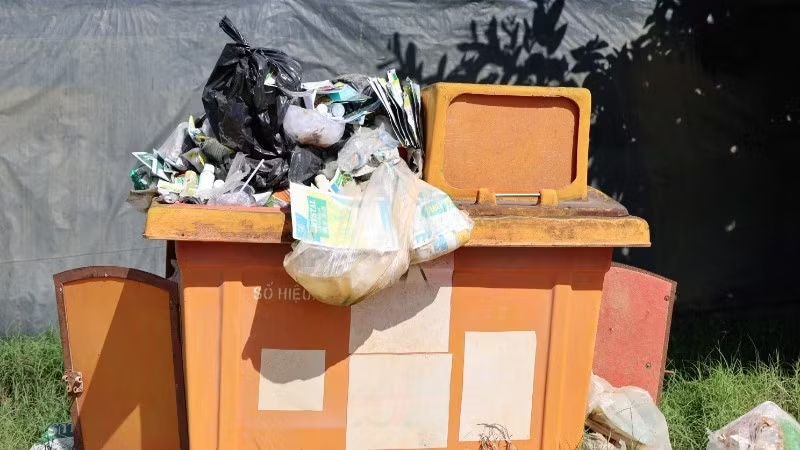
The completion of the extended producer responsibility (EPR) mechanism is raising expectations of removing bottlenecks related to funding, as well as the organisation of collection and treatment of plant protection product packaging.
EPR is an important environmental policy instrument, requiring businesses to take responsibility for the entire lifecycle of their products, including the post-consumption stage. The mechanism helps realise the principle that “the polluter pays”, while also promoting the development of a circular economy.
Originating in Europe in the 1990s and now widely applied in many developed countries, the EPR mechanism not only contributes to waste treatment but also encourages businesses to innovate product design in an environmentally friendly direction, enhance recyclability and reusability, and move towards sustainable agricultural development.
In Viet Nam, EPR was codified in the 2020 Law on Environmental Protection and subsequently detailed in Decree No. 08/2022/ND-CP (as amended and supplemented by Decree No. 05/2025/ND-CP). Recently, the Government issued Decree No. 110/2026/ND-CP (effective from May 25, 2026), further refining the legal framework, clarifying the responsibilities of producers and importers in recycling and waste treatment, while establishing a transparent and efficient mechanism for the management, allocation, and use of financial contributions.
According to Nguyen Thanh Yen, Deputy Head of the Policy and Legal Affairs Division (Department of Environment, Ministry of Agriculture and Environment), this marks an important step forward in ensuring the EPR mechanism operates in a synchronised manner, covering the entire cycle from mobilisation to utilisation of resources. The new regulations also update requirements on waste classification and the labelling of products to confirm that hazardous waste thresholds are not exceeded for production and supply facilities.
Under the regulations, before April 1 each year, producers and importers must declare their financial contributions to support waste treatment for products placed on the market in the previous year via the National EPR Information System; before April 20, they must complete payment to the Viet Nam Environmental Protection Fund.
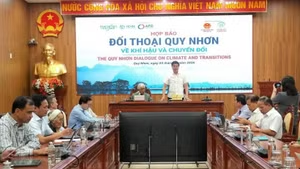
Luong Ngoc Quang, Deputy Head of the Food Safety and Environment Division (Plant Production and Protection Department), speaks at the forum.
In his opening remarks, Tran Van Cao, Deputy Editor-in-Chief of the Agriculture and Environment Newspaper, emphasised that EPR is not a tax but a responsibility mechanism, in which contribution obligations must be implemented fairly among enterprises. Completing this mechanism will help supplement resources for localities, improve the efficiency of agricultural waste management, and minimise impacts on the environment and public health.