Significant scope for achieving Net Zero
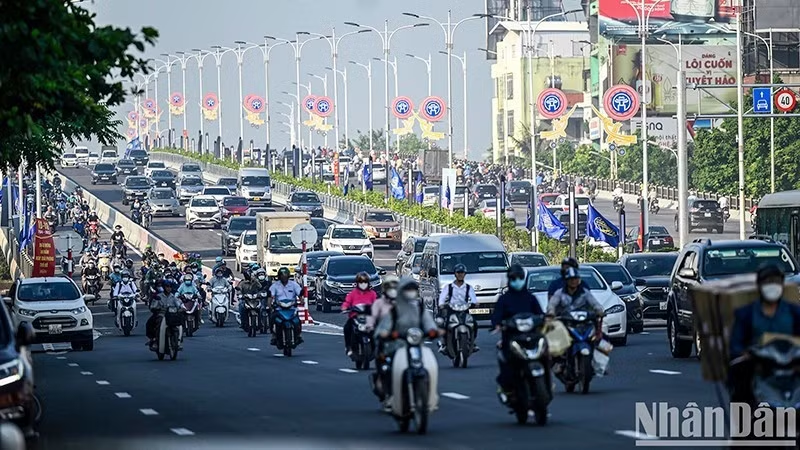
According to vehicle registration statistics, the country has around 7 million cars and 80 million motorbikes, scooters, and other types of vehicles and machinery; the railway sector operates more than 400 locomotives and over 6,000 carriages; inland waterways have 240,000 vessels and boats; the maritime sector has more than 1,200 ships; and there are approximately 300 civil aircraft.
Data and operational realities show that road transport accounts for more than 85% of total emissions from the entire transport sector, as vehicles using fossil fuels (petrol and diesel) account for over 80% of the fleet. A large proportion of these are old vehicles that fail to meet EURO emission standards, causing serious environmental pollution.
From 2025, according to estimates by the Ministry of Construction, the transport sector will reduce greenhouse gas emissions by around 6% per year. This is entirely feasible if the authorities implement a range of coordinated measures such as phasing out vehicles that fail to meet emission standards, limiting new production, using “clean” fuels, and promoting public transport. Specifically, by strengthening the capacity to supply green energy vehicles to gradually replace petrol- and diesel-powered vehicles in line with Prime Minister’s Decision No. 876/QD-TTg (dated July 22, 2022) on the action programme for green energy transition and the reduction of carbon and methane emissions in the transport sector (Decision 876).
The target is that by 2050, 100% of road vehicles nationwide will use green energy, equivalent to a reduction of 45.62 million tonnes of CO2 equivalent. Other modes such as rail, waterways, and aviation will also gradually transition at specific rates, ensuring that indicators meet the planned targets.
Decision 876 also sets out a specific roadmap for green transition of transport vehicles, particularly in road transport, focusing on the use of clean energy, vehicle conversion, and investment in green transition infrastructure.
According to Le Van Dat, Deputy Director of the Academy of Construction Strategy and Cadres Training (Ministry of Construction), the transport sector currently has four emission-reduction pillars that can be implemented: efficient energy use; conversion of freight transport; transition in fuels/energy/vehicles; and the use of public transport to replace private vehicles.
Specifically, regulatory agencies need to develop plans to limit energy consumption levels for private petrol- and diesel-powered vehicles, increase load factors for transport vehicles, shift freight transport from road to lower-emission modes such as rail and waterways, and supplement and complete green public infrastructure and vehicles to meet people’s travel needs. At the same time, it is necessary to accelerate the supply of private vehicles using green energy and research the application of alternative fuels.
Many positive developments
Controlling and limiting sources of pollution is one of the contents approved by the Prime Minister under Decision No. 2530/QD-TTg (dated November 19, 2025) on the national action plan to address pollution and manage air quality for the 2026–2030 period, with a vision to 2045; in which fossil fuel-powered transport vehicles are identified as subjects to be regulated according to a specific roadmap.
For road transport, after 2030, the number of electric vehicles will continue to rise sharply, reaching 75% of cars and 100% of motorbikes by 2050. During the same period, other forms of green energy such as hydrogen and methanol will begin to be tested and used widely.
In rail transport, electric energy has been used in some urban railway vehicles during the 2019–2025 period. However, non-urban locomotives still use traditional fuels. The hydrogen option may be applied from 2040. From 2050 onwards, the proportion of locomotives using green fuels will reach around 60%.
By 2035, inland waterway vehicles will begin using electricity and hydrogen, with the share of green energy reaching around 45% by 2050. Coastal maritime transport vehicles will use 90% alternative fuels from hydrogen and ammonia. As for aviation, sustainable aviation fuel (SAF) will start to be deployed from 2035, aiming to account for 50% of total energy demand by 2050.
According to Le Hoai Nam, Deputy Head of the Department of Environment (Ministry of Agriculture and Environment), the national action plan to address pollution and manage air quality for the 2026–2030 period, with a vision to 2045, sets out five main solutions to achieve the objectives, in which controlling pollution sources from transport activities and moving towards limiting and completely stopping emissions is a key factor.
Given the social reality that a very large number of private vehicles, especially motorbikes, are used for transport, implementing solutions to transition and replace fuels and vehicles will have a significant impact on the normal activities of people and businesses. Therefore, an appropriate roadmap and practical financial support for citizens and transport enterprises are required. This issue has also been directed by the government and assigned to relevant ministries and sectors to study and propose solutions since the beginning of 2025.
To date, several implemented solutions and measures have shown effectiveness, particularly in changing public awareness and sense of responsibility towards environmental protection.