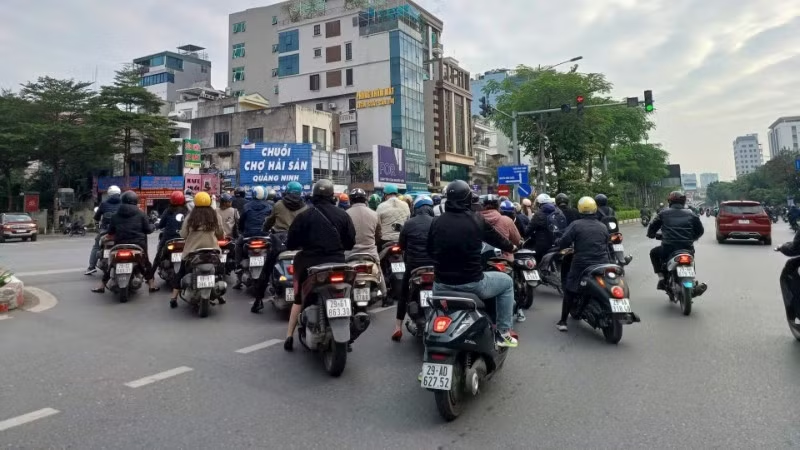
According to statistics from the Traffic Police Department under the Ministry of Public Security, there are currently more than 7.2 million cars and 80.6 million motorbikes registered nationwide.
Of these, a very large proportion are older vehicles that have been in use for five years or more, particularly motorbikes that have been in use for many years without regular inspection or maintenance, making them significant sources of greenhouse gas emissions.
However, the control of emissions from these vehicles, especially in urban areas where vehicle density is high, remains ineffective.
With regard to vehicle emissions, the Prime Minister has issued a decision in July 2022 approving the action programme on green energy transition and the reduction of carbon dioxide and methane emissions, a decision in November 2024 stipulating the roadmap for applying emission standards to imported and domestically manufactured and assembled motor vehicles, and a directive in July 2025 on a number of urgent and resolute tasks to prevent and address environmental pollution.
On that basis, the Ministry of Public Security has procured thousands of specialised devices, including vehicle scales, radiation measuring devices, chemical marking equipment, noise meters, exhaust gas analysers and smoke opacity meters.
These tools have enabled competent authorities to directly detect and handle violations related to vehicle emissions and environmental pollution.
In the first three months of implementing the directive on measures to address pollution, traffic police penalised thousands of vehicle owners for violations of emission regulations.
Difficulties in detecting and handling violations related to vehicle emissions stem from a number of causes, including the lack of specific regulations on inspection and measurement procedures for emission levels, the absence of uniform application of national technical standards on vehicle emissions, shortages of emission-measuring equipment, weak and uncoordinated inter-agency cooperation in controlling and handling emission-related violations, sanctions that are insufficiently deterrent for certain environmental crimes and offences, and inconsistencies between environmental regulations and technical infrastructure and social conditions.
These limitations underline the urgent need to enhance the capacity of competent authorities to control vehicle emissions, particularly as the country is working towards the net-zero emissions target.
To address these challenges, relevant agencies need to implement a set of coordinated solutions and focus on resolving specific issues.
First, in terms of mechanisms and policies, it is necessary to revise, supplement and promulgate legal documents and innovative mechanisms and policies to remove bottlenecks, ensuring that competent authorities have adequate legal tools to promptly and effectively deal with environmental violations.
Second, the law enforcement capacity of competent authorities must be strengthened, along with changes to patrol and inspection methods. Clear responsibilities should be assigned to units and individuals in cases where prolonged violations occur. At the same time, appropriate vehicles and equipment must be provided to meet practical requirements for inspecting and controlling vehicles in traffic.
Third, it is essential to step up the application of information technology and digital transformation in patrol, inspection and the handling of traffic safety violations. This includes building data centres, enhancing big data analysis capabilities, and using artificial intelligence while interlinking relevant databases to detect violations and issue early warnings for vehicles showing signs of non-compliance or overdue inspections.
In major cities, intelligent traffic signal systems should be deployed, using sensor-equipped cameras that operate in real time based on actual traffic conditions. This would help reduce stopping and waiting times, thereby cutting fuel consumption and emissions.
In addition, to effectively promote transition to green vehicles, supportive solutions and policies for road users should be considered, such as exemptions or reductions in fees and taxes, and instalment purchase schemes for green vehicles.
At the same time, taxes and fees on newly registered fossil fuel-powered vehicles should be increased, along with parking charges in central areas.
Efforts should also be accelerated to complete technical infrastructure serving green vehicles and public transport systems in major urban centres.
To successfully implement these solutions, functional agencies need to intensify public communication on green transport applications and the use of green vehicles through mass media, state-managed citizen service application platforms and social media.
Public transport systems should be operated effectively. Relevant sectors should be urged to advise on and propose mechanisms and policies to support enterprises involved in manufacturing and assembling clean energy vehicles, as well as those developing infrastructure to support their operation.