From “Assistance” to “Development Partnership”
In the more than half a century since the establishment of diplomatic relations and 33 years of ODA cooperation, Japan — through the Japan International Cooperation Agency (JICA) — has become one of Viet Nam’s most important development partners. What stands out is not only the scale of support, but the evolving philosophy of cooperation that has moved in step with the country’s development.
In the early period, cooperation focused on basic infrastructure. In recent years, the emphasis has expanded to long-term pillars: sustainable development, climate change response, innovation, institutional improvement, and human resource development. This shift reflects a new cooperation mindset, moving from “assistance” to “development partnership”, based on respect for Viet Nam’s autonomy.
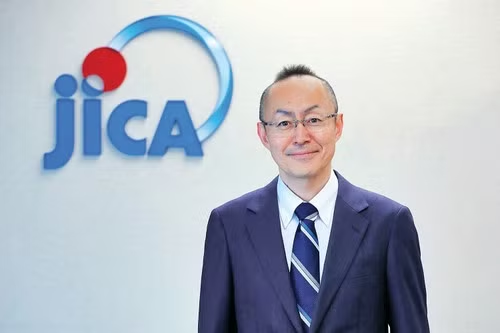
According to Kobayashi Yosuke, Chief Representative of JICA Viet Nam Office, the Ishikawa Project (1995–2021) is a clear testament to trust-based cooperation. The project accompanied Viet Nam in formulating five-year socio-economic development plans through academic exchange and policy dialogue. More importantly, it was not one-way consultancy, but a process of thinking together and making choices together, with Viet Nam firmly in the driver’s seat. On the foundation of respect for autonomy, Viet Nam–Japan legal and judicial cooperation has been implemented by JICA since 1996, accompanying institutional reform. From a time when the legal system was incomplete and inadequate for integration, many fundamental laws have now been developed, and legal professionals have matured to actively participate in drafting and refining legislation.
In JICA’s approach, Viet Nam is always at the centre of reform, with a strong focus on strengthening implementation capacity and candidly addressing challenges, particularly the gap between regulations and practice — an issue of great concern to the business community.
High-quality infrastructure, a pillar of green growth
When it comes to Viet Nam–Japan cooperation, it is impossible to overlook the symbolic infrastructure projects where the philosophy of sustainable development is translated into reality. Metro Line 1 (Ben Thanh–Suoi Tien) in Ho Chi Minh City, which began operation at the end of 2024, is a prime example. Beyond easing congestion, the city’s first metro line offers a low-emission transport option and helps foster a culture of public transportation. In the environmental sector, wastewater treatment projects in major cities also bear the clear imprint of Viet Nam–Japan cooperation, improving quality of life and enhancing resilience to climate change. What these projects share is the philosophy of high-quality infrastructure, whereby development is calculated over the entire lifecycle of each project.
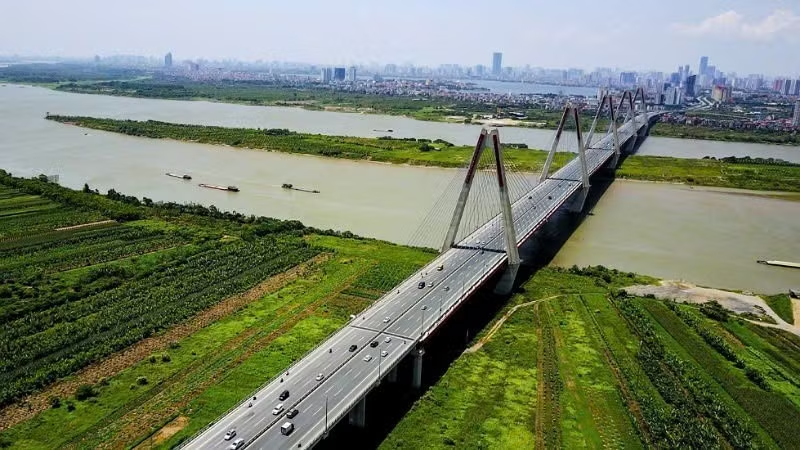
This philosophy has shaped symbols of Viet Nam–Japan cooperation over decades, from metro lines and Nhat Tan Bridge to Lach Huyen Port and wastewater treatment plants. According to JICA, high-quality infrastructure not only lays the foundation for sustainable development but is also a key factor in strengthening Viet Nam’s long-term competitiveness as it moves towards the goal of becoming a high-income country by 2045. Technology transfer and human resource development are identified as consistent focal points, enabling Vietnamese enterprises and engineers to mature and engage more deeply in major projects.
From a broader perspective, infrastructure cooperation between Viet Nam and Japan is gradually moving beyond individual projects towards a more integrated approach encompassing innovation and economic development. Each project not only meets immediate needs but also lays the groundwork for a green, safe, and liveable future. The flexible combination of ODA loans, technical cooperation, and grant aid remains a key strength enabling JICA to accompany Viet Nam in the long term.
In the time ahead, projects such as Metro Line 2 in Ha Noi or the extension of Metro Line 1 in Ho Chi Minh City are expected to become important pieces in the green growth picture of major urban centres.
Energy – Science – People: The long-term foundation of the Net-zero commitment
The journey towards green development is inseparable from the energy transition — a major challenge but also a field rich with opportunities for Viet Nam in the decades to come. With an approach grounded in long-term commitment, JICA accompanies Viet Nam with both financial resources and a sustainable vision focused on capacity building and trust consolidation.
International resources can only be effective when paired with appropriate mechanisms and private-sector participation. In Quang Tri, wind power projects co-financed by JICA have become models of public–private partnership, providing real momentum towards the goal of net-zero emissions by 2050. However, energy transition is not merely an investment story. Challenges related to policy, grid connectivity, and market mechanisms highlight the urgent need for a transparent, stable, and predictable institutional environment. Policy dialogue and trust-building between the state and businesses are seen as key conditions for both promoting growth and ensuring emission reduction goals. In addition, JICA supports Viet Nam in developing evidence-based climate policies. Through technical cooperation programmes, capacities to implement climate commitments are enhanced, from emissions monitoring to strengthening the role of enterprises.
Entering the 2025–2030 period, Viet Nam–Japan cooperation is expected to expand into areas such as the circular economy, carbon credits, sustainable agriculture and transport, climate change adaptation in the Mekong Delta, flood control planning in central regions, and water environment improvement. Green transformation is not merely a matter of technology or finance but a story of people and awareness. As the Net Zero commitment spreads from policy to community, green development will gradually become a natural choice for society.
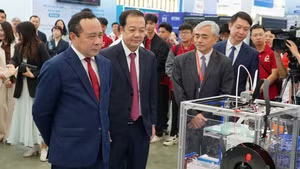
From energy transition, Viet Nam–Japan cooperation is extending into more foundational pillars: science and technology, and human development. Infrastructure or technology can only truly realise their value when operated by people with knowledge, capacity, and an aspiration for innovation. In this spirit, JICA has partnered with Ha Noi University of Science and Technology and Japanese partners to implement the Global Consumer Intelligence (GCI) training programme from 2025. According to Prof. Matsuo, the programme enables Vietnamese students to access artificial intelligence (AI) knowledge and nurture high-tech human resources linked to innovation and start-ups — the core drivers of green growth.
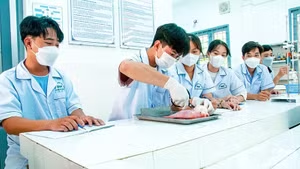
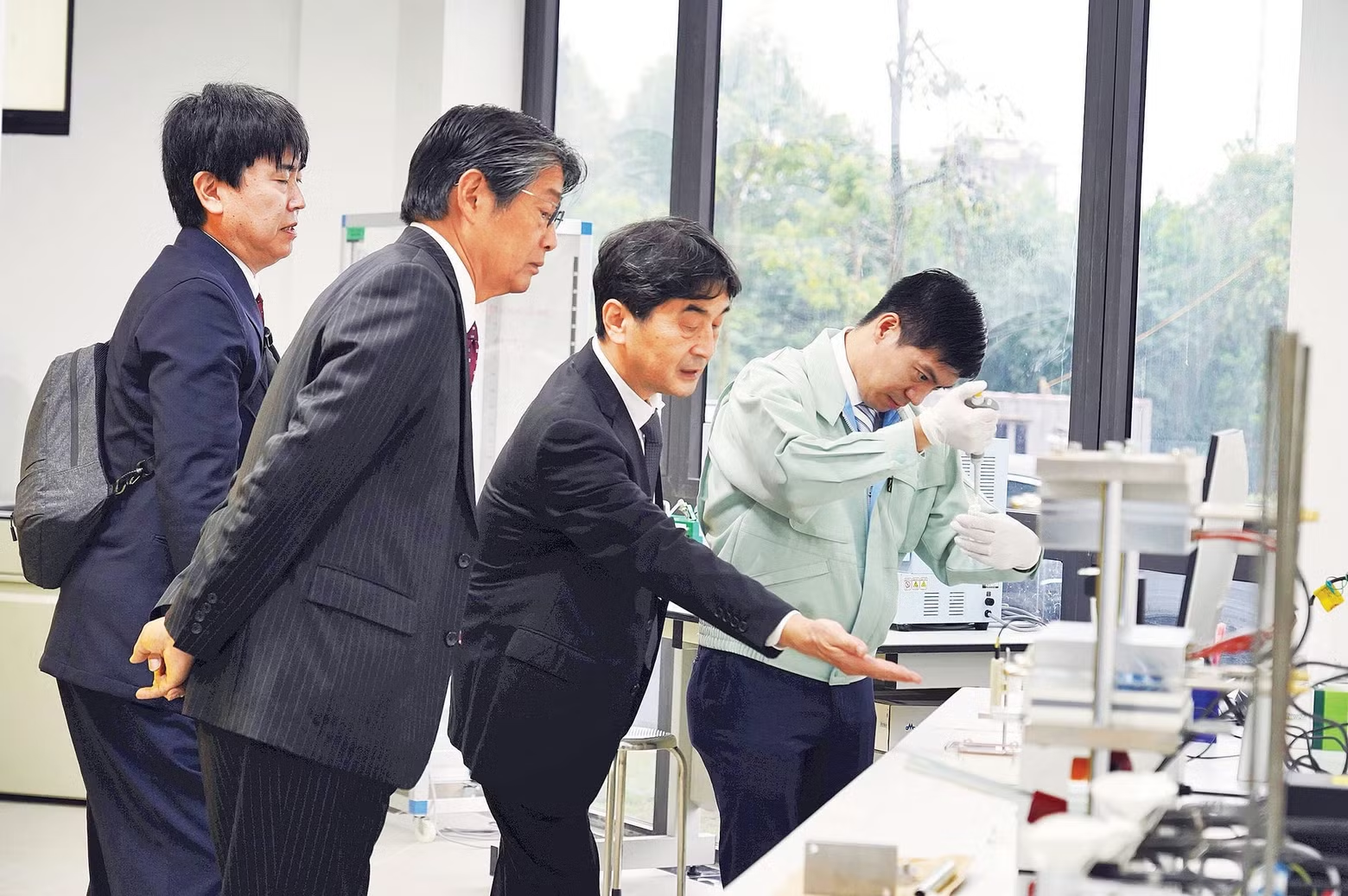
Alongside training, Viet Nam–Japan scientific cooperation is moving into practical fields directly tied to sustainable development needs. According to Prof. Dr. Hoang Minh Son, Director of Viet Nam National University, Ha Noi, the establishment of the Research – Development – Training Centre for Analytical Science and Technology has restored science and technology to their core role: serving environmental monitoring, food safety, and water and air quality analysis. On this foundation, evidence-based policymaking capacity is strengthened, enabling development decisions to become increasingly grounded and sustainable.
JICA considers human resource development a pillar of sustainable infrastructure. The establishment of the Viet Nam–Japan University and new programmes, including in semiconductors, shows that education cooperation is gradually aligning with the foundational industries of the future. Alongside this, the quiet contributions of Japanese volunteers have created enduring “soft threads” that strengthen people-to-people ties between the two countries.
Over the next 5–10 years, Viet Nam–Japan cooperation is expected to continue expanding in areas such as AI, semiconductors, smart cities, and healthcare. However, rather than the traditional “transfer” model, JICA is moving towards a “co-creation” approach — working with Viet Nam to find solutions to new challenges in a rapidly changing world. When energy transition is underpinned by science, technology, and people, sustainable development will no longer be a distant commitment but a long-term journey of partnership, nurtured by knowledge, trust, and a shared responsibility for the future.
Over the past 33 years, total ODA support from Japan to Viet Nam has reached approximately 3,000 billion JPY, with more than 100 billion JPY in 2023 alone. These figures reflect not only the scale of support, but also a consistent viewpoint: green transformation is a long-term journey that requires serious investment in time, resources and institutions.