Implementing an effective physical security strategy requires a close combination of technological solutions and human resource training. An effective physical security "barrier" will help businesses, organisations, or infrastructure operate efficiently, safely, and sustainably in the current challenging environment.
Shifting from passive to active
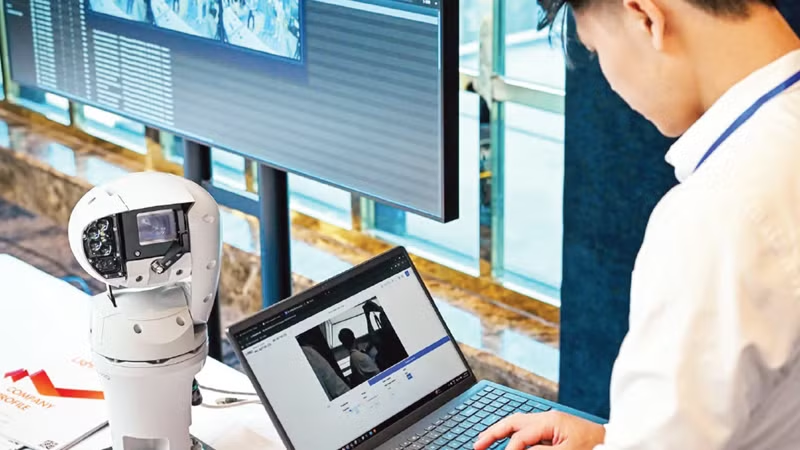
Physical security is the protection of objects and assets that we can observe, see, and feel; it comprises measures to protect people, infrastructure, and existing assets. For example, 15–20 years ago, Viet Nam began using public security surveillance cameras in factories and neighbourhoods. In addition, in the context of today's strong digital transformation, the wave of technological innovation is creating an unprecedented amount of data.
According to Nguyen Quang Dat, Head of Management of Seagate Company in Viet Nam, if in the whole of 2005 the world generated data equivalent to just one zettabyte (ZB), in 2020 the volume of data created had reached seven ZB, and it is forecast to rise to around 394 ZB in 2028. This means that, within just over 20 years, global data volume will increase nearly 400 times, putting immense pressure on storage systems. Because data still needs to be stored on servers or in the cloud, this crucial digital asset also needs physical security protection.
“Regarding physical security, the world has gone through three stages of development,” said Vu Kiem Van, General Director of MobiFone Global under MobiFone Telecommunications Corporation. Accordingly, the first stage was “fragmented monitoring,” where cameras and Building Management Systems (BMS) were controlled and monitored separately and independently, without sharing data and with completely different technical capabilities and operating methods.
Since 2022, physical security has entered phase 2, where all security systems are being integrated into a centralised monitoring platform. This reduces labour, operational, storage, and maintenance costs, while simultaneously enhancing defensive capabilities against security threats.
Currently, thanks to the rapid development of technology, the deployment of physical security has taken a new step forward: the application of AI-powered data analysis to predict and build proactive defence scenarios based on data collected from the Internet of Things (IoT) or from sensors of devices in a multi-layered physical security system.
Currently, thanks to the strong development of technology, the deployment of physical security has taken a new step forward, applying AI-powered data analysis to predict and build proactive defence scenarios based on data collected from the Internet of Things (IoT) or from sensors of devices in a multi-layered physical security system. Thus, while previously physical security systems were entirely passive, only deploying response solutions to mitigate damage after an incident occurred, now the response process is automated, activated according to predefined scenarios, enabling proactive risk prevention and control, and comprehensively protecting the critical physical security infrastructure of agencies and organisations.
Increasing demands
Physical security risks are becoming a top concern in the context of rapidly developing technology and increasingly complex interconnected networks. According to a survey by Grand View Research, the total size of the global physical security market in 2025 reached over 158 billion USD and is predicted to increase to nearly 220 billion USD by 2030.
In Viet Nam, data from IMARC Group shows that the physical security market scale in 2024 was approximately 500 million USD and is expected to increase to nearly 2 billion USD by 2033. Furthermore, in the coming years, to achieve economic growth targets, Viet Nam will continue to heavily invest in strategic infrastructure such as airports, high-speed railways, inter-regional highways, and high-tech industrial parks. This will lead to a demand for the construction of fully automated, synchronised, interconnected physical security systems that save time and effort and ensure near-absolute accuracy.
According to Lieutenant Colonel Nguyen Dinh Tuan, former Deputy General Director of MobiFone, the physical security system in Viet Nam has developed rapidly over the past years, but it remains fragmented, lacks common standards and interconnections, and has not kept pace with the requirements of real-time monitoring and response. In the context of increasingly complex security and order situations, building multi-layered, rapid-response, data-integrated monitoring systems to ensure proactive risk management has become an urgent need. Therefore, MobiFone has identified physical security as one of the strategic pillars in the "telecommunications-technology-digital transformation" ecosystem that the corporation is building.
From telecommunications infrastructure, data centres, and digital platforms to new technologies such as AI (Artificial Intelligence), IoT, Cloud, and Big Data, MobiFone aims to develop integrated, intelligent security solutions, ready for national-scale expansion. However, to form a synchronised physical security ecosystem that practically serves the needs of protecting people, property, and operations of the country, along with the efforts of MobiFone Company, a close connection is essential between the State, businesses, leading technology partners in the world, and the expert community.