More than merely a supporting tool, AI has emerged as a driving force for innovation, enabling the industry to overcome the limitations of traditional design and manufacturing methods. In the past, Vietnam’s mechanical sector relied largely on automation and numerical control. Today, however, the trend is shifting decisively towards intelligent autonomous manufacturing, where machinery, robots, sensor systems and smart control platforms integrated with AI can make decisions independently, self-optimise and adapt to real production conditions.
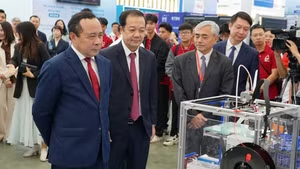
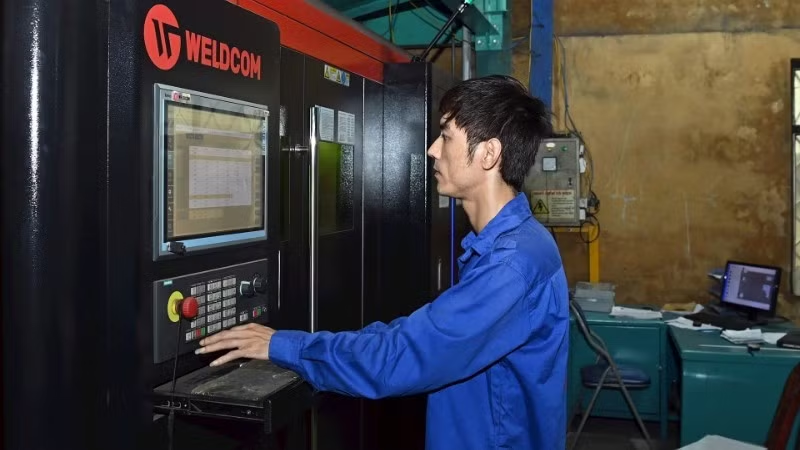
According to Dr Nguyen Lac Hong, Vice Chairman of the Viet Nam Association of Mechanical Industry, technologies such as Big Data, the Internet of Things (IoT), industrial platforms and digital twin models have brought about a profound shift in mechanical design and manufacturing. Through machine learning, multiple design options can be generated and evaluated against criteria such as durability, production cost or weight before the optimal solution is proposed. This is particularly valuable in sectors requiring high precision, including automotive manufacturing, aerospace, robotics and machinery production. In mechanical processing, AI is being directly integrated into Computer Numerical Control (CNC) systems to optimise cutting processes in real time.
Technologies such as Big Data, the Internet of Things (IoT), industrial platforms and digital twin models have created a strong shift in the way mechanical design and manufacturing are carried out.
Dr Nguyen Lac Hong,
Vice Chairman of the Vietnam Association of Mechanical Industry
Commenting on the role of AI in mechanical engineering, Dr Vu Duong of Duy Tan University noted that AI is applied to optimise design, production processes, quality control, predictive maintenance and the development of new materials, thereby enhancing productivity, accuracy and overall efficiency. In addition, machining parameters such as cutting speed and feed rate can be flexibly adjusted to achieve optimal performance. Systems using cameras combined with AI algorithms are capable of analysing product surfaces and detecting defects such as cracks, warping or dimensional deviations.
Despite its considerable potential, the application of AI in Viet Nam’s mechanical industry still faces numerous barriers. According to Dr Dinh Van Chien, Director of the Institute of Mechanical Engineering, Automation and Environment, harnessing AI’s potential requires substantial costs and resources, including investment in AI infrastructure, specialised software, and the recruitment or training of skilled personnel. Moreover, the demand for high-performance computing can significantly increase operating costs, necessitating continuous investment in computing resources and maintenance.
At present, the level of AI adoption remains largely at the experimental stage, concentrated mainly among large corporations and research institutes. More than 90 per cent of mechanical enterprises, particularly small and medium-sized ones, lack the capacity to deploy AI widely in production. The foremost challenge lies in the lack of synchronised digitalisation of production data. Data from machining equipment, inspection devices and design software remain fragmented or are not stored in standardised formats, leaving AI models with insufficient data for learning and making it difficult to achieve high accuracy.
Viet Nam’s National Strategy on Research, Development and Application of AI to 2030 identifies mechanical engineering and manufacturing as priority sectors. AI is already, and will continue to be, a core factor reshaping the country’s mechanical industry, driving a shift from an “experience-based design” model to one “based on data and artificial intelligence”.
In addition, there is a shortage of interdisciplinary human resources, with very few engineers possessing combined expertise in mechanical engineering, AI and numerical simulation. Meanwhile, intelligent manufacturing systems require technical personnel capable of operating and maintaining equipment integrated with sensors, machine learning algorithms and digital models. From a technological perspective, many smart mechanical devices still have to be imported at high cost. AI integrated into imported machinery often functions as a “black box”, making it difficult to customise to domestic production conditions. Vietnamese enterprises have yet to master sensor modules, data collection systems or simulation software with integrated AI.
Viet Nam’s National Strategy on Research, Development and Application of AI to 2030 identifies mechanical engineering and manufacturing as priority sectors. AI is already, and will continue to be, a core factor reshaping the country’s mechanical industry, driving a shift from an “experience-based design” model to one “based on data and artificial intelligence”. This is not merely a technological orientation, but a strategic task for the mechanical sector in the era of digital transformation, contributing to Viet Nam’s progress towards intelligent, autonomous and globally competitive manufacturing.
However, to achieve this, experts in the mechanical field emphasise the need for strategic and coordinated solutions. First and foremost, a national digital mechanical data repository should be established, encompassing design, manufacturing, simulation and sensor data. This repository would serve as the foundation for training AI models, enabling wider application of the technology.
At the same time, greater emphasis must be placed on developing interdisciplinary human resources in mechanical engineering, electronics and AI, strengthening links between educational institutions and enterprises so that engineers have opportunities to gain hands-on experience on real production lines.
In addition, efforts should be made to promote the localisation of smart mechanical products. Developing “Make in Viet Nam” machine control software, machine vision systems and digital twin models would help enterprises reduce costs and gain technological autonomy. Alongside this, enhanced research collaboration among institutes, universities and businesses is essential to build a smart mechanical ecosystem, creating conditions for testing and refining technologies before they are brought to market.