Practical applications and challenges
AI application in vocational education is essential for improving management, training, and recruitment while ensuring technological autonomy and labour market competitiveness.
According to Master Le Viet Cuong from the Ha Noi College of Electronics and Refrigeration, AI profoundly impacts all fields, particularly vocational education, which trains the direct workforce for production, services, and technological innovation.
AI elevates teaching and learning quality while developing digital skills and adaptability for staff, lecturers, and students. It saves lecturers time on lesson preparation, enables personalised learning for students, and provides schools with data to refine curricula.
However, AI adoption remains low, with fewer than 10% of institutions using it regularly. This is due to shortages of skilled personnel and data, inconsistent IT infrastructure, inadequate legal frameworks and incentives for business-school cooperation, as well as concerns over data privacy and investment costs.
AI elevates teaching and learning quality while developing digital skills and adaptability for staff, lecturers, and students. It saves lecturers time on lesson preparation, enables personalised learning for students, and provides schools with data to refine curricula.
The main challenges stem from the absence of teams with sufficient expertise in technology and data; unsynchronised facilities and information technology infrastructure; inadequate legal frameworks and mechanisms to foster cooperation between businesses and vocational schools; as well as concerns over the security of learning data and the high costs of technology investment.
AI automates processes, analyses big data, and personalises learning to boost training outcomes, supporting teaching, management, practical simulations, career guidance, and smart recruitment.
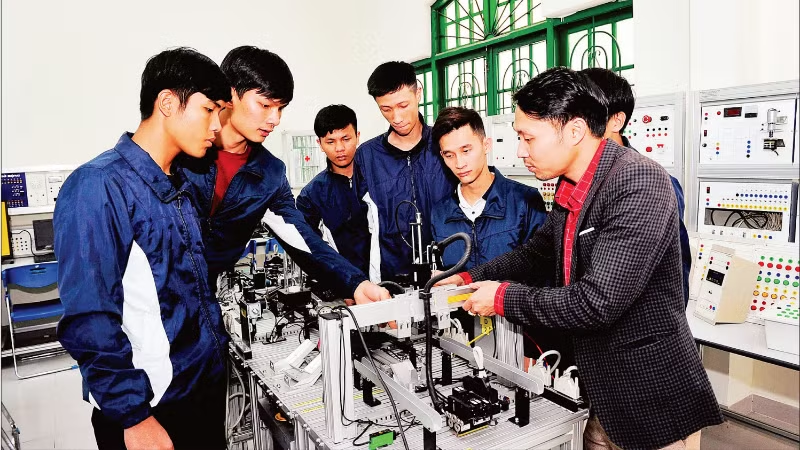
Nguyen Thanh Hung, former Deputy Head of the Department of International Relations under the Government Office, said that many vocational institutions have piloted AI in management and training, including tutoring systems, chatbots for student support, and rapid feedback. Some use AI with Augmented Reality/Virtual Reality (AR/VR) for step-by-step skill simulations in assembly and equipment repair.
Nevertheless, challenges persist in infrastructure, resources, and implementation capacity. Many training centres lack synchronised equipment, while lecturer and manager AI training remains limited, creating bottlenecks.
Vocational education emphasises hands-on skills, whereas AI focuses on digital and simulation learning, making integration without compromising practice quality difficult.
Recommendations and future outlook

AI adoption is inevitable for better management, teaching, learning, and digital transformation in education. Success requires overcoming barriers in infrastructure, human capacity, training methods, and responsible use.
According to Le Viet Anh from the Viet Nam Education Quality Management Agency under the Ministry of Education and Training, Viet Nam has more than 1,800 vocational institutions, including nearly 400 colleges. The ministry is refining occupational competency frameworks, prioritising digital skills and technology application as key learner evaluation criteria.
Dr Nguyen Van Nghi, former Vice Rector of the School of Science and Technology Management under the Ministry of Science and Technology, stresses that AI is vital for national human resource strategies, yet only about 30% of vocational schools currently have standard digital laboratories.
Viet Nam needs a comprehensive AI ecosystem — from policies and data to simulation infrastructure, teacher capacity, and industry-school partnerships — to bridge policy and practice.
He emphasised that Viet Nam needs a comprehensive AI ecosystem — from policies and data to simulation infrastructure, teacher capacity, and industry-school partnerships — to bridge policy and practice.
Despite its great potential, Viet Nam’s vocational education still has gaps in technological infrastructure, simulation capabilities, teacher capacity, and data standardisation. Building an AI ecosystem therefore requires close coordination between macro-level policies and micro-level actions such as piloting models and training personnel.
From now until 2035, Viet Nam’s labour structure will shift strongly towards high-skill demands, making vocational education development strategies particularly crucial.
Experts suggest that training institutions need clear digital transformation roadmaps, defined AI application goals, infrastructure investment, and lecturer and manager training to build a responsible technology use culture. AI should be seen as a support tool, not a replacement for the central role of teachers and learners. Additionally, KPIs must be established to measure effectiveness and assess AI’s impact on training quality, output skills, and employment rates.
Barriers in infrastructure, human resources, training methods, and data security require ongoing resolution. Perfecting policies, increasing investment, and developing digital talent are prerequisites for directing AI applications towards sustainable development goals.