A bridge for sharing knowledge
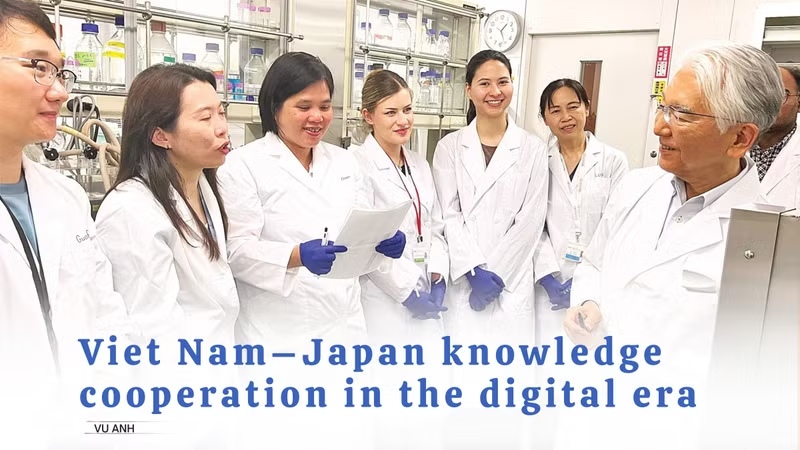
VANJ may be described as the “brainchild” of several generations of young Vietnamese intellectuals in Japan. Established in October 2019, with core members comprising Vietnamese scientists living and working in Tokyo, the network has since expanded nationwide. In pursuit of its mission to “disseminate knowledge, foster academic connections and contribute to society”, VANJ has undertaken numerous significant activities, becoming an important focal point linking Vietnamese scientists in Japan with ministries, agencies, and institutions in Viet Nam.
On the Japanese side, VANJ has acted as a conduit for sharing job and scholarship opportunities with Vietnamese students. Recently, the network also supported university professors from Hiroshima, Tokyo, and Osaka in recruiting candidates for Japan’s semiconductor workforce training programme, JST-NEXUS.
VANJ may be described as the “brainchild” of several generations of young Vietnamese intellectuals in Japan. In pursuit of its mission to “disseminate knowledge, foster academic connections and contribute to society”, VANJ has undertaken numerous significant activities, becoming an important focal point linking Vietnamese scientists in Japan with ministries, agencies, and institutions in Viet Nam.
“Our university is very interested in Vietnamese students because they are diligent, creative, and intelligent. I hope you will succeed and continue to guide the next generation, thereby affirming the standing of Vietnamese scientists in Japan,” said Professor Masayuki Shimada, Dean of the Faculty of Applied Biological Science at Hiroshima University, at the 2025 VANJ Conference.
From Viet Nam’s perspective, VANJ has connected with domestic agencies to introduce Vietnamese scientists in Japan whose expertise aligns with priority areas identified by the government, such as semiconductors and digital transformation.
Participating for the first time in the 2023 VANJ Conference, Dr Doan Thi Kim Dung, a specialist in bioengineering at the Innovation Centre of NanoMedicine in Kawasaki, chaired a thematic session on “Nano Bioengineering”. She shared: “By attending the conference, I not only kept abreast of the latest advances in biomedical engineering but also learned directly from professors, scientists, and research groups about creative research thinking, particularly effective ways of organising and implementing scientific projects.”
To date, Dr Dung’s research has yielded tangible outcomes with broad medical applications. Notably, nano drug delivery systems have been successfully used in cancer treatment and in next-generation vaccines such as mRNA vaccines against COVID-19, enhancing drug stability, improving therapeutic efficacy, and reducing side effects. Nanomaterials also play a crucial role in biomedical diagnostics and imaging, serving as contrast agents or biological probes, thereby improving the accuracy of early disease detection.
An academic “relay hub”
The VANJ Conference has consistently demonstrated agility in responding to emerging changes, issues and technologies that address society’s pressing needs each year. In 2025, the VANJ Conference places particular emphasis on applying digital transformation across scientific disciplines, thereby fostering interdisciplinary collaboration. Under the theme ““Interdisciplinary Collaboration in the Era of Digital Transformation”, the 2025 VANJ Conference seeks to connect scientists from diverse fields to research and apply new technologies to tackle broader societal challenges, notably clean energy, environmental protection, energy-efficient new materials, and the application of artificial intelligence (AI).
VANJ is a highly meaningful platform for Japanese scientists to share their knowledge, research experience and scientific achievements with Vietnam’s intellectual community.
Professor Takashi Ogi
Department of Advanced Science and Engineering, Hiroshima University
It can be said that, regardless of their field, Vietnamese researchers within VANJ not only demonstrate outstanding competence but also serve as role models for generations of students and young doctoral candidates, guiding the next cohort along the path of genuine scientific pursuit. “VANJ places great importance on nurturing successive generations with a spirit of dedication to the scientific community. Most members find a suitable direction for their future, whether further academic opportunities or appropriate career paths, through conversations and exchanges with preceding generations,” said Dr Ngo Minh Chu, a doctoral researcher at the National Institute of Advanced Industrial Science and Technology (AIST) and Head of the VANJ Organising Committee.
VANJ members are also keenly aware of their responsibility as a “bridge” in promoting cooperation between Viet Nam and Japan. “VANJ is a highly meaningful platform for Japanese scientists to share their knowledge, research experience and scientific achievements with Vietnam’s intellectual community,” Professor Takashi Ogi, Department of Advanced Science and Engineering, Hiroshima University, noted.
“This network serves as an academic ‘relay hub’, connecting Viet Nam’s research demands and scientific development orientations with Japan’s research strengths, technological capabilities and advanced methodologies,” affirmed Dr Cao Le Anh Kiet, Deputy Head of the VANJ Organising Committee and a specialist in chemical engineering at Hiroshima University.