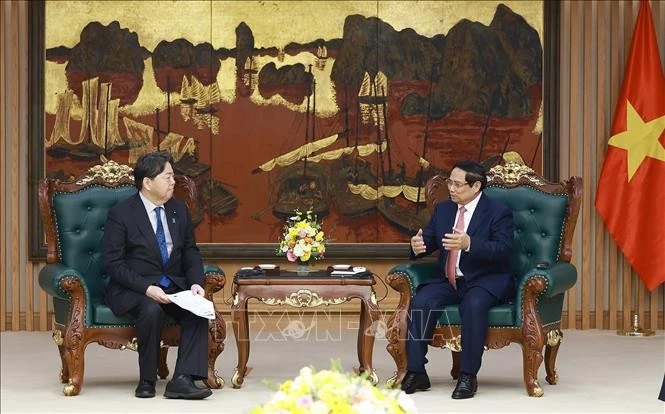
Receiving Japan’s Minister of Internal Affairs and Communications Hayashi Yoshimasa in Ha Noi, PM Chinh expressed his pleasure at the strong, comprehensive, increasingly in-depth and substantive development of the Viet Nam–Japan Comprehensive Strategic Partnership, underpinned by a high level of political trust.
He said that Japan continues to be Viet Nam’s number one partner in official development assistance (ODA) and labour cooperation, third-largest investor, and fourth-largest partner in trade and tourism. Cooperation between localities of the two countries has also been thriving. Japan is among Viet Nam’s leading strategic partners in science and technology, digital transformation, innovation, and high-quality human resource training.
The Government leader called on the Japanese minister to continue promoting bilateral cooperation and enhancing political trust through increased exchanges of high-level and all-level delegations. He also asked the guest to convey his invitation to Japanese Prime Minister Takaichi Sanae to visit Viet Nam at an early date in 2026.
The Prime Minister noted that Viet Nam has set the goal of achieving double-digit economic growth in the coming period, pursuing rapid and sustainable development based on science and technology, innovation, and digital transformation, identifying this as an objective requirement, a strategic choice, and a top priority. Viet Nam is focusing on accelerating national digital transformation, building modern digital infrastructure, and developing artificial intelligence and big data.
In the spirit of unlimited cooperation between the two countries, PM Chinh suggested that Japan’s Ministry of Internal Affairs and Communications continue working closely with Vietnamese ministries and agencies in governance and management, supporting Viet Nam in planning and developing science and technology infrastructure, including digital infrastructure, technology transfer, and the training of high-quality human resources, including managers, experts, scientists, and the production and business workforce.
He also suggested sharing experience, enhancing governance capacity, ensuring information security and safety, building policy frameworks; cooperating in high-tech agriculture; creating more favourable conditions for Japanese enterprises to invest more heavily in research and development (R&D) in Viet Nam; and promoting cooperation between localities of the two countries.
The PM further said that the two sides should sign cooperation documents to implement specific cooperative activities and projects in a spirit of valuing intellect, saving time, and making timely and decisive decisions. He also asked the Japanese Ambassador to Viet Nam to help promote bilateral agreements and cooperation commitments.
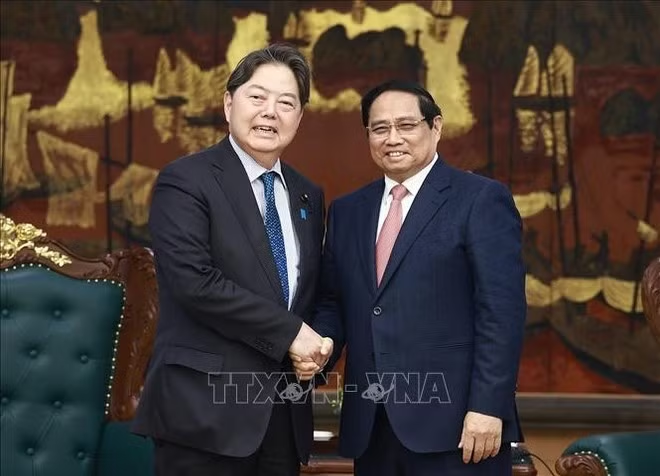
On this occasion, he expressed his hope that Japan would continue to create favourable conditions for the community of around 600,000 Vietnamese people living, studying, and working in the country.
For his part, Minister Hayashi Yoshimasa expressed sympathy over the heavy losses Viet Nam has suffered from recent natural disasters and floods, and appreciated Vietnamese workers in Japan for their positive contributions to the development and prosperity of both countries.
Sharing the Prime Minister’s views and agreeing with his assessment of the important role of science and technology, innovation, and digital transformation, he praised the Vietnamese Government’s management role and Viet Nam’s strong efforts and decisive steps in digital transformation, particularly in database development. He expressed confidence that Viet Nam will continue to develop strongly in the time ahead and successfully achieve its goal of building a powerful and prosperous nation.
Emphasising that cooperation between the two countries has no limits and that Japan is an irreplaceable partner of Viet Nam in the new era, the minister affirmed that he would promote bilateral cooperation in the areas mentioned by the Prime Minister.
Japan wishes to continue cooperating with ASEAN countries, including Viet Nam, in digital transformation and the development of safe and secure artificial intelligence, he said, expressing his belief that cooperation between the two countries in digital transformation and information technology will continue to grow stronger.