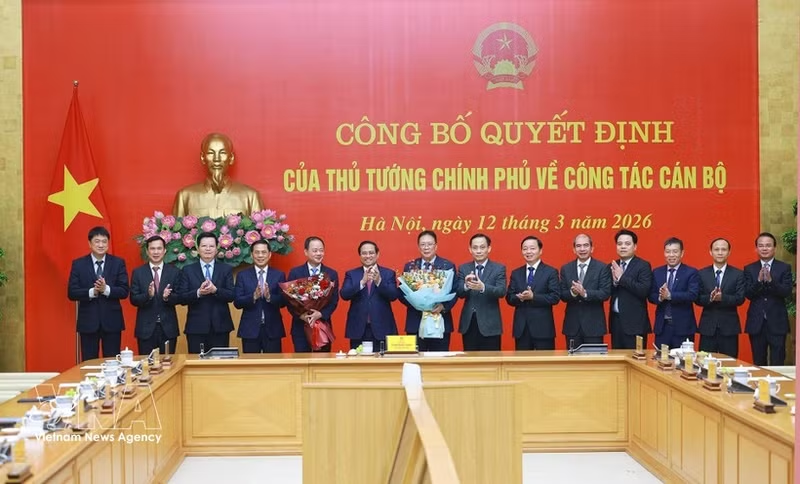
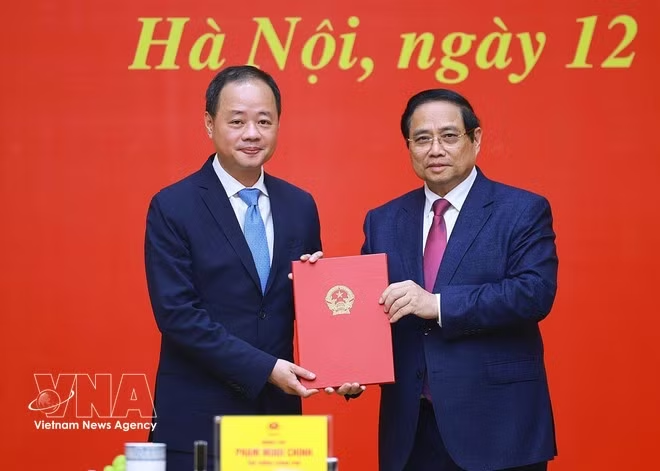
PM Chinh praised Thai as a seasoned management official with more than two decades of broad experience spanning scientific research, state management and local governance.
Highlighting the VAST's significant role, achievements and contributions to national development, he called on Thai and the academy's leaders to build on its proud tradition while advancing its heavy but also glorious mandate in the years ahead.
They were pressed to further enhance internal solidarity, maintain integrity and mettle in confronting obstacles, and strictly follow the Party’s guidelines and the State’s policies and laws, contributing to a strong and united Party organisation within the VAST and upholding democracy, collective strength and intellectual capacity.
At the same time, they must accelerate the effective implementation of the Resolution of the 14th National Party Congress and the thematic ones of the Politburo, particularly Resolution No. 57 on science – technology development, innovation and national digital transformation.
The VAST was encouraged to spearhead digital transformation, green and energy transition, and workforce restructuring and upskilling; acquire mastery of core and foundational technologies across the 11 strategic technology groups with 35 strategic product groups; and bring mathematics, physics, chemistry and biology to advanced global and regional levels by 2030.
It must continue to serve as the Party and State’s strategic advisory body on science – technology in key areas such as artificial intelligence, energy, marine economy, water security, and aerospace, alongside building a national sci-tech database, PM Chinh said.
The Government leader also stressed the imperative to translate research findings into commercial outcomes, guided by the principle of identifying clear problems, marketable products, real-world applications, measurable impact and tangible benefits. The VAST should lead in training quality manpower for science – technology and innovation, build a dedicated team of top scientists, and overhaul governance and organisational structure while improving the institutional framework and autonomy mechanism.
The VAST must shift from a “task-oriented" mindset to a “results-oriented” one, from “doing more” to “doing the right things thoroughly”, and from “having research works” to “making major contributions to improving national productivity, quality and efficiency”, he said.
He expressed confidence that Thai and VAST leaders will develop the academy into Viet Nam’s foremost sci-tech research powerhouse and gradually bring it on par with top-tier establishments in the region and the world.
Accepting the role, Thai, born in 1974, pledged to exert all-out effort to fulfil the responsibilities entrusted by the Party, State and people, steadily elevating the VAST's stature and role to contribute to national advancement in the new era, beginning with support for Viet Nam’s ambition of achieving double-digit economic growth in the coming years.