This provides an important foundation for improving production efficiency, enhancing competitiveness and promoting sustainable agricultural development.
At present, many farmers and cooperatives are strengthening linkages to participate more deeply in value chains, supply standardised raw materials for deep processing and export, and gradually enhance the value of Vietnamese agricultural products in the global market.
Large linkages on small fields
To improve economic efficiency on the same area of agricultural land, Thanh Thuy Commune in Phu Tho Province has actively supported local cooperatives in introducing new crop varieties into production. From low-yield two-crop rice fields, farmers have shifted to producing ST25 rice under a linked-chain model.
With support from Doan Ha Agricultural Service Cooperative, models of high-quality rice cultivation meeting VietGAP standards and many material zones certified under the OCOP programme have gradually been established and strongly developed.
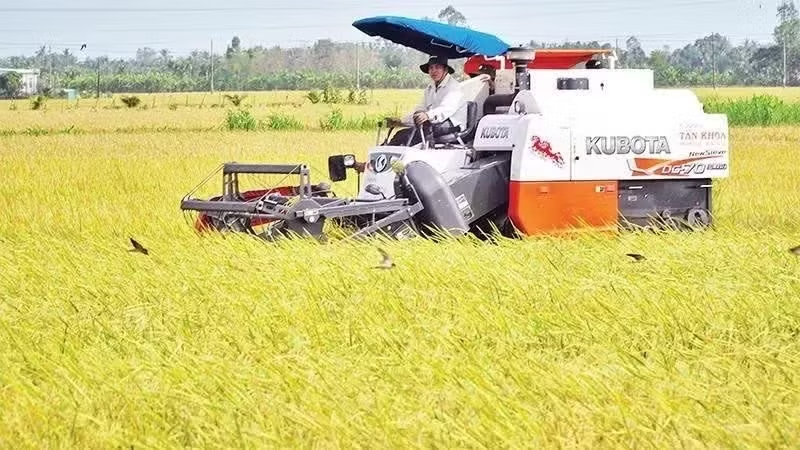
Nguyen Tien Cong, a member of Doan Ha Agricultural Service Cooperative, said large-scale concentrated production has created favourable conditions for the cooperative to introduce mechanisation into the fields. Through the large linkage model, farmers have gained access to advanced farming processes, gradually changing their production mindset from subsistence farming to commodity rice production.
At present, the cooperative’s rice yield averages 60-70 quintals per hectare. In addition, the nutritional and commercial value of ST25 rice is higher than ordinary rice, giving farmers confidence ii production.
Nguyen Manh Ha, Vice Chairman of the Thanh Thuy Commune People’s Committee, said the ST25 rice variety is well suited to local climatic and soil conditions. The commune will continue expanding the cultivation area of ST25 speciality rice under VietGAP standards, aiming to obtain four-star OCOP certification.
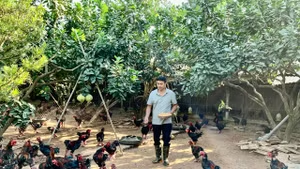
Not only have farmers in Thanh Thuy Commune succeeded with production models on large fields, members of Vinh Cuong Agricultural Service Cooperative in Vinh My Commune, Ca Mau Province, have also created strong changes by renewing their production mindset.
From small-scale and fragmented farming, the cooperative has gradually shifted to commodity rice production under a value chain, becoming one of the outstanding units in the Mekong Delta region, with an agricultural production scale of more than 20,000ha, including over 10,000ha of high-quality rice.
To maintain and ensure that large linkages on small fields are sustainable and bring high economic efficiency, the cooperative participates in the production process from the beginning of the crop season under a closed process: from selecting varieties, supplying materials, providing technical guidance and managing fields to harvesting and consuming products. As a result, it minimises uneven product quality, unstable prices and cases in which purchasing units break contracts.
According to Trinh Minh Cuong, director of the cooperative, alongside building material zones, the cooperative has proactively connected with processing, trading and logistics enterprises, met production standards and made information transparent to improve the efficiency of linkages and product consumption. These efforts have brought major opportunities for local agricultural products through negotiations with processing and export enterprises.
Opening the way for Vietnamese agricultural products to reach further
At present, fragmented and small-scale agricultural production is being replaced by linked production models. Under these models, farmers cultivate together on large-scale model fields, with ensuring food security as the top priority.
According to Le Van Su, Vice Chairman of the Ca Mau Provincial People’s Committee, amid the impacts of climate change, the locality is accelerating the restructuring of agricultural production towards sustainability. The province is planning specialised rice-growing areas, investing in irrigation infrastructure and attracting processing and export enterprises to participate in building material zones. This is the foundation for effectively implementing the project on 1 million ha of high-quality, low-emission rice linked with green growth in the Mekong Delta.
According to Dr Dang Kim Son, policies and guidelines on agriculture, farmers and rural areas have been issued by the government, ministries and sectors in a relatively synchronous manner, creating strong momentum for the development of agriculture, farmers and rural areas in the new period. In addition, the signing of a series of free trade agreements has expanded export markets, promoted the formation of large-scale sectoral value chains and helped turn Viet Nam into one of the world’s agricultural product powerhouses, with export turnover exceeding 70 billion USD in 2025.
According to Le Duc Thinh, Director of the Department of Cooperative Economy and Rural Development, for product chains to develop effectively and improve competitiveness, agriculture can no longer continue with small-scale and fragmented production. Building material zones requires synchronous coordination from the central to local levels, based on public-private cooperation among management agencies, technical support units, cooperatives, enterprises and farmers in production areas with advantages, thereby improving the efficiency and added value of the agricultural sector.
From a mindset of individual production, Vietnamese farmers are gradually joining linked chains with clear standards, with cooperatives serving as the bridge. This is not only a change in production scale, but also a shift in the agricultural development mindset of millions of farming households. Large linkages on small fields are gradually helping shape a modern Vietnamese agriculture sector with strong competitiveness in the global agricultural supply chain.

![[Infographic] GRDP growth scenarios for 34 provinces and cities in fourth quarter of 2026](https://en-cdn.nhandan.vn/images/nyM650OGFWrOVWc-xajqN-rTZ68Rlmc1fiGJOhBRYHFSa4DhrHNDxEFdnz313Vk5dNJuxdkHglPA3rLeaPeiaUheNuCI723k2lNssd-YLJuKR58epWq7s21lV5WjM-HR2-Qpbi4MwAzqt9wRjL4WjGkfEz7RO9qhcwg8o8LQFK8/grdp-growth-scenarios-for-34-provinces-and-cities-in-q42026-anh-dai-dien.jpg.avif)