The year 2026 has observed notable shifts in policymaking approaches, with the goal of improving management effectiveness increasingly pursued in tandem with the need to maintain and expand development space for the private sector.
Against this backdrop, the Government’s proposal to reduce income tax by 30% in 2026–2027 for household and individual businesses, and enterprises with annual revenue of up to 10 billion VND clearly demonstrates how fiscal policy serves as an instrument to support growth. Such support goes beyond easing immediate tax obligations to empowering businesses to retain more resources for production and business activities.
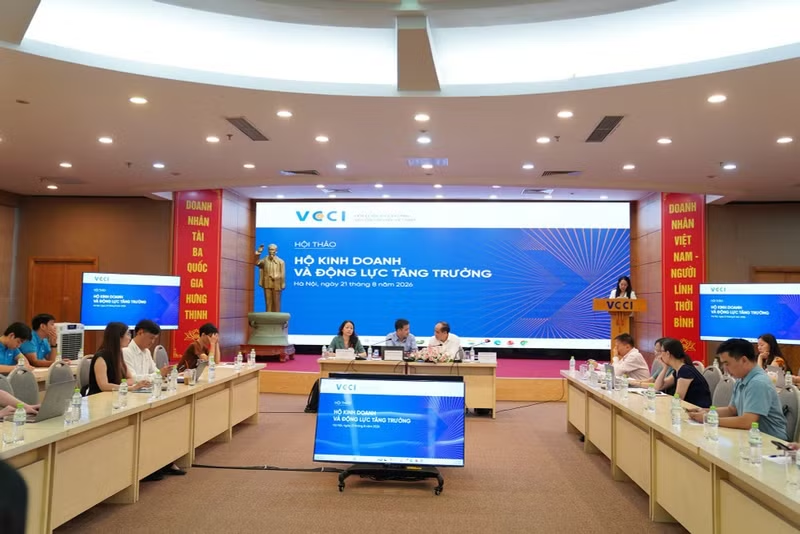
Speaking at the workshop “Household Businesses and Growth Drivers”, held by the Viet Nam Chamber of Commerce and Industry (VCCI) on August 21, Nguyen Thi Bich Thuy, Deputy Head of the Division for Supporting Enterprises and Household Businesses under the Agency for Private Enterprise and Collective Economy Development at the Ministry of Finance, stated that, overall, the policies presented at the event demonstrate that support for household businesses and the private sector centres on improving the business environment, reducing compliance costs, expanding access to land and other resources, providing financial and credit support, promoting science and technology, innovation, and digital transformation, developing human resources, and expanding access to international markets.
In practice, however, household businesses must not only fulfil their tax obligations but also simultaneously adapt to requirements concerning accounting, electronic invoices, technology, administrative procedures, and continually updated sector-specific regulations. When multiple changes take effect within the same period, implementation costs are no longer tied to individual obligations alone but accumulate into an overall burden on the same business operation.
Cao Thi Thanh Lan, a representative of the Department for Tax, Fee, and Charge Policy Management and Supervision under the Ministry of Finance, also noted that revenue thresholds are not the only issue. During the transition to new management and declaration methods, household businesses continue to face difficulties in fulfilling tax and accounting obligations, using invoices, and adapting to new requirements.
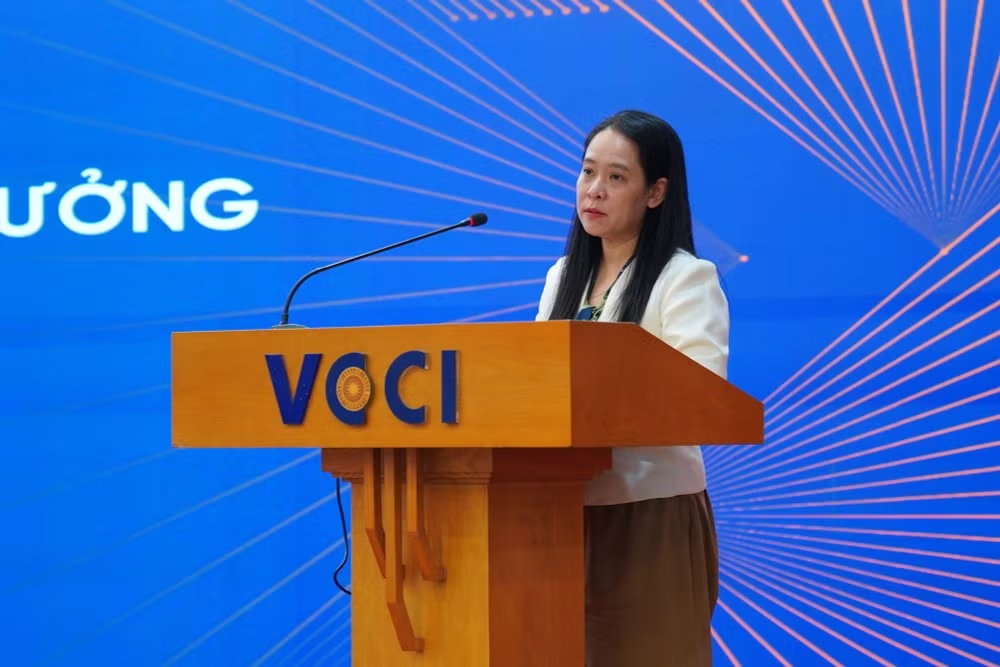
Unlike enterprises with dedicated accounting, legal, or technology departments, a household business owner may simultaneously oversee sales, procurement, inventory management, cash-flow monitoring, and administrative obligations. Lan therefore noted that even a minor regulatory adjustment on paper could trigger multiple changes in day-to-day operations, from the time needed to understand new rules and learn how to use software to rearranging personnel and facilities.
Also at the workshop, a proposal to prohibit the display of tobacco products at points of sale under the draft law amending and supplementing a number of articles of the Law on Prevention and Control of Tobacco Harms was cited as a specific example underscoring the need to balance regulatory objectives with practical feasibility.
Given that many small grocery stores have limited space and use their sales counters for both displaying and storing goods, a comprehensive ban on tobacco displays could require household businesses to redesign counters and shelves, install covered storage units, and change their storage and customer-service procedures. This could incur additional costs and create situations in which compliance requirements are ambiguous in practice.

At the workshop, representatives of household businesses advocated considering restrictions solely on displays visible from outside points of sale, rather than imposing a complete ban throughout the interior. This approach, they argued, would still limit public exposure to tobacco products while enabling businesses to store the products and conduct lawful transactions inside their premises.
At the same time, should the new regulation be introduced, household businesses requested a transition period of 18–24 months, accompanied by detailed guidance, so that business owners have sufficient time to understand the requirements, prepare their facilities, and adjust their operations before full compliance becomes mandatory.