The development history of many of the world’s leading economies reveals a common thread: national success has gone hand in hand with the rise of leading enterprises. It is no coincidence that the Republic of Korea (RoK) is associated with Samsung; China with Alibaba, Tencent, and Huawei; and Germany with Siemens, Volkswagen, and SAP.
Notably, these countries did not simply wait for businesses to grow through market forces alone. They proactively formulated long-term development policies, created stable business environments, prioritised innovation, supported companies in expanding into international markets, and protected their legitimate competitive interests.
The goal is not to create a monopoly for any particular company, but to foster enterprises with sufficient scale and competitiveness to compete globally, thereby working alongside governments to drive growth and enhance national standing.
China, the RoK, and Germany: Enterprises transform their countries’ global standing
In China, Tencent has developed WeChat into a “super app” serving more than one billion users, creating a vast ecosystem spanning electronic payments, commerce, entertainment, and public services. Alibaba ushered in a new era of e-commerce and the digital economy, enabling millions of businesses to access domestic and international markets.
Meanwhile, Huawei invests tens of billions of USD in research and development each year, helping China move from a follower to one of the world’s leaders in telecommunications and a range of high-tech fields.
At the same time, large financial institutions such as ICBC provide capital for the economy, laying the groundwork for expanding investment and trade. As these enterprises have grown into global players, China’s economic influence has expanded accordingly.
The RoK offers an even clearer example of the role played by leading enterprises. From a poor, war-torn country, it achieved the “Miracle on the Han River”, underpinned by the growth of major industrial conglomerates.
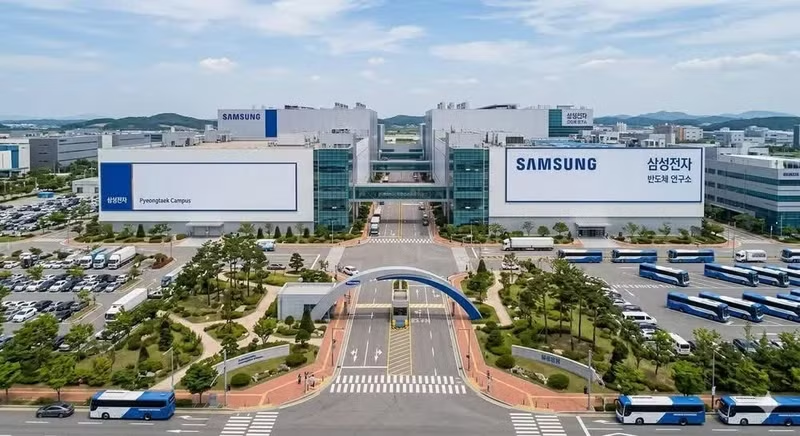
Today, Samsung is not only one of the world’s leading manufacturers of smartphones and semiconductor chips, but also a symbol of the RoK’s technological capabilities. The group accounts for a significant share of the country’s exports, creates hundreds of thousands of direct and indirect jobs, and plays an important role in the global semiconductor industry.
LG, meanwhile, has established a global presence in home appliances, chemicals, and, particularly, electric-vehicle batteries through LG Energy Solution, a supplier to major automakers including Tesla, General Motors, Hyundai and Volkswagen.
Germany has followed a different path. Rather than relying on a large number of globally renowned consumer technology corporations like those in the US or China, the country has built its strength on world-leading industrial and manufacturing enterprises.
Siemens is one of the world’s largest industrial technology groups, with leading positions in automation, infrastructure, and digital industries — all of which underpin Germany’s manufacturing capabilities. Volkswagen has become a major global automaker with a portfolio of brands ranging from Audi and Porsche to Bentley and Lamborghini.
SAP, meanwhile, is Europe’s largest enterprise management software company and has been likened to the “Microsoft of enterprise management”. Together, these companies have helped build the “Made in Germany” brand, synonymous worldwide with quality, technology, and reliability.
Viet Nam needs an ecosystem of national enterprises
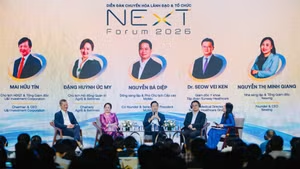
For Viet Nam, the lesson is not to replicate the model of any particular country, but to build a robust ecosystem of national champion enterprises across multiple sectors. These companies may be state-owned or private and may operate in technology, agriculture, food, finance and banking, energy, infrastructure, or real estate, provided they possess the capacity to compete internationally.
Viet Nam is also pursuing its own approach to developing national enterprises with a distinctly Vietnamese identity. The country is shifting from a model in which “the State leads and businesses implement” towards one in which “the State enables and businesses lead the market”. Accordingly, the State is moving beyond conventional support towards creating the environment, policies, and resources needed for businesses to make long-term investments, with the aim of fostering enterprises capable of serving as flagships in key industries.
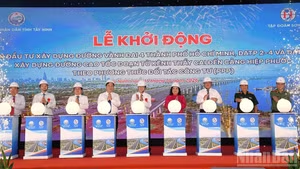
At the same time, Viet Nam is concentrating resources on strategically important sectors capable of generating long-term competitive advantages, including AI, semiconductors, manufacturing, clean energy, digital infrastructure, and digital finance. Mechanisms and policies have begun to take shape to encourage businesses to make long-term investments in research and development, master core technologies, and build global brands. Beyond this, Viet Nam is also stepping up efforts to promote fundamental scientific research, paving the way for Vietnamese intellect and innovation. General Secretary and President To Lam once stressed: “Fundamental scientific research is not merely a specialised academic endeavour, but a strategic foundation for national development in the 21st century.”
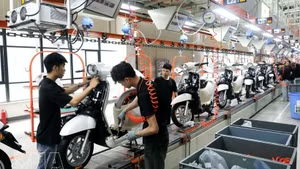
In fact, Viet Nam has already seen the emergence of a number of enterprises with the potential to assume such a role, including Viettel in technology and telecommunications, Vingroup in industry and technology, Techcombank in finance, Vinamilk in the food industry, and Masterise Group in real estate.
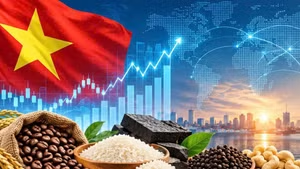
As more Vietnamese enterprises grow to regional and global scale, their combined strength will not only create jobs and contribute to the State budget, but also help develop domestic supply chains, foster innovation, and enhance the standing of the Vietnamese economy.