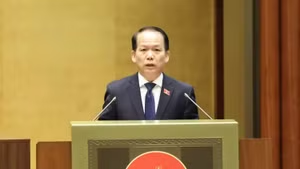
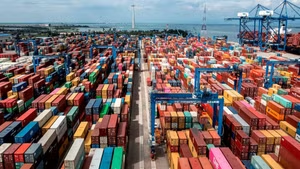
At a conference on studying, disseminating, and implementing Politburo resolutions and directives, on September 3, General Secretary and President To Lam stressed that “regional development must link the economy with culture, society, social welfare, the environment, climate change adaptation, and national defence and security, while enhancing the autonomy and resilience of each region and the economy as a whole.”
Viewed within the broader set of tasks set out by the Politburo in Resolution No. 27-NQ/TW, the requirement to reorganise national development space is not simply aimed at creating more room for growth but must also address pressures related to the environment, water resources, population, urban areas, and the capacity to provide social services.
Accordingly, regional development is placed within a broader structure. Alongside targets for GRDP, economic structure and urbanisation, Resolution No. 27-NQ/TW sets targets for life expectancy, healthy life expectancy, health insurance coverage, doctors per 10,000 people, the Human Development Index, poverty reduction, wastewater treatment, forest cover, and new-style rural development.
This approach regards the quality of people, living conditions, and the ecological foundation as integral parts of the development process.
Growth cannot exceed carrying capacity
In reality, the six socio-economic regions are currently facing different risks, including the degradation of upstream forests and biodiversity in mountainous areas; pollution, waste, and overloaded infrastructure in urban-industrial regions; storms, floods, droughts, and landslides in central Viet Nam and the Central Highlands; and land subsidence, saltwater intrusion, and declining water resources in the Mekong Delta. These risks can disrupt production chains, shorten the lifespan of infrastructure, increase economic costs, and directly affect livelihoods.
A notable new point in Resolution No. 27-NQ/TW is the requirement to organise development space within ecological limits and in line with the environment’s carrying capacity. Accordingly, a development project or area cannot be assessed solely on its ability to generate output, jobs, and revenue but must also take into account demand for land, water, and energy; the amount of waste generated; pressure on urban infrastructure; and the ability of ecosystems to recover.
Resolution No. 27-NQ/TW sets the target that 100% of operating industrial parks and export processing zones in all six regions will have centralised wastewater treatment systems meeting environmental standards by 2030, while forest cover rates are to be determined according to the characteristics of each region. These are not targets separate from growth, as forests, water resources, and environmental quality determine the long-term viability of many economic sectors.
Bui Chi Kien of the Department of Sectoral Economics under the Party Central Committee’s Commission for Policies and Strategies said that the environment needs to be viewed as a strategic form of national capital. Accordingly, green urban areas not only improve quality of life but also enhance their appeal to investment, high-quality human resources, and creative industries. Therefore, environmental protection is not simply a cost of dealing with the consequences but also an investment in long-term growth capacity.
Bui Chi Kien shared this view before the competent authorities issued Resolution No. 27-NQ/TW, but it is highly consistent with the requirement that “water resource governance be given a particularly important position” as the important resolution calls for a real-time data-based management system linking reservoirs, irrigation, hydropower, water supply, flood prevention, and saltwater intrusion control.
Under this approach, water resource management has shifted from dealing with individual projects and localities to monitoring the system as a whole, thereby supporting early decision-making when droughts, heavy rainfall, flooding, or water shortages for production occur.
For the Mekong Delta, coastal urban areas, industrial centres and major port clusters, Resolution No. 27-NQ/TW requires dedicated resilience programmes and standards, combining technical works with natural infrastructure. This is particularly important because reinforcing infrastructure without restoring mangrove forests, flood drainage corridors, water surfaces, and natural absorption areas may increase costs without necessarily reducing overall risks.
At the national scientific seminar themed “Renovating Viet Nam’s development model to meet the requirements of the new era” on August 20, Prof, Dr Giang Thanh Long, senior lecturer at the National Economics University, noted during discussions on the issue that climate change cannot be left out of development forecasts and economic growth projections.
This view shows that if climate risks are treated merely as a separate environmental issue, growth plans may be built on unsustainable assumptions. Therefore, resilience needs to be incorporated into the entire process of planning, project selection, and investment efficiency assessment. The costs of disaster prevention, water resource protection, and ecosystem restoration should not be viewed simply as expenditures that reduce resources available for growth. Instead, they are investments aimed at reducing damage, protecting social assets, and maintaining the continuity of economic activity.
Quality of life determines regional competitiveness
As economic regions, growth poles and major cities attract more investment, carrying capacity concerns not only the natural environment but also increasingly affect issues such as labour and population, pressure on housing, transport, schools, hospitals, water supply, waste treatment, and social welfare services. Therefore, if social infrastructure fails to keep pace with the demands arising from production infrastructure, high living costs, longer commuting times, and declining service quality will reduce the attractiveness of the region.
Presenting the key contents of Resolution No. 27-NQ/TW at the conference on studying, disseminating, and implementing Politburo resolutions and directives on September 3, Politburo Member Nguyen Thanh Nghi, Secretary of the Party Central Committee and Head of the Party Central Committee’s Commission for Policies and Strategies, said that the goal by 2045 is to build at least five cities of international stature, serving as hubs connecting and developing with regional and international networks.
The resolution prioritises the development of the two largest growth poles, namely the Ha Noi metropolitan region and the Ho Chi Minh City metropolitan region, while orienting the development of green cities, smart cities, and compact cities.
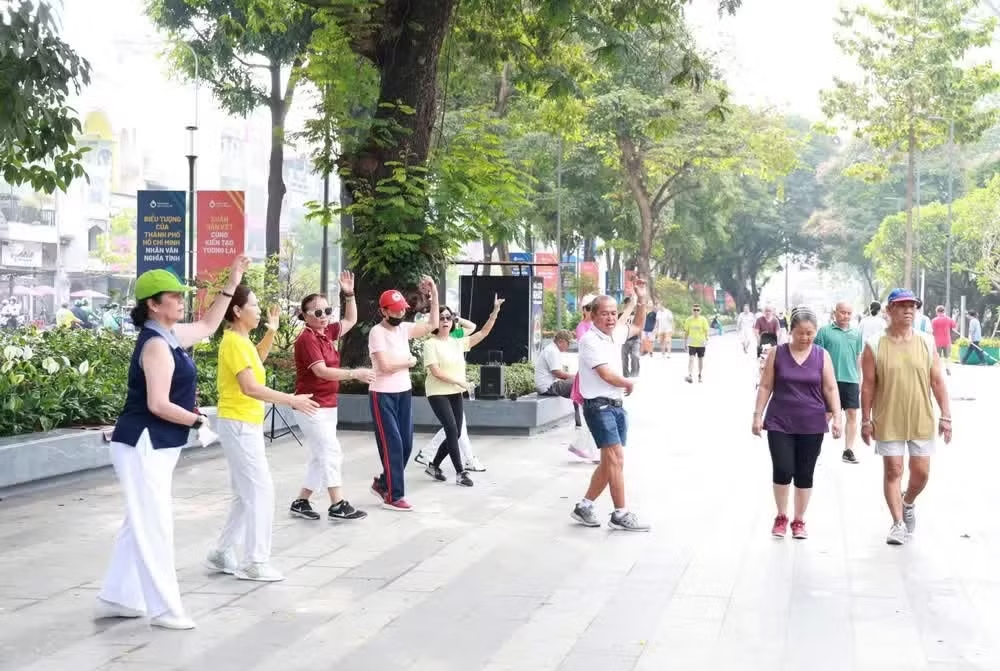
However, the international stature of a city is not reflected solely in its economic scale, buildings or transport systems. Competitiveness also lies in its ability to provide a safe living environment, quality healthcare and education services, cultural spaces, good air quality, the capacity to adapt to natural disasters, and equal access opportunities for its residents.
Sharing this view, Dr Tran Triet of the University of Natural Sciences under Viet Nam National University Ho Chi Minh City said that it is time to measure the success of development not only by GDP or growth rates, but also by air quality, water resources, food safety, green spaces, and the resilience of nature and communities to natural disasters and climate change.
Dr Tran Triet noted that human development does not naturally accompany economic growth but requires long-term investment in public health and quality of life.
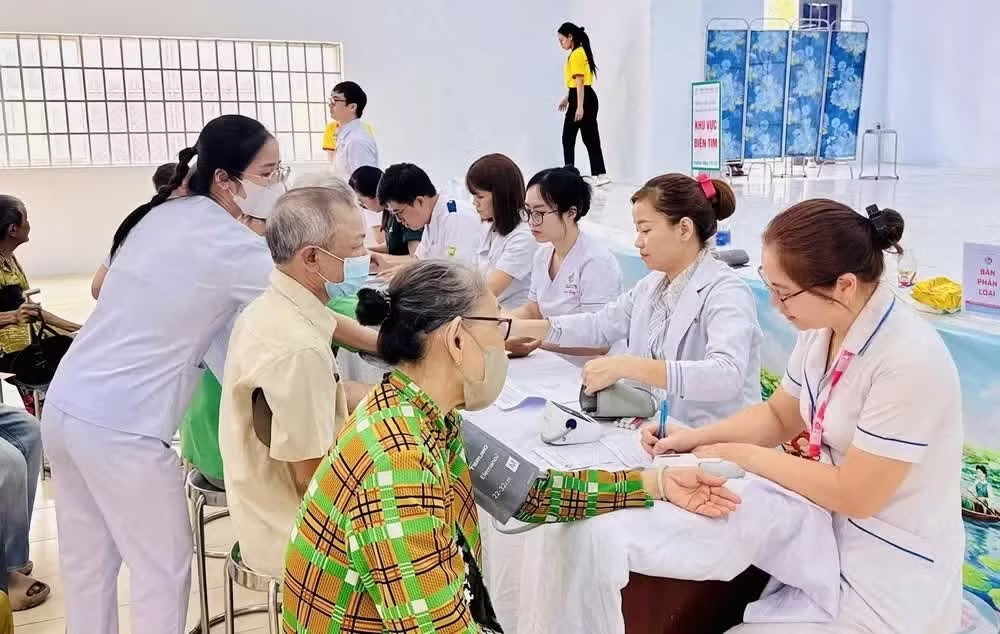
This approach is consistent with the social and environmental indicators that Resolution No. 27-NQ/TW sets for each region by 2030. Specifically, Resolution No. 27-NQ/TW calls for the regional healthcare system to be developed in a comprehensive, coordinated, modern, and interconnected manner, with preventive healthcare as the key, grassroots healthcare as the foundation, and specialised healthcare as the driving force. Health, housing, and education are components of development capacity, as they determine the quality of the workforce and the ability to retain skilled workers.
According to Prof, Dr Giang Thanh Long, Viet Nam is simultaneously experiencing its golden population period and rapid population ageing, while urbanisation accompanied by migration is changing population structures in both urban and rural areas. Digital transformation is creating new opportunities but also risks creating new gaps between population groups. He said that economic development cannot be separated from social welfare and the healthcare system.
These changes manifest themselves differently in each region. Industrial and service centres may face shortages of housing, schools, and care services for migrant workers, while areas experiencing population outflows risk a shortage of young workers and a rising proportion of elderly people. Planning must therefore forecast population structures, migration patterns, and service needs, while narrowing educational gaps and creating conditions for workers to retrain in response to automation and digital transformation.
From another perspective, Prof, Dr Ngo Thang Loi, senior lecturer at the National Economics University, pointed out that income disparities between regions and localities remain large, while the positive impact of growth on poverty reduction and improvements in human development indicators tends to diminish. This is a warning that an increase in GRDP does not necessarily automatically translate into corresponding social progress.
Therefore, the effectiveness of regional development should be assessed through people’s access to jobs, education, healthcare, housing, culture, and a safe living environment. The ultimate goal is not to keep people in place at all costs or continue drawing people to major cities but to create conditions for everyone to have more choices about where to live and work, without their opportunities being limited by their place of residence.
This is also an important requirement that General Secretary and President To Lam emphasised in his directive speech at the conference on studying, disseminating, and implementing Politburo resolutions and directives, that the value of a document must be reflected in its ability to address practical problems and create changes that the people can feel.
Accordingly, the goal of regional development needs to be translated into practical results, such as safer water sources, an improved living environment, reduced damage caused by natural disasters, more accessible public services, and greater development opportunities for people. Resolution No. 27-NQ/TW not only opens substantial growth space for the six socio-economic regions but also sets clearer limits and responsibilities.
Rapid growth can only be sustainable when it does not undermine the resource base, push social infrastructure into a state of overload or leave part of the population outside the benefits of development.
In this spirit, when environmental and social resilience is regarded as part of competitiveness, each socio-economic region can develop rapidly while still preserving room for future generations.