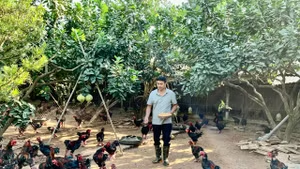
According to Nguyen Van Long, Head of the Department of Science and Technology under the Ministry of Agriculture and Environment, as of June 12, the system had registered 18,500 products across 112 product categories and 919 consignments. It had also integrated data from 547 farming households, 255 growing areas and 149 enterprises in 26 of the country’s 34 provinces and centrally run cities.
The system is currently operated on an online platform and is developing a mobile application to facilitate information updates, access and verification by producers, businesses and regulatory authorities.
For the durian sector, which was selected as the first pilot commodity, three export containers have so far been shipped to the Chinese market with complete traceability data uploaded to the system. Under the ministry’s plan, from July 1, implementation will be expanded to other key commodities, including rice, meat, eggs, milk, pineapples, passion fruit, tea and agricultural products intended for both domestic consumption and export.
According to leaders of the Department of Science and Technology, traceability does not replace the quarantine, testing, or technical standards that importing markets are currently applying. Exporting enterprises must still fully comply with regulations relating to food safety, plant quarantine, animal quarantine and other technical requirements.
However, as many markets tighten standards on quality, transparency and supply-chain accountability, traceability is increasingly becoming an almost mandatory requirement for a wide range of agricultural products.
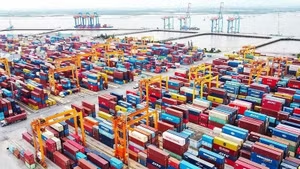
Through the traceability system, regulatory agencies, businesses and import partners can monitor the entire production process of a product, from raw-material areas, production facilities, harvesting, preliminary processing and manufacturing to transportation and distribution. This not only helps strengthen consumer confidence but also facilitates the handling of issues arising in relation to product quality.
Notably, the Ministry of Agriculture and Environment has sent an official note to the General Administration of Customs of China introducing Viet Nam’s agricultural product traceability system, with a view to promoting data connectivity, information verification and the gradual recognition of traceability data for export activities.
In the coming period, the ministry will continue improving the system by enhancing interoperability with specialised databases, ensuring data verification capabilities, information security and connectivity with national management platforms.
At the same time, it will step up training and guidance for enterprises, cooperatives and farmers participating in the system, while coordinating with relevant ministries and agencies to refine mechanisms for data connectivity and sharing, gradually building a synchronised and modern traceability ecosystem.
Experts noted that amid intensifying competition in international markets, traceability is not only a management tool but also an important condition for enhancing competitiveness, strengthening brand value and increasing the value of Vietnamese agricultural products.
The establishment of a unified nationwide traceability system is expected to support the digital transformation of the agricultural sector, improve market transparency and lay the foundation for sustainable long-term development.